Showing posts with label Osler. Show all posts

Wednesday, May 17, 2017

1889: Osler's asthma remedies

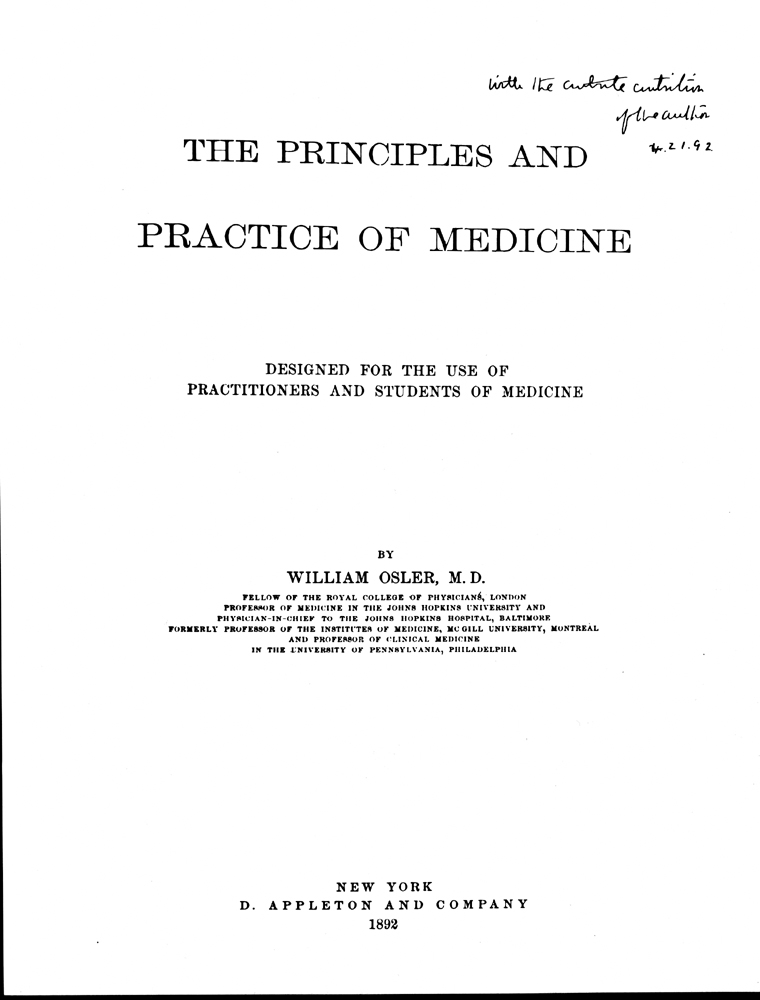
Dr. Osler's book "The Principles and Practice
of Medicine" was first published in 1892, and
was continually updated until 2001. 
Dr. William Henry Osler's recommended treatment for asthma didn't sway much from what other physicians of his day prescribed.  Since there really was no one medicine to resolve an asthma attack, which medicine to recommend was mainly based on personal preference.

However, Osler was among the first to note the urgency of treating asthma.  He said "immediate and prompt relief is demanded."  Remedies include any of the following:
  • A few whiffs of chloroform will produce prompt but temporary relief
  • Perles of nitrite of amyl may be broken on the handkerchief or 2-5 drops on cotton-wool and inhaled
  • Strong stimulants given hot or a dose of spirits of chloroform in hot whiskey will sometimes induce relaxation
  • Morphia or morphia with cocaine will produce more permanent relief (requires hypodermic injection). Good for obstinate attacks.
  • Antispasmotics, such as belladonna, stramonium, and lobelia in solution or cigarettes
  • Solanacae with nitrate or chlorate of potosh (common in most remedies)
  • Any form of asthma cigarettes (one form benefits one pt while another benefits another)
  • Nitre paper made with strong solution of potash.  "Filling a room with the fumes of this paper may sometimes ward off a nocturnal attack."
  • Tobacco smoke:  sometimes as potent as the prepared cigarette
  • Large meals early in the day as opposed to later
  • Coffee is better than tea
  • City is better than country
  • High and dry altitudes are more beneficial than sea shore
  • Oxygen may also be tried
  • City living was better than country living
Osler was among the first to recommend oxygen for the treatment of asthma, yet while epinephrine (adrenaline) was discovered in 1901, updated editions of his book prior to his death did not mention this quick acting medicine.

Many historians have  noted that Osler was unique in that he mentioned that "death from the attack is unknown."  However, many asthma experts during the 19th century, including Henry Hyde Salter, made similar observations.

References:
  1. "Sir William Osler At Seventy -- A Retrospect," The Journal of the American medical Association," 1919, Saturday, July 12, pages 106-108
  2. Osler, William, "The Principles and Practice of Medicine," 1892, New York, pages 497-501
  3. Bliss, Micheal, "William Osler:  A Life in Medicine," 1999, New York
Further readings:
  1. Jackson, Mark, "Asthma: The Biography," 2009, New York, pages 211-12
  2. Brenner, Barry E, ed., "Emergency Asthma," 1998, New York, pages 212-14

Monday, May 15, 2017

1889: Osler defines asthma

William Osler is often referred to as the
Father of Modern Medicine.  He shared his
medical knowledge in 1896:  "The Principles
and Practice of Medicine
William Henry Osler is considered by many as the Father of Modern Medicine. He shared his medical knowledge in his 1889 publication "The Principles and Practice of Medicine."  It is from this book we can still delve into his mind to see what he was thinking about various diseases, including our own: asthma.

It was his ideals about medicine that transformed the way medicine was taught.  He was well respected by physicians around the world, and his word was considered like words from the Bible.

In this way he was able to settle many debates about medicine, and push forward new ideas that were scientifically solid and old ideas that continued to have merit in the newly founded scientific world of medicine.

While he didn't have much new to add to asthma wisdom, he set the standards for future practice and research in this area.  He believed the following to be true about asthma and allergies:  (1):
  1. It's of nervous origin
  2. Various triggers set off an acute attack
  3. Attacks involve swelling of bronchial mucus membrane
  4. Attacks involve constriction of bronchial muscles
  5. Attacks involve increased secretions 
  6. Flow is obstructed by this swelling, constriction and increased secretions
  7. Asthma and allergies are similar in origin and unique in their symptoms
  8. Asthma and allergies are hereditary
  9. Many asthmatics present with allergies (hay fever)
  10. Children are more affected than adults
  11. Men are affected more so than women (1)
As with Frances Rackemann, his ideas about asthma being a nervous condition sent many researchers and scientists down the wrong path, and may ultimately have delayed progress in the field of asthma. He wrote that "the affection sometimes runs in families, particularly those with irritable and unstable nervous systems."

Yet his understanding of the benefits of science in medicine would prove to benefit asthmatics.

Further reading:
References:
  1. Osler, William, "The Principles and Practice of Medicine," 1892, New York, pages 497-501

Friday, May 12, 2017

1889: William Osler: The father of modern medicine

Sir William Henry Osler
The turn of the 19th century was the dawn of modern medicine. So medicine needed a father, and the man to step into that role was Sir William Henry Osler.

Due to the significance and respect for his character, the ideas he wrote about were seriously considered by the medical community, including what he wrote about asthma

The growth of a legend:

Willie Osler was born to a family with a prominent history. His father was an Anglican minister, and Osler's goal was to follow in his father's footsteps It was this goal that landed him in 1867 at Trinity College in Toronto.

Yet this was also a time when physicians and scientists were using science to disprove some old ideas about science and medicine.  Charles Darwin proposed an idea that challenged the age old idea of natural selection, and chose to believe science instead.  Science was in direct competition with religion.

Perhaps it was for this reason that Osler's heart just wasn't in the ministry.  He spent most of his free time reading about medicine.  His heart, and perhaps fate,  lead him ultimately to switch from studying ministry to medical school where he excelled.

He started Medical School at Trinity College where the methods of teaching medicine were primitive and left to the desires of each respective professor. The college hospital admitted only 25 patients at a time, and medical students could only see patients taken care of by their own physician. (3, page 54)

Once Medical School was complete after three or four years young physicians had little experience working with real patients, and the young Olser took acceptance to this.

Osler believed pathology was essential to improving medical wisdom.
Like other physicians before him, he would have been befuddled by the
lack of scarring caused by asthma.  This must have been what caused him
to deduce, as others had before him, that asthma must be nervous.
For this reason, much of the treatment focuses on the nervous component
Much of his time was spent studying and performing autopsies. He was often so involved in his work that he ate in the same room he performed these autopsies. His goal was to learn as much as he could about the human body and medicine.

Most of the classes were taught by local physicians, and payment for these classes was given directly to the professor. Lectures were mainly given from old medical textbooks and were "flung at us pellmell without word of guidance, and leaving us standing helpless, bewildered, and starved in the midst of what seemed a superabundance of wealth," wrote Osler.  (3, page 54)

He ultimately transferred to McGill University where his writings, research and ideas quickly won the attention of his fellow students and professors.  He continued to study, research and perform autopsies (while eating in the same room).

During his final year in med school he worked so hard on his graduation thesis on pathologic anatomy that he was rarely seen by his fellow students  His theses would ultimately win accolades "because it was greatly distinguished for originality and research." (1)

It was partly because of this work and the potential in the young Osler that he was offered a job as a teacher at McGill University. But he declined, choosing instead to attend school in Europe to further his medical wisdom. He did his studies in Vienna and Germany, which were considered to be leading nations in medicine and science at that time.

In 1874 he returned to Canada, and, coincidentally, one of the medical professors at McGill University had resigned.  At the young age of only 25, and with very little experience as a physician, Osler was offered and accepted his first teaching job.  Within a year he was named as a professor of medicine.

He wasn't paid enough money to make a good living as a teacher, so he had to start a practice.  Yet he ultimately became so rapt in his job as a teacher that he gave little attention to his medical practice and other opportunities to make money.  However, he did manage to see patients, including many famous ones. 

His enthusiasm allowed him to get the most out of his students, and he became an instant hit as a teacher.  A year later he became one of the seven founders of the Association of American Physicians, and in 1889 he became one of the first physicians at John Hopkins University.   It was here that his career took off.

A transformation in medicine:

John Hopkins was built on the idea that it would be the best medical hospital in the world. To run its medical school Henry Osler was hired based on his reputation and his bold ideas for the medical profession.

This turned out to be a wise decision, because it was Osler who came up with the idea that medical students learn best when working with actual patients.  He often repeated the maxim:   "Listen to your patient, he is telling you the diagnosis."

While other medical schools were unorganized and offered two or three year programs, John Hopkins would offer a four year program that required a year as an intern working alongside physicians in the medical ward to obtain experience working with real patients.  .

 Osler became rapt in medical wisdom, and loved to share this wisdom.
 Here he is writing "The Principles and Practice of Medicine"
This was the first time this was ever done, and it was a big hit.  It was such a big hit that within a few years many medical school were transforming the way they taught medicine.  No longer would physicians graduate from medical school when their only experience was from lectures, textbooks, and a few random patients.

Through all this time Osler continued to do what he loved best, and that was to study the human body by performing autopsies and reading books.  He spent a ton of time in the morgue, laboratory and library.  He likewise continued to write about what he learned through his experiments and observations.

During his career he wrote over 750 contributions to the medical world of literature, including a the first textbook of Internal medicine published in 1892:   "The Principles and Practice of Medicine."  While he didn't know it at the time, it would end up being the last medical book written by just one person.

Osler would continue his work until his death in 1919, yet not before he became a legend in his own time. His name was known by physicians throughout much of the world. The debate had already begun as to whether he was the greatest physician to ever have lived.

Click here for more asthma history.

References:
  1. "Sir William Osler At Seventy -- A Retrospect," The Journal of the American medical Association," 1919, Saturday, July 12, pages 106-108
  2. Osler, William, "The Principles and Practice of Medicine," 1892, New York, pages 497-501
  3. Bliss, Micheal, "William Osler:  A Life in Medicine," 1999, New York
Further readings:
  1. Jackson, Mark, "Asthma: The Biography," 2009, New York, pages 211-12
  2. Brenner, Barry E, ed., "Emergency Asthma," 1998, New York, pages 212-14

Friday, September 23, 2016

1849: Great inventors at the dawn of modern medicine

The man who would become the father of modern medicine was born in Canada on July 12, 1849.  His parents would name him William Henry Osler. He was born into an era where medicine was changing for the better, and he would grow to become a significant part of it.

Yet a post about the life and times of the infamous Dr. Osler won't come on this blog for another few months.  First we must consider medical significance of the era to which he was born into.

It was an era, they say, where physicians were just starting to adapt to new equipment, such as the stethoscope, laryngoscope, thermometer and microscope.  Students were just starting to learn about them, and physicians just starting to adapt them into their daily practice.

The incorporation and use of these devices would allow physicians to learn what went on inside the body that affected what went on outside the body.  It was by knowledge obtained by their investigations with these tools that antiquated medical theories about medicine were being reviewed.  Those proven true were further substantiated, and those proven false were cast away.  

The following are some of the significant contributions that affected the medical community at this time:

Oliver Wendell Holmes (1809-1894)
was among the first to realize
fevers may spread by unclean hands.
 (4, page 457)
1843:  Oliver Wendell Holmes announced to the medical community that women in child bed should not be attended by physicians who had been studying the victims of perpetual fever. He was concerned the causative agent might be spread to the mothers and their babies. He recommended that physicians and medical caregivers wash their hands and change their clothing after leaving patients infected with perpetual fever. He received harsh criticism from his fellow physicians who were in harsh opposition to change. (4, page 457)

Ignaz Semmelweis (1818-1865)
proved hand washing between patients
 reduced the spread of sickness.
He was mocked and ignored.
(4, page 458)
1846:    Ignaz Philipp Semmelweis became an assistant in an obstetric ward in Vienna where there was such a high death rate from child bed fever that women feared to go there. Semmelweis observed the death rate was higher in the 1st ward where he and his fellow male physicians worked compared to the 2nd ward where female mid wives worked. Upon investigation he learned the women were much cleaner in appearance than the physicians, who often walked proudly around with blood stained hands and aprons. The physicians also were more likely to perform postmortem investigations just prior to checking the vagina. The women, on the other hand, did not have blood stained clothes and washed their hands in calcium chloride solution between patients. When he insisted his physicians likewise wash their hands and put on clean clothes prior to checking women in child bed, the death rate fell from 9.92% to 3.8%. The following year it was down to 1.27%. The proud physicians were unhappy, and eventually rejected Semmelweis. After they went back to their old poor habits, the death rare once again duly rose. (4, pages 457-8)
Charles Darwin (1809-1882)
His theory of evolution
may have been controversial,
yet it helped transform medicine.

1859:  Charles Darwin, the grandson of Erasmus Darwin, published his "Origin of Species" in which he introduced his theory of evolution. Surely it resulted in much scrutiny and controversy, but this may have been one of the key publications that helped to spark the scientific revolution, of which the medical profession was one of the main beneficiaries. However, and to be expected, many proud and stubborn medical professors and physicians refused to let go of old theories. Yet the few who did continued investigating, and scientific evidence would ultimately force change, and change for the better.
Louis Pasteur (1882-1895)
His Germ theory of Medicine
Revolutionized medicine 

1865:  Louis Pasteur discovered that microbes were the cause of diseases. He invented vaccinations for anthrax, cholera, consumption and smallpox." (3)
Joseph Lister (1827-1912)
invented a rinse to disinfect wounds.
It was also useful for cleaning mouths.

1870s:  Joseph Lister discovered that antiseptic use reduced post surgical infections.  He was a British scientist and physician who observed that about 50 percent of amputation patients survived the surgery but died later of septic fevers, or what was known as "ward fevers."   With knowledge of the works of men like Pasteur and Semmelweiz, Lister surmised microbes in the air were infecting wounds, and so he used phenol as an antimicrobial to reduce the death rate by 15 percent. (4)  He recommended the antimicrobial carbolic acid to be placed on bandages to keep the wounds clean, and he invented a machine to pump carbolic acid into the air in the rooms where surgeries were being performed.  Post operative mortality rates plummeted. (5)

Listerine bottle from the 1920s
1879:  While working with Jordan Wheat Lambert (1851-1889), Lister invented an antiseptic to use during surgeries.  In honor of Lister's discovery, Lambert insisted the product be named "Listerine," introducing it to surgeons in 1879.  The product was so successful that it was ultimately marketed to dentists as an oral rinse in 1895, and to the public as a mouthwash in 1914.  The product is still available on the market to this day (although the taste has been improved).

A young William Osler must have been inspired by all this wisdom, becoming so rapt that he cast aside his father's dream that he go into the ministry, and instead studied medicine.

References:
  1. "Sir William Osler At Seventy -- A Retrospect," The Journal of the American medical Association," 1919, Saturday, July 12, pages 106-108
  2. Osler, William, "The Principles and Practice of Medicine," 1892, New York, pages 497-501
  3. Bliss, Micheal, "William Osler:  A Life in Medicine," 1999, New York
  4. Garrison, Fielding Hudson, "An introduction to the history of medicine," 1921, London and Philadelphia, 
Further readings:
  1. Jackson, Mark, "Asthma: The Biography," 2009, New York, pages 211-12
  2. Brenner, Barry E, ed., "Emergency Asthma," 1998, New York, pages 212-14
RT Cave Facebook Page
RT Cave on Twitter
Print Friendly and PDF

Wednesday, June 8, 2016

1820-1930: Pneumonia, the new "captain of the men and death

Thomas Addison (1793-1860
For most of human existence tuberculosis was known as the deadliest disease.  It was such a deadly disease by the 17th century, that John Bunyan (1628-1688), the famous author of "Pilgrim's Progress" referred to it as "the captain of men and death."  It wouldn't be until the early 20th century that tuberculosis would take a back seat to pneumonia.

While pneumonia has been present since the beginning of mankind, and the medical profession has been aware of it since the 5th century, little new information was learned about it.  It really wasn't until the end of the 19th century that physicians started to get a grasp on this disease.

Dr. Thomas Addison, a physician to Guy's Hospital in London,  was the first to write about pneumonia not being a disease that affected just the "interstices" of the lungs but the "air vessicles" themselves. (8, page 193)

Carl von  Rokitansky, a German physician, was the first to describe lobar pneumonia. (10, page 1308)

He said:
The red inflammatory product becomes gray and compact and indurated.  The air cells contract over the granulations, coalesce with them round their circumference, and become obliterated, their tissue being changed into a fibro-cellular structure, in which, from the similarity of their organization, the granulations are most probably also merged. (10, page 1308)
Various physicians described a pneumococcus associated with patients with lobar pneumonia.  (8,page 197)

Carl von Rokitansky (1804-1878)
In 1880 Sternberg found it in the saliva, and in 1881 Louis Pasteur discovered the same. (8, page 197)

In 1882 Ernst victor von Leyden and Gunther drew fluid from hepatized lungs of living pneumonia patients and discovered pneumococci in this fluid. (8, page 197)

Yet in all of these cases, the significance of the discovery went unnoticed.  (8, page 197)

It wasn't until 1875 that Edwin Klebs associated pneumonia with the bacteria, describing an "oval coccus" that he obtained from cases of lobar pneumonia. (8, page 197)(?)

A few years later Karl Friedlander and Hans Christian Gram started working together in the morgue of a hospital in Berlin and added to Klebs work by identifying the specific types of bacteria associated with pneumonia.

In 1882 Friedlander isolated streptococcus Pneunomiae in the sputum of a patient inflicted with pneumonia, and in 1884 Gram isolated Klebsiella Pneumoniae in the sputum of a patient  inflicted with pneumonia.

The procedure that Gram described when writing of his discovery was later called the gram stain.  It's a technique where a small sample of the sputum is stained, and this causes the cell walls of the bacteria to turn a certain color so the bacteria can be clearly identified. 

This technique is still used in labs to this day.  Yet while Gram simply used the technique to identify bacteria in sputum samples, it's used today to distinguish between different types of bacteria.

In 1888 Nikolia Fedorovich Gamaleia was working in Pasteur's lab when he inoculated sheep and dog with pneumococcus and this caused lobar pneumonia in these animals.

This experiment proved that pneumococcus was the cause of lobar pneumonia.  Gamaleia is also credited in 1888 as discovering bacteriolysins that destroy bacteria.  (11)

He also worked with pasteur to improve the process of inoculation.

By 1891, interstitial changes may occur in acute lobar pneumonia and this may result in fibroid pneumonia (fibrosis of the lungs), and this will be chronic.  (10, page 1309)

In 1896 French student Ernest Duchesne discovered penicillin, yet the significance of his discovery went unknown, and the discovery was left hanging.

William Henry Osler, in the early editions of his book, "The Principles and Practice of Medicine," mentioned using oxygen for emphysema and asthma, and by 1898, or the third edition, he finally recommended oxygen for pneumonia.

However, while he mentions oxygen as an option, he rarely prescribed it for his patients.

He wrote:
It is doubtful whether the inhalation of oxygen in pneumonia is really beneficial. Personally, when called in consultation in a case, if I see the oxygen cylinder at the bedside I feel the prognosis to be extremely grave. It does sometimes seem to give transitory relief and to diminish the cyanosis. It is harmless, its exhibition is very simple, and the process need not be all that disturbing to the patient. The gas may be allowed to flow gently from the nozzle directly under the nostrils of the patient, or it may be administered every alternate 15 minutes through a mask. (12)
In 1901, in his popular medical textbook "The Principles and Practice of Medicine," Dr. Osler referred to pneumonia as the new captain of men and death. He wrote:
The most widespread and fatal of all infectious diseases, pneumonia, is now the "Captain of the Men and Death," to use the phrase applied by John Bunyon to consumption." 
 By 1918 pneumonia became the leading cause of death, overtaking tuberculosis. In describing the new leading cause of death, Osler burrowed from Bunyan, describing pneumonia as "captain of men and death. (4)

References:

References:
  1. "Leading Cause of Death, 1900-1998," http://www.cdc.gov/nchs/data/dvs/lead1900_98.pdf
  2. Sturges, Octavius, "The Natural History and Relations of Pneumonia," London, 1876
  3. "History of Pneumonia," The British Medical Journal,  Jan. 19, 1952, pages 156-158
  4. Schmitt, Steven K., "Oral Therapy for Pneumonia:  Who, When, and With What?" editorial, Journal of Clinical Outcomes Management,  March, 1999, vol 6, No 3, pages 48-50
  5. Bellis, Mary, "The History of Penicillin," http://inventors.about.com/od/pstartinventions/a/Penicillin.htm
  6. Marrie, Thomas J, "Community Acquired Pneumonia," 2001, New York, chapter one by Jock Murray, "The Captain of Men and Death: The History of Pneumonia."
  7. Auld, A.G., "The Pathological Histology of Bronchial Affections," The Lancet, Aug. 6, 1892, page 312
  8. Allbutt, Clifford, ed, A System of Medicine, 1909, Toronto, chapter on "Lobar Pneumonia,"  by P.H. Pye-Smith, pages 191-205
  9. Addison, Thomas, "A Collection of the published works of Thomas Addison," 1868, 
  10. Auld, A.G., "Fibroid Pneumonia," The Lancet,  June 13, 1891, page 1308-1310
  11. "Nikolai Fedorovich Gamaleia, The Free Dictionary by Farlex, http://encyclopedia2.thefreedictionary.com/Nikolai+Fedorovich+Gamaleia
  12. Osler, William, "The Principles and Practice of Medicine," 1898, 3rd ed., New York
  13. *Photo compliments of sciencephotolibrary.com
  14. "Plutarch," britannica.com, http://www.britannica.com/EBchecked/topic/465201/Plutarch, accessed 7/20/14
  15. Laennec, Rene, "Mediate Auscultation," translated by John Forbes, Notes by professor Andral, 4th edition, 1838, New York, Samuel S. and William Wood, pages 84-87 for bronchitis treatment, and 175-177 for emphysema treatment
  16. Andras, author of the notes in the book, "Mediate Auscultation, by Rene Laennec," ibid
  17. Reynolds, Arthur, R., "Pneumonia: The New Captain of the Men and Death," February 28, 1903, Journal of the American Medical Association," XL(9):583-586, http://jamanetwork.com/journals/jama/article-abstract/854678, accessed 1/2/16
RT Cave Facebook Page
RT Cave on Twitter
Print Friendly and PDF

Monday, August 10, 2015

476 A.D.: The fall of Rome

Nothing may be more significant to the history of asthma and respiratory therapy, or medicine in general, than the fall of the mighty Roman Empire.  For it is a fact that as Rome fell, so too did all knowledge.  As all knowledge fell, so too did knowledge of science, philosophy, and medicine.

There was a time when Romans believed their empire would last forever.  In a sense, they may even have taken it for granted.  The reason for the decline is still being debated to this day, although the following are often credited:  (5, page 41-2)
  1. Rome was too large to be managed.  Rome was so spread out it was difficult to communicate  with people and inspire them to join the military, participate in government, or create industry.  
  2. Christianity distracted leaders from problems of the empire, which required intense concentration to remedy.  
  3. Able and educated men became Bishops rather than become military leaders in a defunct military or become governors in a nation that was falling apart.  Fixing the government seemed a hopeless task.  
  4. Population declined markedly between 250-400 A.D. mainly due to the bubonic plague.
  5. Rome had a weak economy, weakened more by population decline.  The economy worsened as markets shrank, and international trade declined.  
  6. The inability to form a industrial technology to support nation (no specialization)
  7. Regions became more dependent on themselves, weakening the whole (the Empire)
  8. Taxes were high, and an alienated populace didn't want to pay them
  9. Slavery.  Before 200 A.D. there were wars and slaves captured to do the work.  When wars were no longer needed, the number of slaves declined, yet by then Roman aristocracrats were so spoiled they were too lazy to do the work themselves
Many scholars provide most of the blame for the fall of Rome, and eventually the decline of science and medicine, to the rise of Christianity, which started in Rome as a secret society and grew to be a credible institution. 

Yet Historian  Edward Withington claims this theory is far overblown.  He said:  (1, page 119)
It must be admitted that the triumph of our holy religion, though by no means so responsible for the decline of medicine as is sometimes asserted, nevertheless tended to hasten than to hinder the downfall; but by means of one great institution it has, in the long run, done far more to further the healing art than it ever did to injure it."
Withington explains that various Christians, out of their good hearts, established some of the world's first hospitals and even an ambulance service.  He said:
"There is, I believe, no certain evidence of any medical institution supported by the voluntary contributions of the people, or by private munificence, till we come to the Christian days.  The primitive Church, as we learn from the Acts of the Apostles, cared for it's poor from the earliest time, but we find no definite notice of any special buildings for the reception of the sick till the close of the fourth century.  St. Jerome, writing about 400 A.D., says, that Fabiola, a noble Roman lady and his own friend, was the first to build a hospital."
 Withington proceeds to list various Christian hospitals. (1, page 119)

Christianity enveloped western Europe, and in 476 A.D., German barbarians crushed Rome to a pulp, destroying libraries and places of learning. Germans and Christians intentionally cast away all "the gifts of Athens and Alexandria," because the material world that evolved through technology was the antithesis of an eternal life with God in heaven. (2, page 84)

William Osler, in a 1913 lecture at Yale, said:
"Knowledge other than that which made a man 'wise unto salvation' was useless.  All that was necessary was contained in the Bible or taught by the Church.  This simple creed brought consolation thousands and illumined the lives of some of the noblest of men.  But 'in seeking a heavenly home man lost his bearing upon earth.'" (2, page 85?)
Other historians provide most of the blame for the fall of Rome on slavery.  In the early days of Rome there were only a few slaves, with most of them working on farms.  Most Romans were farmers in these days, and they were the people recruited to fight wars.  As Rome continued to win wars, the number of slaves skyrocketed.  It got to the point that there were more slaves than Romans who work for hire.  It got to the point that there were even more foreigners than Romans fighting Roman wars, according to historian Harold Johnston.  (6, page 87)

The country was almost completely run by foreigners, many of whom were better educated than their Roman masters.  Johnston explains said:. (6, page 87)
Ruinous as were the economic results of slavery, the moral effects were no less destructive. It is to slavery more than to anything else that is due the change in the character of the Romans in the first century of the Empire. With slaves swarming in their houses, ministering to their luxury, pandering to their appetites, directing their amusements, managing their business, and even educating their children, it is no wonder that the old Roman virtues of simplicity, frugality, and temperance declined and perished. And with the passing of Roman manhood into oriental effeminacy began the passing of Roman sway over the civilized world.
You can see how easy it was for the average Roman to become dependent on the slaves.  It got to the point that when the economy collapsed, it was difficult to get the average Roman excited about doing the work.

By the beginning of the 5th century German Barbarians were allowed to live in peace with the Romans in Rome.  So between slaves and Germans, foreigners far outnumbered Romans.  So, in 476 A.D., when the German Barbarians attacked Rome, there was little the natural born citizens of Rome could do to stop them.

These barbarians wanted to completely demolish Rome and all it stood for, and so they destroyed the libraries and places of learning.  While watching these places burn, the Germans were watching the demise of all knowledge.  It would all be lost for over a thousand years.

References:
  1. Withington, Edward Theodore, "Medical History from the Earliest Times: A Popular History of the Art of Healing," 1894, London, The Scientific Press. 
  2. Osler, William Henry, "The Evolution of Modern Medicine: A series of lectures delivered at Yale..." page 85
  3. Meryon, "
  4. Cantor, Norman F, "The Civilization of the Middle Ages: A Completely Revised and Expanded Edition of Medieval History," 1993, first edition, Harper Collins Publishers
  5. Cantor, Norman, "The Civilization of the Middle Ages: A Completely Revised and expanded Edition of Medieval history: The Life and Deal of a Civilization," 1993, Harper Collins Publishers, New York
  6. Johnston, Harold Whetstone, "The Private Life of Romans," 1908, Chicago, Atlanta, New York, Scott, Foresman and company
RT Cave Facebook Page
RT Cave on Twitter
Print Friendly and PDF

Wednesday, June 3, 2015

400 B.C.-200 A.D.: A history of 'vital air'

Air has existed since the beginning of our existence, that we know for sure.  Without air we wouldn't have life, and people must have figured that out at an early date.  They also must have figured out early that breathing is necessary for life, considering when people stop breathing life ends.  (7, page 473)

Primitive people and ancient societies didn't know about air, let alone about oxygen. However, as far back as 1000 B.C., ancient Hindu physicians who wrote the Charaka and Sustrata recognized both the presence of the lungs and the 'prana vayu,' a substance in the air that many historians believe was oxygen. (5)

"Charaka (500 B.C.) mentions the head, the chest, the ears, the tongue, the mouth and the nose as the seat of 'prana vayu.'  Sustrata (1000 B.C) spoke of 'prana vayu' as flowing in the mouth. What else can this 'prana vayu' be identified with," said S.K. Jindal in his 2008 book, "Oxygen Therapy." (5)

Anaximenes of Miletus (585-525 B.C.) believed that air "was the primary principle," and he referred to it as the pneuma, or "the breath of life," said William Henry Osler, the father of modern medicine. He said the "pneuma was described by Anaximens as the "psychic force that animates the body and leaves it at death -- 'our soul being air, holds us together'" (9, pages 38-39)

Yet it was Empedocles (490-430 B.C.), a pre-Socratic Greek philosopher, who first conceived the idea that air contained a substance that was vital to life. He defined air as one of the four basic elements: air, water, earth and fire. Everything that we see is made up of these substances, and health of animals and humans was determined by the equilibrium of these four substances. (9, page 40)

He was also the first to describe respiration:
"As soon as that humidity, of which there is a great store on the first formation of the foetus, begins to be diminished, the air insinuating itself through the pores of the body succeeds it; after this the natural heat, by its tendency to make its escape, drives the air out, and when this natural heat enters the body again the air follows it afresh. The former of these actions is called Inspiration, and the latter Expiration."  (1, page 47-48)
He described how with the inspiration air entered into the body, and that it was circulated through the body by the "continuous motion" of the blood, and that it nourishes the heart and the mind.  Empedocles explained that the heart "nourished in the sea of blood which courses in two opposite directions: this is the lace where is found for the most part when men call Thought; for the blood round the heart is Thought in mankind." (2, page 186)

He also may have been the first to observe in the "faetus in utero" that "respiration commenced before birth."

Aristotle (384-322 B.C.), a Greek philosopher and student of Plato (and teacher to Alexander the Great), mentioned "air" as one of the essential elements of life.  He observed that air had weight when he wrote that "a bladder filled with air was heavier than an empty bladder." (6, page 19)

He did not know that there was a difference between arteries and veins, although he did know that both were filled with blood. He also knew that the heart was the key to "circulation" of the vital spirit.  He actually came up with the term vessels as he noted the vessels contained the blood as in a vase. The lungs inhaled the spirits and pneuma from the air from the trachea (which he referred to as the arteria because it contained air. Hippocrates also referred to the trachea as the arteria). (9, page 72)

Praxagoras of Athens (born 340 B.C.) believed that "pulsation was only in the arteries, and maintained that only the veins contained blood, and the arteries air," wrote Osler.  "As a rule the arteries are empty after death, and Praxagoras believed that they were filled with an aeriform fluid, a sort of pneuma, which was responsible for their pulsation."  He was among the first to study the pulse. (9, page 72)

Archimides (287-212 B.C.), a Greek mathematician and astronomer, wrote that "air is weighed in air." (6, page 19)

In the 3rd century B.C., Erasistratos (335-280 B.C.) of the School of Alexandria, in Egypt, recognized the relationship between air and blood and that air was essential for life to exist. Around 294 B.C. Erasistratos "taught that arteries carried blood to the various parts of the body; those vessels carried air and air only, and the blood was carried in the other vessels, the veins."  (7, page 473)

He also believed the heart contained no blood (8, page 94)  In fact, Osler explains, it was for this reason arteries got their name, as the term "artery" comes from the Greek term arteria, or air.  The trachea was referred to as the windpipe, or arteria tracheia, also known as "the rough air tube." (9, page 72)

Erasistratos contested that air contained a substance (a pneuma) that, once it entered the body, it was transformed into this "vital pneuma" that was essential for life.  This transformation was performed in the "left ventricle of the heart and, together with blood, results in heat, energy, and life.... a part of the vital pneuma enters the brain where it turns into 'psychic pneuma.'  This psychic pneuma processes sensory perceptions and renders possible understanding and knowledge."  (3, page 8)

Osler said that this "vital pneuma" was also the cause of the heart beat, "the source of innate heat of the body, and it maintained the processes of digestion and nutrition." It was sent to the brain where an animal spirit is formed, and this spirit was sent to the nerves of the body to give the person emotion and sensation and motion. Osler added that when we use the terms "high spirits" and "low spirits," these terms come from the views of Erasistratos and other ancient Greek philosophers.  (9, page 73)

By 70-160 A.D. Athenaeus of Cicilia opened what was called the "pneumatic school" of medicine that "flourished" for many years.  The pneumatic theory held that there was a pneuma in the air that was inhaled, transported to the heart by vessels, and then transported to the rest of the body by vessels.  This pneuma was therefore essential for good health and life, for maintaining a balance of the four humors by maintaining an appropriate level of heat and moisture. (2, page 291)

Aretaeus of Cappadocia (130-200 A.D.), a physician from ancient Greece, believed the heart was "the exciting cause or principle of respiration," according to Hamilton, "being seated in the centre of the lungs, which it inspires with a desire for fresh air. The lungs he did not believe to be susceptible of pain, from being composed of a loose sort of substance like wool; rough cartilaginous arteries, according to him, were dispersed throughout them; they were unprovided with muscles, and furnished only with some small and slender nerves, by means of which their motion was produced." (1, page 32)

Middle Ages diagram of Galen's concept of blood flow
Aelius (Claudius) Galenus (better known as Galen) (130-200 A.D.), was a famous Greco-Roman physician who studied the heart extensively.  Osler said he "studied particularly the movements of the heart, the actions of the valves, and the pulsatile forces in the arteries. He observed venous blood was darker, and believed it provided nutrition to the body. Arterial blood was thinner and brighter, and this was because it contained an abundance of "vital spirit," or vital air.  Arterial blood was warmed in the left ventricle, and this heat was sent to all the organs of the body.(9, page 80).

Galen also observed, as did Erasistratus, that the veins and arteries communicate by small pores and small vessels that allows for the mingling of spirits and blood. He did not, however, know the blood circulated, as he though it made it's way to the organs by small pores. However, some historians, including Osler, believe he was very close to figuring this out, and if given more time he probably would have. He did not see the heart as a pump, but as a fireplace, said Osler. (9, page 80)

He believed the purpose of the heart was to warm the blood; that it was nothing more than a heater.  He believed the left ventricle purified the blood and sent pure blood to the vital organs, such as the liver.  (7, page 473)

It should also be known that, according to Phillip Crampton in his 1839 "Outlines of the history of medicine," nothing remained of the writings of Erasistratos, so much of what we know about his anatomical discoveries comes from the writings of Galen. Crampton said that Galen described the views of Erasistratus of the passage of blood and air through the body this way:
According to him, the air passes from the lungs to the heart, which performs the functions of a smith's bellows, attracting the air by the dilatation of the left auricle; from the left auricle it passes by the arteries which contain air, or rather animal spirits, to every part of the body. The veins contain all the blood, and according to this supposition, fever and inflammation are the consequence of any portion of blood passing, by an error loci, from the veins into the arteries. (10, page 519)
Galen supported this view and added to it.  Crampton said it was Galen who was perhaps the first to describe human respiration:
Some notion of the state of experimental philosophy in the time of Galen, may be formed from the account which he gives of the experiment by which he Convinced the assembled physicians and philosophers of Rome, that air was contained within the cavity of the chest, between the lungs and the pleura costalis; he says he explained to them the manner in which the air passed from the lungs through the cribriform plate of the sethmoid bone into the ventricles of the brain, in which a true respiration was performed, the organ rising and falling in correspondence with the motions of the chest, and the air escaping through the sutures and the palate (10, page 520)
So Galen supported the views of Erasistratos and then expanded upon them. He agreed with Erasistratus that some pneuma in the air was inhaled, warmed in the heart, and sent to the body by a series of vessels and cannals and pores.  He also believed something of waste was exhaled.  He actually proved by experiments Erisistratos wrong when he asserted the arteries contained air not blood.  Galen proved arteries contained blood.  (7, page 473)(9, page 82)

Arthur John Brock, in the introduction of his 1916 translation of some of Galen's works, explained Galen's thoughts on how blood and air flowed through the body:
In his opinion, the great bulk of the blood travelled with a to-and-fro motion in the veins, while a little of it, mixed with inspired air, moved in the same way along the arteries; whereas we now know that all the blood goes outward by the arteries and returns by the veins; in either case blood is carried to the tissues by blood-vessels, and Galen's ideas of tissue nutrition were wonderfully sound. (10, page xxxvi)
He also explained that the "spongy flesh of the lungs acts upon the air we inhale converting it to a subtler product, pneuma.  This refined breath passes through very find 'pores' into branches of the pulmonary vein, and thence is 'attracted,' with blood, by the attractive faculty into the left ventricle of the heart, where it encounters more hot blood and becomes metamorphosed into life giving, i.e. 'vital' pneuma." As the pneuma is 'transported' to the various parts of the body it is further metamophosed.  (4, page 45)

"Why were there two sets of vessels for the same fluid?" Galen wondered.  And he speculated, as historian William Hamilton said that...
...the great vein (vena cava) was the great reservoir of the blood, while the aorta was the recipient of the spirits, and that, notwithstanding the proximity of the mouths of the veins and arteries to each other, the blood, during the continuance of health, did not enter the vessels in which the spirits flow; but, when this arrangement happens to be disturbed by any violence, that the blood forces its way into the arteries, and occasions more or less disorder of the system. The only use which he assigned to the process of respiration was to supply the arteries with air (what he referred to as vital air).
Yet this is all just speculation, and there were many theories as to what this 'vital air' contained.  Regardless, Galen was so well respected by the medical community that his theory grabbed a hold and held a prominent position in the minds of physicians for the next 1,900 years.  This theory held strong even when better wisdom became available.

References:
  1. Hamilton, William, "A History of Medicine, Surgery and Anatomy," 1831, Vol. I, London, New Burlington
  2.  Prioreschi, Plinio, "A History of Medicine: Greek Medicine," Vol. II, 1994, 2004, 2nd ed., NE,  Horatius Press
  3. Tesak, Juergen, Chris Code, "The History of Aphasia: Theories and Protagonists," 2008, New York, Psychology Press
  4. Wilson, Nigel, "Encyclopedia of Ancient Greece," 2006, NY, Taylor and Francis
  5. Jindel, S.K.,Ritesh Agarwal, "Oxygen Therapy," 2009,2nd ed., Jaypee Brothers, pages 5-8
  6. Tissier, page 19
  7. Hill, Leonard, "Recent Advances in Physiology and bio-chemistry," 1908, London, Edward Arnold
  8. Garrison, Fielding H, "An introduction to the history of medicine," 3rd edition, 1922, Philadelphia and London, W.B. Saunders Company, page 95
  9. Osler, William, "The Evolution of Modern Medicine: A series of lectures at Yale University on the Silliman Foundation in April, 1913," New Have, Yale University Press, 1921,
  10. Crampton, Phillip, "Outlines of the history of medicine from the earliest historic period to the present time, intended to illustrate the connextion between the progress of anatomy and the improvements of the healing arts," read before the Royal College of Surgeons on November 29, 1838, published in The Dublin Journal of Medical Science, 1839, Volume 14, Dublin, Published by Hodges and Smith, pages 504-533
  11. Galen, writer, Arthur John Brock, translator, "Galen: On the Natural Faculties," 1916, London and New York, William Hienemann and G.P. Putnam's Sons
RT Cave Facebook Page
RT Cave on Twitter

Print Friendly and PDF

Monday, May 11, 2015

500 B.C.: Pythagoras introduces Greece to philosophy

Pythagoras of Samos (570-495 B.C.)
Even though he made no direct impact on medicine itself, Pythagoras of Samos (570-495 B.C.) may well be the most significant figure to our asthma history. The reason is because he might have been responsible for bringing Egyptian and Babylonian philosophy, math, astrology and medicine to ancient Greece.

By no means am I implying here that Pythagoras invented philosophy, for that couldn't be further from the truth: the quest for knowledge, which is what philosophy is, started long before Pythagoras was even born.

Near the beginning of civilization there were a few sages who pondered in secret about the world around them, and doubted it was all created by the gods.  They asked questions and sought answers, and what they discovered became the first theories.

They studied the stars and planets and became the first astrologers.  They studied numbers and became the first mathematicians.  They studied geometry and became the first architects.  They studied medicine and became the first physicians.

Pythagoras celebrates sunrise (by Fyodor Bronnikov)
Such wisdom was only privy to a select few members of the priesthood or aristocracy, and what they learned was used to advance civilization.  An anonymous sage in Sumeria invented the potter's wheel to make clay pots, and and another sage learned how to build channels and aqueducts to irrigate the land. Another anonymous sage invented a language and a system of writing.  An anonymous sage in Egypt invented the material and tools for building massive pyramidal structures, and another learned how to mummify the dead to prepare their bodies for the afterlife.

The problem with this early philosophy was that it was far and few between.  The majority of the people, about ninety-nine percent of them, worked a minimum of twelve shifts everyday, seven days a week.  They did not have time to think and ask questions let alone time to learn.  Yet during the 9th century B.C. things were occurring in ancient Greece that would change all this, thus giving rise to the Age of Philosophy in ancient Greece.

No one knows exactly when this occurred, but sometime before the great poet Homer sat down to write his epic poems, gymnasiums were being built near the temples of various gods,and these were dedicated to shaping the bodies of young men.  (1, page 80)

In these gymnasiums young men would exercise, play games, and otherwise prepare their bodies for battle. Occasionally they ventured off to battle, and they won many wars, and they marched home with prisoners of war.  These prisoners were turned into slaves, and by the 6th century B.C. nearly all the citizens of Greece owned many slaves, and these slaves did all the work.  This allowed the citizens of Greece plenty of time to enjoy the pleasures of life.

Some citizens spent their days pondering about the world around them, and they yearned for answers.  So they traveled abroad to Egypt, and Mesopotamia, and India.  In this way, they spent time with the sages of these places, and they expanded their knowledge.

At this time, the best medical schools were in Egypt, and therefore it was probably at the schools at Heliopolis that the Greeks came into contact with Egyptian medicine. They must have been very impressed with this knowledge that they took it home and shared it with their fellow citizens of Greece. (7, page 22)(6, page 4)

It was in this way that the Egyptian method of healing at temples morphed into Aeslepion temples in Greece.  Apollo was a god similar to Thoth.  Thoth was worshiped as Hermes.  Other Egyptian gods, such as Isis, were worshiped in Greece, and later Rome, until around 50 B.C. (6, page 2)

Pythagoras is perhaps the man responsible 
for bringing Egyptian and Babylonian
math, astrology, and medicine
to ancient Greece.


So this was the world that Pythagoras was born into in 570 B.C., give or take ten years.  Since nothing was written about him during his lifetime, all we know of him comes from second hand accounts after his death.  It's from these accounts that historians learned his dad was Parthenis, and that he was a descendant of the gods.  His mother was Mnesarchu.  (3, page 7-9)

They learned that an oracle at Pythian told Parthenis that his wife was pregnant with a child who would be blessed with great wisdom and who would be of great benefit to mankind. In recognition of the oracle, the child was named Pythagoras.  (3, page 7-9)

In his youth he must have spent quality time in the gymnasium at Samos, as he became a gifted athlete.  He was also a gifted student who loved to learn, and so must have listened to the stories of the orators, and the lectures of the sages.  At one point he listened to a lecture by the philosopher Phercydes about the "immortality of the soul," and he was "so charmed" that he dedicated the rest of his life to philosophy.  (1, page 81)

To satiate his quest to learn more he began his travels around the world, or so legend has it.  He first traveled to Meletus of Anatolia (modern day Turkey), which was at the time the home of philosophers.  While there he learned of the wisdom of three early Greek philosophers.  

Thales of Miletus was perhaps the first Greek Philosopher
1.  Thales of Meletus:  (624-546) He was a Greek citizen who lived in Meletus of Anatolia.  He is often credited as being the first philosopher and scientist.  He was the first who, instead of giving credit of all physical phenomenon to the gods, searched for the true cause.  He asked questions and searched for answers.  The answers were called theories. (3 page 12)

He traveled to Babylon and learned astrology, and used it to predict an eclipse of the sun.  He traveled to Egypt and learned from the Egyptian sages at Heliopolis.  He learned geometry and predicted the height of the pyramids using only its shadow.  He learned Egyptian medicine, which at the time was the best in the world. It's believed that he started the process of blending Egyptian medicine into Greek philosophy. (5, page 89-90)

He concluded that water was the primary element, and that all other elements were derived from it. By his observations he associated life with water.  Of this, historian Henry E. Sigeris said in 1987:
Thales had been in Egypt and saw the Fertilizing effect of water of the Nile that flooded the land periodically. He even ventured an explanation of this natural phenomenon, as Herodotus tells us.  Throughout the East he could see that life was bound to the presence of water.  Where water reached vegetation was abundant, and where it ceased, the desert began. Whatever was alive was moist, and Thales must have noticed that life-giving human and animal sperm was moist.  And so he came to believe that there was a casual relationship between water and life... when water evaporated, did it not become air? Such observations and speculations must have guided Thales in his assumption that water was the primary element.  (5, page 90)
Because of Thales, Meletus is often considered to be the birth place of Greek philosophy. (3, page 12)(5, pages 89-90)

Anaximander was among the world's first scientists, or, among the first
to question why things exist and to seek out answers by empirical means.

2.  Anaximander of Miletus: (611-546 B.C.) He became the pupil of Thales, and together he and his master were the first known philosophers, and therefore the first astrologers, scientists, mathematicians, and physicians. (3, page 12)

He did not believe, however, that water was the primary element.  Of him, Sigerist said:
He believed that the elements commonly thought to constitute the world -- water, earth, fire and air, with their qualities wet, dry, hot or cold -- were derived from one common indeterminate substance.  From this inexhaustible primary substance which 'includes everything in itself and guides everything,' two pairs of elements with opposite qualities were born, which seemed to be in ideal balance. In the beginning of the world these elements were separated with the earth in the center, and covered by a sphere of water. which was surrounded by air and ultimately fire. Everyday experience taught what happens when fire acts upon air, water, and earth. The earth became dry, water evaporated, pressure increased, and the ring of fire burst... Thunder and lightning were not the work of Zeus, but were caused in a perfectly natural way when air was compressed in a cloud and burst forth violently.  All living creatures originated in the water, and some became land animals when the water evaporated.  Man too arose from a fish-like creature. (5, page 91)
Sigerest said Aristotle said that Anaximander said "all things are full of gods."  In this way, Sigerist said, Anaximander began the transition away from believing everything was caused by gods, to the idea that they were caused by naturally occurring phenomena.  (5, page 91-92)

3.  Pherecydes of Syros:  (570-495 B.C.) He was among the first to rationalize Greek mythology.  In this way, he is credited as being the first to establish the idea that the human soul was immortal.  This type of thinking was taught by Pherecydes at the gymnasium of Syros, and it greatly impressed a young Pythagoras. (2)

It is then speculated that Pythagoras traveled abroad, to Egypt, Mesopotamia and India.  It's believed he spent 20 years in Egypt learning from its sages.  Some speculate he even became an Egyptian priest.  He then was taken to Mesopotamia and held captive for 12 years in Babylon. During his time there he learned from Mesopotamian sages.   (3, page 12-14)

Medical historian Max Neuburger said once his travels were done he settled in Crotona, which is now Southern Italy. He said:
(He) founded a guild in Crotona, religious and moral, did pioneer work, not only in mathematics, astronomy and acoustics, but in investigation of the structure of the body, reproduction and development, the functions of the senses and mental activity, as well as in the treatment of the sick. (8, page 105)
Neuburger also said that being that there was also an Asclepion in Crotona, physicians at the medical school at Crotona were probably constantly in touch with the Pythagorean followers, many of whom were physicians. So early on there was a mingling of the different schools of philosophy or medicine. (8, page 106)

His greatest interest was regarding religion, and so he preached that what was learned in this life could be used in the next life when the soul moves on to another body, or to the final resting place.  (3, page 25)

Some speculate he came up with this idea from Phercydes, although some speculate this wisdom came from the Egyptians, who likewise believed the soul traveled into the afterlife.  Although others speculate this wisdom came from the Indians, who believed in reincarnation of the soul, or that once you die you are reborn as another person.

His followers were interested in his ideas about religion, but they were also interested in all his philosophical wisdom.  While historians credit Thales as the first philosopher, Pythagoras was the first person to refer to himself as a philosopher during his own lifetime.

Again, we must understand that philosophy is the quest for knowledge.  So when Pythagoras, and all the later ancient philosophers, lectured, they preached all the wisdom of the day, which included  mathematics, science, astronomy, astrology, music, and medicine.  It wasn't until many centuries later that each of these were extracted from under the rubric or umbrella term philosophy to become natural sciences all of their own.

So by his lectures he shared this knowledge.  His fellow Greek citizens were so impressed that word quickly got out about all the knowledge of Pythagoras, and so he quickly developed a large following. Renouard said his followers became known as Pythagoreans Disciples, or simply Pythagoreans.

Pythagoras established these followers of his into "a well-disciplined school," said Henry Sigerist in his 1922 history of medicine. It was called the Pythagorean Order.  (5, page 94-95)

Renouard said his followers would often sell all they had to dedicate their lives to Pythagoras and the general good.  (1, page 83)  Sigerist said they ate a healthy diet in order to maintain a healthy balance, or equilibrium, within their bodies.

Neuburger said, according to Pythagoras: (8, page 107)
The body was formed from the warm, the breath causes cooling.The causes of disease are bile, blood and phlegm. Predisposition to disease are excess or lack of warmth, nourishment, etc. Inflammation arises from accumulation of phlegm -- in itself warmth producing. (8, page 107)
When they were sick it was because the equilibrium was disturbed, and it was only re-established "physically with medicine, and mentally with music. This was why both medicine and music were greatly cultivated in the Pythagorean school, " said Sigerist. (5, page 96)

Neuburger said:
Health, according to him was a condition upon the equilibrium of materials present in the body (cold, moist, warm, dry, sweet, bitter); sickness results through the predominance of one quality, cure from a restoration of the balance, through the addition of the opposite one. (8, page 107)
Neuburger said he neglected "most surgical procedures, and mostly employed the following as remedies: (8, page 106)
  • Simples
  • Poultices
  • Salves
  • Expiations
  • Spells
  • Magical herbs
  • Incantations
  • Religious music
  • Physical exercise (gymnastics)
  • Dietetic measures (such as limited consumption of meat) (8, page 106)
Renouard said Pythagoras taught a system of numbers that he probably learned from the Egyptians. (1, page 84)
"He designated God by the figure 1, and matter by 2; so he expressed the universe by 12, because this results from the juxtaposition of the figures 1 and 2."  (1, page 84)
Renouard said he explained the three distinct parts of life, or the three worlds: body, soul, and spirit.  So in this way the universe was in "harmony with the body and the soul," which, according to Pythagoras, were "manifested by three distinct faculties: sensibility, thought, and intelligence."  (1)

Renouard said Pythagoras introduced the Greeks to the significance of the number four.  He preached that there were "four spheres from which are formed each one of its three distinct worlds, (that) correspond to four elementary modifications of inert or amorphous matter. These primitive modifications are called fire, air, earth, and water, and are the elements which constitute all material substance." (1, page 84)

He was the first to establish the idea that the brain was the center of human intelligence. (8, page 106-107)(9, page 83)  This was a major step as far as medicine was concerned because physicians of neither Egypt nor Mesopotamia considered this fact.  Egyptians thought it was the heart, and Babylonians thought it was the liver.

He is also credited with creating the Pythagorean Therum, which states that the square of a hypotenuse of a right angle is equal to the sum of its squares. He is also credited with being the first to say the earth was a sphere, among other things.

We  must remember, however, that since most of what is known of him was told by second hand accounts after his death, much of what we know of him was probably exaggerated. Much of what was attributed to him was probably actually invented or discovered by one of his contemporaries or peers.  This was probably because Pythagoras lectured mostly in secret because much of what he taught was radical.  His followers were sworn to secrecy.  Perhaps this explains why Pythagoras was credited with all the wisdom of the Pythagoreans.  (3, page 20)(5, page 95)

Sigerist said that another reason for this was because "loyalty to the master impelled his student to attribute every contribution of any importance to him (Pythagoras)."

This was typical, however, of the ancient world, as most people were forced to, or in most cases willing to, make a humble contribution to the the collective.    (5, page 95)

Many historians also believe much of what he is credited with may even have been known for generations before he was even born, such as the pythagorean therum, which must have been known when anonymous architects were building many of the structures of the ancient world.  It may have been postulated by Egyptian mathematicians, or perhaps even by an anonymous sage from ancient Sumeria.

Pythagoras was well respected in life, although his ideas on mathematics were generally not accepted until well after his death.  However, the teachings of his school would influence many succeeding generations of Greek philosophers, including Plato and Hippocrates.  In fact, his teachings also continue to influence people to this day.

Pythagoras died sometime around 500 or 490 B.C., although his philosophy lived on for many years by his followers. They continued to lecture, and in this way philosophy was learned by many Greek citizens, including Plato and Hippocrates. In fact, his teachings continue to influence people even to this day.

Henry E. Sigerist, in his 1922 history of medicine, said that Pythagoras may simply have been a benefactor of the times he was born into, a time when Greek citizens were becoming better educated about the world around them.  He said:
Many people were no longer satisfied with the naive and primitive worship of the Homeric gods and felt shocked by the many scandals mythology reported about them. We saw that the cult of Asclepius developed in this atmosphere, as did a number of mystery religions under Asiatic influence. Pythagoras is one of the exponents of the great Orphic movement." (5, page 95)
So by the 5th century there was such a demand for wisdom that many of the gymnasiums were transitioned to places of learning, thus becoming the schools and universities. (4, page 39)

Many believe this system of associating education with a temple was learned from Egyptian and Babylonian sages, as both those nations had a similar system of learning.

The most famous of these Greek schools were associated with temples of the god Asclepius, who was the the messenger of the gods and capable of communicating their wisdom with the citizens of Greece.  These schools became known as Asclepions.

Renouard said these gymnasiums were "surrounded by halls and porticos where philosophers, rhetoricians, artists, and physicians assembled to hold their schools and dispute on questions of art." (1, page 80)

So with a lot of time on their hands, and a burning passion to learn, Greek citizens like Thales, Anaximander, Pherecydes and Pythagoras traveled the world in search of the wisdom of the sages.  What they brought back to Greece inspired its citizens, peeking their interest in philosophy.

It was Pythagoras, and Pythagoras alone, whether this is accurate or not, who is given credit for introducing ancient Greece to philosophy.  Of this, Renouard concludes that Pythagoras was: (1, page 90)
"The last celebrated example of distant peregrinations in search of wisdom..." (after him) "the sages of Greece ceased their journeys in search of light in foreign countries, for their own country became in its turn a center of illumination for all nations." (1, page 90)
Pythagoras gave rise to the Age of Philosophers.  This is key to our asthma history because without ancient Greek philosophy, modern medicine would be ages behind where it is today, if it existed at all.

References:
  1. Renouard, Pierre-Victor, "History of Medicine: from it's origin to the nineteenth century," 1867, Philadelphia, Lindsay and Bakiston
  2. "Pythagoras," Encyclopedia Britannica.com, http://www.britannica.com/EBchecked/topic/485171/Pythagoras, accessed 11/1/12
  3. Harkins, Susan Sales and William H. Harkins, "Biography from Ancient Civilizations, Legends, Folklore, and Stories of Ancient Worlds: The Life and Times o Pythagoras," 2007, Mitchell Lane Publishers
  4. Osler, William, "The Evolution of Modern Medicine: A series of lectures at Yale University on the Silliman Foundation in April, 1913," New Have, Yale University Press, 1921,
  5. Sigerist, Henry E., "A history of medicine," 1987,
  6. Sandwith, Fleming Mant, "The Medical Diseases of Egypt: part I," 1905, London, Henry Kimpton
  7. Withington, Edward, "Medical History from the earliest times," 
  8. Neuburger, Max, writer, "History of Medicine," 1910, translated by Ernest Playfair, Volume I, London, Oxford University Press
  9. Garrison, Fielding Hudson, "An introduction to the history of medicine," pages 80-83.  
RT Cave Facebook Page
RT Cave on Twitter
Print Friendly and PDF