Showing posts with label Withington. Show all posts

Monday, August 10, 2015

476 A.D.: The fall of Rome

Nothing may be more significant to the history of asthma and respiratory therapy, or medicine in general, than the fall of the mighty Roman Empire.  For it is a fact that as Rome fell, so too did all knowledge.  As all knowledge fell, so too did knowledge of science, philosophy, and medicine.

There was a time when Romans believed their empire would last forever.  In a sense, they may even have taken it for granted.  The reason for the decline is still being debated to this day, although the following are often credited:  (5, page 41-2)
  1. Rome was too large to be managed.  Rome was so spread out it was difficult to communicate  with people and inspire them to join the military, participate in government, or create industry.  
  2. Christianity distracted leaders from problems of the empire, which required intense concentration to remedy.  
  3. Able and educated men became Bishops rather than become military leaders in a defunct military or become governors in a nation that was falling apart.  Fixing the government seemed a hopeless task.  
  4. Population declined markedly between 250-400 A.D. mainly due to the bubonic plague.
  5. Rome had a weak economy, weakened more by population decline.  The economy worsened as markets shrank, and international trade declined.  
  6. The inability to form a industrial technology to support nation (no specialization)
  7. Regions became more dependent on themselves, weakening the whole (the Empire)
  8. Taxes were high, and an alienated populace didn't want to pay them
  9. Slavery.  Before 200 A.D. there were wars and slaves captured to do the work.  When wars were no longer needed, the number of slaves declined, yet by then Roman aristocracrats were so spoiled they were too lazy to do the work themselves
Many scholars provide most of the blame for the fall of Rome, and eventually the decline of science and medicine, to the rise of Christianity, which started in Rome as a secret society and grew to be a credible institution. 

Yet Historian  Edward Withington claims this theory is far overblown.  He said:  (1, page 119)
It must be admitted that the triumph of our holy religion, though by no means so responsible for the decline of medicine as is sometimes asserted, nevertheless tended to hasten than to hinder the downfall; but by means of one great institution it has, in the long run, done far more to further the healing art than it ever did to injure it."
Withington explains that various Christians, out of their good hearts, established some of the world's first hospitals and even an ambulance service.  He said:
"There is, I believe, no certain evidence of any medical institution supported by the voluntary contributions of the people, or by private munificence, till we come to the Christian days.  The primitive Church, as we learn from the Acts of the Apostles, cared for it's poor from the earliest time, but we find no definite notice of any special buildings for the reception of the sick till the close of the fourth century.  St. Jerome, writing about 400 A.D., says, that Fabiola, a noble Roman lady and his own friend, was the first to build a hospital."
 Withington proceeds to list various Christian hospitals. (1, page 119)

Christianity enveloped western Europe, and in 476 A.D., German barbarians crushed Rome to a pulp, destroying libraries and places of learning. Germans and Christians intentionally cast away all "the gifts of Athens and Alexandria," because the material world that evolved through technology was the antithesis of an eternal life with God in heaven. (2, page 84)

William Osler, in a 1913 lecture at Yale, said:
"Knowledge other than that which made a man 'wise unto salvation' was useless.  All that was necessary was contained in the Bible or taught by the Church.  This simple creed brought consolation thousands and illumined the lives of some of the noblest of men.  But 'in seeking a heavenly home man lost his bearing upon earth.'" (2, page 85?)
Other historians provide most of the blame for the fall of Rome on slavery.  In the early days of Rome there were only a few slaves, with most of them working on farms.  Most Romans were farmers in these days, and they were the people recruited to fight wars.  As Rome continued to win wars, the number of slaves skyrocketed.  It got to the point that there were more slaves than Romans who work for hire.  It got to the point that there were even more foreigners than Romans fighting Roman wars, according to historian Harold Johnston.  (6, page 87)

The country was almost completely run by foreigners, many of whom were better educated than their Roman masters.  Johnston explains said:. (6, page 87)
Ruinous as were the economic results of slavery, the moral effects were no less destructive. It is to slavery more than to anything else that is due the change in the character of the Romans in the first century of the Empire. With slaves swarming in their houses, ministering to their luxury, pandering to their appetites, directing their amusements, managing their business, and even educating their children, it is no wonder that the old Roman virtues of simplicity, frugality, and temperance declined and perished. And with the passing of Roman manhood into oriental effeminacy began the passing of Roman sway over the civilized world.
You can see how easy it was for the average Roman to become dependent on the slaves.  It got to the point that when the economy collapsed, it was difficult to get the average Roman excited about doing the work.

By the beginning of the 5th century German Barbarians were allowed to live in peace with the Romans in Rome.  So between slaves and Germans, foreigners far outnumbered Romans.  So, in 476 A.D., when the German Barbarians attacked Rome, there was little the natural born citizens of Rome could do to stop them.

These barbarians wanted to completely demolish Rome and all it stood for, and so they destroyed the libraries and places of learning.  While watching these places burn, the Germans were watching the demise of all knowledge.  It would all be lost for over a thousand years.

References:
  1. Withington, Edward Theodore, "Medical History from the Earliest Times: A Popular History of the Art of Healing," 1894, London, The Scientific Press. 
  2. Osler, William Henry, "The Evolution of Modern Medicine: A series of lectures delivered at Yale..." page 85
  3. Meryon, "
  4. Cantor, Norman F, "The Civilization of the Middle Ages: A Completely Revised and Expanded Edition of Medieval History," 1993, first edition, Harper Collins Publishers
  5. Cantor, Norman, "The Civilization of the Middle Ages: A Completely Revised and expanded Edition of Medieval history: The Life and Deal of a Civilization," 1993, Harper Collins Publishers, New York
  6. Johnston, Harold Whetstone, "The Private Life of Romans," 1908, Chicago, Atlanta, New York, Scott, Foresman and company
RT Cave Facebook Page
RT Cave on Twitter
Print Friendly and PDF

Saturday, May 23, 2015

331 B.C- 619 A.D..: The School of Alexandria

Figure 1 --Alexander the Great had a vision of creating
a great city, and compiling all the science and wisdom of
the world in one place.  He died before he was 32, thus
not living to see his dream come true. 
The evolution of medicine was slow moving through most of history.  One of the reasons for this was that it was illegal to touch a human corpse except in preparing it for burial or cremation.  This was one of the main reasons Galen's ignorant explanations of the human body were worshiped as the medical Bible for over a thousand years after his death.  This created a roadblock for learning about diseases like asthma and allergies.

This roadblock made it so it was nearly impossible for there to be any major advancements in medicine.  If someone learned something about the human body by dissecting, it was usually done by stealing a corpse from a graveyard, or from a prison, and performed illegally.  And the information learned was kept secret from a monarchy that might kill you, or at least throw you in prison, for learning something that opposed the view of the establishment. So even if something was learned, it was probably never published.  And if it was published, it was so posthumously. 

Thankfully, however, there were a few places scattered around the world where it was legal to perform autopsies.  It was at these places where physicians would flock to obtain medical knowledge, and patients would flock to get the best treatment.  Among the first such place was the great city of Alexandria in Egypt. (1)

Alexander the Great is considered one of the greatest military leaders of all time.  Born in 356 B.C. in Macedonia, a city just north of Greece (Macedonia was not a city-state like Athens and Sparta).  He spent his childhood watching his father, Phillip II, build Greece into a great military power, winning battle after battle. (1)

When he was 13 Aristotle was hired to be his personal tutor.  Like other Greeks, he learned about science, medicine, and philosophy.  (1) Aristotle taught him to read and speak Greek, and taught him to respect philosophy the way the Greeks did.  He loved Greece, it's gods, it's history, and he dreamed of teaching it's culture to people all over the world. (2)

Figure 2 -- A rendering of Ancient Alexandria.  The lighthouse
you see depicted here was one of the seven wonders of the
ancient world.  This was one of the most beautiful cities ever.
His father, Phillip, conquered most of the Greek city-states, and when his father died, Alexander went on to conquer many nations, including Egypt.  As he did in other places he conquered, he championed Greek culture.

As noted by historian John Watson:  "The rapid extension of Grecian arms under Alexander the Great, lead to the diffusion of taste and learning among the surrounding nations.  Pergamus and the new capital of Egypt (Alexandria), became points of scientific attraction second only to Athens; and with the spread of general knowledge, the study of medicine extended to these cities."  (4, page 74)

The Asclepion of Pergamus was surrounded with architecturally amazing structures that "were occupied as places of public instruction and scientific intercourse. Here the orators, sophists, and philosophers of the city held their daily conferences, and sometimes amused themselves in expounding to the sick the vaticinations of the priests. As a school of medicine, the Asclepion of Pergamus enjoyed a long continued celebrity." (4, page 74)

Alexander died in 323 B.C. of a mysterious illness in the palace of Nebuchadrezzar II of Babylon.  He was only one month shy of his 32nd birthday.  At this time the Egyptian portion of Alexander's empire was given to Ptolomy Soter (367-282 B.C.), the brother of Alexander. 

Figure 3 -- The library of Alexandria was one of the largest libraries
in the ancient world.  Physicians came from all over the world
to study here.  Unfortunately it was destroyed by barbarians.
Can you just imagine if this was never destroyed?  Perhaps medical
knowledge would have been advanced faster, and there would be
better asthma and allergy knowledge today, and maybe even better
medicine, or a cure.  If I could go back in time, I'd want to go to the
City of Alexandria during its glory days and peruse ancient writings
Like Alexander, Ptolomy loved arts and sciences, and he formed the great library of Alexandria, and he placed Aristotle in charge of it.  (3, page 33) The flow of knowledge through this city was so abundant its great library "rendered Alexandria the great repository of science and wisdom." Some estimate that by the reign of Ptolomy Philadelphus (36-29 B.C.) the library had accumulated a collection "about two hundred thousand rolls of papyrus, equal to about ten thousand of our modern printed volumes." (4, page 79)
Ptolomy also started Museum of College of Philosophy, or the school of Alexandria, in 331 B.C., which was described best by John Watson in 1856:
It's chief apartment was a lecture room and place of general concourse.  Around the main building, on the outside, was a covered walk or portico.  And connected with it was an Exhedra, in which the philosophers sometimes sat in the open air... This noble institution was originally designed to serve in part as a school for the training of  youth in the higher walks of learning, and in part as a retreat within which men of genius and acquirements, free from the necessary and providing for their daily wants, might have leisure and opportunity, each in his own way, for extending the domain of science, or for increasing the enjoyments of improving the condition of their fellow beings. (4, pages 77-8)
Figure 4 -- Ptolomy
By the time of Ptolomy Philadelphus, the school "had already risen to the highest rank among the Greek schools. (4, page 79)

One of the main reasons for this was that for the first time in the ancient world, dissection was legal in Alexandria.  This was significant, because religion made even touching a human corpse illegal in Ancient Egypt, Greece and Rome.  Now, for the first time in history, the human body could be studied, and it was.  In this way Aristotle was able to describe the insides of the human body by actual dissection. (3, page 33)  

The school was also a place for public lectures and readings, which were very important in Alexandria, as in all ancient civilizations.  This was because books were expensive and few could read.  Great minds would orally educate about the common wisdom of the day, and readers, or orators, would "familiarize" people with the writings of Homer and other great authors of the day. (4, page 82) Watson explained:
Among the Greeks this had been the common mode of enlightening the people, of amusing them, and of molding their opinion.  Most of the poetry, and much of the written history of the nation, were prepared for public recitation.
Placed in charge of medicine at the school were Erasistratus and Herophilus.

Erasistratus (304-250 B.C.) was from the Isle of Chios, and was the grandson of Aristotle.  He was the founder of the school of anatomy at the school of Alexandria, performing many autopsies.  Herophilus (335-280 B.C.) was a native of Chalcedon and was educated at the school of Cos. He also performed many autopsies at the school. (4, page 85

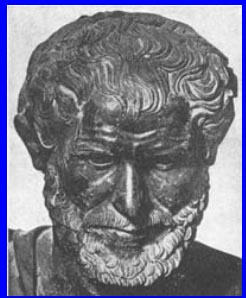
Figure 5 -- Aristotle
Along with Aristotle, they both made stunning observations from their inspections of the internals of the human body, and postulated various hypothesis based on these observations.  For instance, Erasistratus discovered that the trachea was a passageway for air (pneuma) to the lungs, and he discovered veins and arteries both originate from the heart.  Only he, like Aristotle,  believed the arteries were filled with air not blood, and hence the name 'arteries.'  And the passage of pneuma from the veins to arteries was the cause of disease(3, page 35-6, 4, page 86))

He disregarded the four humors of Hippocrates and the four elements of Empedocles, and instead postulated that fevers were caused by inflammation.  He was not a believer in purgatives and most medicine, and instead preferred a good diet and gymnastics.  Some believe he was the first to recommend exercise as a means to stay healthy and for healing.  (4, page 86)

Herophilus was among the "first of the Hippocratic school to distinguish himself as an atomist."  He was the first to use the pulse as an "index of varying conditions of health and disease."(4, page 84)

He properly attributed the pulsations of the arteries to the heart. 


Figure 6 -- Herophilus
Of interest is that Herophilus was charged with opening "the bodies of living criminals, to discover the secret springs of life."  (3, page 35)

Unlike Erasistratus, he was a believer in the hypothesis that imbalances of the four humors cause most diseases.  (4, page 85)

He revered Hippocrates to the point that "when obliged to contradict him he always avoided mentioning his name."   Also, unlike his counterpart, he placed a "high value on drugs, which he called, 'the hands of the gods,' and used them in great variety.  (5, page 62-3)

Erasistratus was an empiracist.  Herophilus was a rationalist. In this way, "the same rivalry which existed in Greece between Cos and Cnidos arose also between Alexandria and Pergamus, in which later place Galen was born, and Aesculapius was held in great respect as one of its most celebrated divinities."  (3, page 36-37)

Regardless, anyone who wanted to be a physician in the ancient world was eager to learn at the school of medicine in Alexandria, as "to have studied medicine at Alexandria, was everywhere considered a passport to the confidence and patronage of the public."  (4, page 92)

The school continued "its celebrity as a seat of learning and as a school of medicine, until it was taken by Saracens in 638 of the Christian era."  (3, page 36)

Figure 7 -- 1532 woodcut showing Herophilus (L) and Erasistratus (R)
Alexandria would fall in 619 A.D., and that ended whatever medical wisdom came out of it.  Many of it's wonders were destroyed by barbarians, including it amazing library.  As the library went up in flames, so to did all medical wisdom except for random scrolls scattered here and there.  (6, page 150-2) (7, page 28)

Until the  School of Salerno was established in the 10th century, there were no known autopsies performed, and medicine was left in limbo, or what historians like to refer to as the dark ages of medicine.  (6, page 150-2) (7, page 28)

References:
  1. "Alexander the Great Alexander of Macedon Biography: King of Macedonia and Conqueror of the Persian," historyofmacedonia.org, http://www.historyofmacedonia.org/AncientMacedonia/AlexandertheGreat.html
  2. "Alexander the Great: Ancient Greece for kids," mrdonn.org, http://greece.mrdonn.org/alexander.html
  3. Meryon, Edward, "History of Medicine: comprising a narrative of its progress from the earliest ages to the present and of the delusions incidental to its advance from empericism to the dignity of a science," volume I, London, 1861,
  4. Watson, John, "The medical profession in ancient times," 1856, Baker and Godwin, New York
  5. Withington, Edward Theodore, "Medical history from the earliest times,"
  6. Garrison, Fielding Hudson, "An introduction to the history of medicine," 1922, Philadelphia, W.B. Saunders Company
  7. The John Hopkins Hospital bulleton," (volume XV 1904), "From the epoch of the Alexandria School (300 B.C.)"
RT Cave Facebook Page
RT Cave on Twitter
Print Friendly and PDF

Monday, April 27, 2015

225 - 200 B.C. Dogmatism is challenged

Even while the dogmatic school of medicine (rational medicine) was being formed at the school of Cos by Hippocratic writers, so too was forming the emperical school of medicine at the school of Cnidos, about 20 miles away. (1, page 29)

In other words: "By the side of dogmatic philosophies Skepticism slowly arose," said Norman Maccoll in 1868.  (6, page 10, 18-19).

What is skepticism?  It is a branch of ancient Greek philosophy thought to have been created by Pyrrho.  Who was he?

Pyrrho lived lived 360-270 B.C., and was among the first of the skeptics, or philosophers who doubted that all wisdom could be learned.  (Skeptic comes from the ancient Greek term "skepsis," which, according to Meriam-Webster, means examination or doubt).

He is often considered as the father of skepticism. His followers were called Pyrrhoneans.  His philosophy was called Pyrrhonism, his school called the Pyrrhonean School. (6, page 13)

However, as was normal for the ancient world, many believe ideas contributed to him arose prior to his lifetime and were merely attributed to him later on.  (6, page 13)

Of his disciples or pupils, Maccoll said the one most important to historians of philosophy was Timon, who lived from 320-230 B.C.  While Pyrrho is known to have written only one poem addressed to Alexander, Timon wrote voluminously. Therefore, it "was through him that Pyrrho's doctrine became first generally known." (6, page 27, 28, 30)

Maccoll wrote that it was Timon who said that a philosopher should ask the following questions:
  1. How are things constituted?  Our conclusions should not come from our opinions or senses because answers derived from them are neither true nor false.  Answers must be derived from empirical evidence. (6, page 21, 22)
  2. In what relation should we stand to them?  We cannot form opinions on things that are beyond our knowledge.  In other words, "We cannot distinguish the false from the true, for both to the senses and the reason all things are alike: they possess no criterion of truth: we must not hazard those decided judgments, in which the dogmatist indulges: we must incline neither to the right hand nor to the left: we must remain unmoved." (6, page 21, 22)
  3. What will result to us from our relation to them? "What effect on our happiness will our attitude to Things have ? This attitude has already been determined to be suspension of judgment. If therefore we are to make a rule of abstaining from all judgments, our happiness must be dependent on this abstinence, and consist in regarding everything external with undisturbed tranquillity of mind; for there is no certainty with regard to what is external, and, where there is no certainty, there can be no happiness. The soul must retire upon itself, looking upon all outside itself as indifferent, and striving to become neither the slave nor the mistress of circumstances, but separate from, and independent of, them." (6, page 21, 23)
Of this third question, Maccoll said: 
The answer to the third question shows the aim of Pyrrho's doubt: like all his contemporaries he searched for a summum bonum: he was not a sceptic in the modern sense of the word : he doubted because doubt appeared to give him the most secure promise of happiness. (6, page 24)
Of the three questions, Maccoll said:
They relate of course to the old points: " Is knowledge absolutely relative ? Is there any objective truth ? Can we have any knowledge of Things as they are in themselves ?" (6, page 31)
The quest of Pyrrhonism was to find the summum bonum, or the highest good. In this regard, Pyrrhoneans were considered eudaemonistic (eudaemonism), which, according to Merriam-Webster, was a theory that the highest goal is happiness and personal well being. (6, pages 8-9,24)

Skepticism died out after the death of Timon, only to be re-established by later philosophers.  (6, page 69)

However, it was from the skeptics, or Pyrrhoneans, that arose the empirical school.  It was the empirics who would ultimately counter dogmatism.  

Empiricism arose through the wisdom of the following triad:  (1, page 29) (3, page 68)(4, page 91)
  • Herophilus:  He lived 325-280 B.C., and came up with many of the theories followed by the the empirical school of medicine
  • Philinus: He was a pupil of Herophilus around 250 B.C., and started the empiric school of medicine
  • Serapion: He was successor of Philinus around 225 B.C., and supported empiricism
This Empirical School of Medicine was basically established to counter the "extravagances" of the Dogmatic School of Medicine at the School of Cos.  (3, page 69)

A common saying of the empiracist was:
"It is not the cause but the cure of disease that concerns us; not how we digest, but what is digestible." (5, page xiii)
The major differences between these schools were as follows:  (1, page 29)(3, page 69) (4, page 68-9)

Dogmatists/ Rationalists/ Hippocratic
Dogmatic School of Medicine
Empiricists/ Emperics
Empirical School of Medicine
Supported ideas of the physician Hippocrates
Supported ideas of the philosopher Pyrrho
Were in search for causes of disease
Were not concerned with causes.  A person was ill is all they needed to know
Speculated on possible causes and remedies
Did not speculate
Created theories to explain causes and why a remedy will work.  Generally, diseases were caused by the body as a whole.
Did not create theories to explain anything.  If something was unknown, it was left at that
Cures were based on the theory postulated. 
Cures were based on experience.  If something worked in the past, it will work today.  Medicine not based on experience could injure
They had few remedies, many of which were harsh, such as bleeding, purging, and vomiting
They had many remedies, and they were generally friendlier than dogmatist remedies and probably worked better
They believed anatomy was important to understand the physiology of disease
They despised anatomy and physiology. 

Serapion was the most outspoken of the empirics, and "he wrote with great vengeance  (1, page 29), as he said:
"What is the use of  knowing the shape and position of the brain and liver, or whether there are such things as brains or livers at all."  (4, page 68)
Another common saying of the empirics was:
"It is not the cause, but the cure of diseases that concerns us; not how we digest, but what is digestible." (4, page 68)
Galen wrote about Serpion the empirist in his Outline of Empericism: (2, page 161)
Of the ancients, however, Hippocrates, Erasistratus, and Herophilus have stated nothing about the treatment suffering from the disease (i.e. lethargy).  But Serapion the Empericist, in Book 1 of his treaties Against the Haireseis, gave some instructions (about this) which are, however, too obscure to be reported here.
Serapion thus became an experimentalists.  He experimented to see what drugs worked best for said disease.  He recorded and made conclusions based on his own observations and experiments, as opposed to coming to speculative conclusions.  (1, page 30)

As described by Edward Withington:
"In short, they (empiricists) reduced the whole art and science of medicine to a system of therapeutics.  A person is ill, that is, he has certain unpleasant feelings or symptoms; surely the first thing to do is to find something which will remove them, and the whole duty of the physician is to discover what particular treatment, and especially what drugs, will get rid of particular sets of symptoms."  (3, page 68-9)
The way to do this is based on the "tripartite foundation" (1, page 30) of the following three methods:  (3, page 69)
  1. Experience:  His own experience and observations
  2. History:  Learning from the experience and observation of his contemporaries and  predisessors
  3. Analogy:  Drawing conclusions based on similar situations to find remedies for new and strange cases
 And thus was formed the Empirical school of medicine.

The empirics were essential to this time because they created an important alternative to the dogmatists, some of whom (see Erasistratus) performed autopsies on live convicted criminals to see what organs did during life.  Hopefully, as some reports suggest, many such victims were given a large dose of morphine before the procedure.  Yet still it was considered inhumane and irrational by the empiricist, and reasonably so.

While the dogmatists based their remedies on speculation, the empiricists used only remedies that were shown by experience to work. This was a viable alternative to the extreme remedies of bleeding and purging used by many dogmatists.  The empiricist also added quite an array of new remedies, including opium and sulpher.

The dogmatists became known as rationalists due to their desire to rationalize diseases and their remedies.  They believed "everything must have a sufficient reason for its existence," Empirics believed what can be observed by experience is known, and what is not known is not to be speculated upon.

References
  1. Meryon, Edward, "History of Medicine: comprising a narrative of its progress from the earliest ages to the present and of the delusions incidental to its advance from empericism to the dignity of a science," volume I, London, 1861,
  2. Eijk, Philip J., editor, "Ancient Histories of Medicine: essays in medical doxography and histeriography in classical antiquity," 1999, Boston,
  3. Withington, "Medical History from it's Earliest Times: a popular history of the healing art," 1894, London, The Scientific Press
  4. Watson, John, "Medical Profession in Ancient Times: an anniversary discourse delivered before the New York Accademy of Medicine November 7, 1855," 1856, New York, Baker and Godwin
  5. Brock, John, "Galen on the natural faculties," 1916, London, New York, William Heinemann, G.P. Putnam's Sons
  6. Maccoll, Norman, "The Greek Skeptics from Pyrrho to Sextus: An Essay which obtained the Hare Prize in the Year 1868," 1868, London and Cambridge, Macmillan and Co.
  7. "Ancient Greek Skepticism," Internet Encyclopedia of Philosophy, http://www.iep.utm.edu/skepanci/, accessed 6/20/14
RT Cave Facebook Page
RT Cave on Twitter
Print Friendly and PDF