
 |
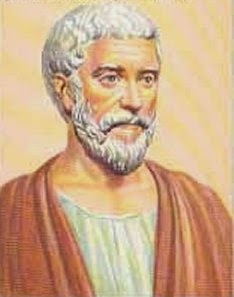
| Pythagoras of Samos (570-495 B.C.) |
By no means am I implying here that Pythagoras invented philosophy, for that couldn't be further from the truth: the quest for knowledge, which is what philosophy is, started long before Pythagoras was even born.
Near the beginning of civilization there were a few sages who pondered in secret about the world around them, and doubted it was all created by the gods. They asked questions and sought answers, and what they discovered became the first theories.
They studied the stars and planets and became the first astrologers. They studied numbers and became the first mathematicians. They studied geometry and became the first architects. They studied medicine and became the first physicians.
 |
| Pythagoras celebrates sunrise (by Fyodor Bronnikov) |
The problem with this early philosophy was that it was far and few between. The majority of the people, about ninety-nine percent of them, worked a minimum of twelve shifts everyday, seven days a week. They did not have time to think and ask questions let alone time to learn. Yet during the 9th century B.C. things were occurring in ancient Greece that would change all this, thus giving rise to the Age of Philosophy in ancient Greece.
No one knows exactly when this occurred, but sometime before the great poet Homer sat down to write his epic poems, gymnasiums were being built near the temples of various gods,and these were dedicated to shaping the bodies of young men. (1, page 80)
In these gymnasiums young men would exercise, play games, and otherwise prepare their bodies for battle. Occasionally they ventured off to battle, and they won many wars, and they marched home with prisoners of war. These prisoners were turned into slaves, and by the 6th century B.C. nearly all the citizens of Greece owned many slaves, and these slaves did all the work. This allowed the citizens of Greece plenty of time to enjoy the pleasures of life.
Some citizens spent their days pondering about the world around them, and they yearned for answers. So they traveled abroad to Egypt, and Mesopotamia, and India. In this way, they spent time with the sages of these places, and they expanded their knowledge.
At this time, the best medical schools were in Egypt, and therefore it was probably at the schools at Heliopolis that the Greeks came into contact with Egyptian medicine. They must have been very impressed with this knowledge that they took it home and shared it with their fellow citizens of Greece. (7, page 22)(6, page 4)
It was in this way that the Egyptian method of healing at temples morphed into Aeslepion temples in Greece. Apollo was a god similar to Thoth. Thoth was worshiped as Hermes. Other Egyptian gods, such as Isis, were worshiped in Greece, and later Rome, until around 50 B.C. (6, page 2)
 |
| Pythagoras is perhaps the man responsible for bringing Egyptian and Babylonian math, astrology, and medicine to ancient Greece. |
They learned that an oracle at Pythian told Parthenis that his wife was pregnant with a child who would be blessed with great wisdom and who would be of great benefit to mankind. In recognition of the oracle, the child was named Pythagoras. (3, page 7-9)
In his youth he must have spent quality time in the gymnasium at Samos, as he became a gifted athlete. He was also a gifted student who loved to learn, and so must have listened to the stories of the orators, and the lectures of the sages. At one point he listened to a lecture by the philosopher Phercydes about the "immortality of the soul," and he was "so charmed" that he dedicated the rest of his life to philosophy. (1, page 81)
To satiate his quest to learn more he began his travels around the world, or so legend has it. He first traveled to Meletus of Anatolia (modern day Turkey), which was at the time the home of philosophers. While there he learned of the wisdom of three early Greek philosophers.
 |
| Thales of Miletus was perhaps the first Greek Philosopher |
He traveled to Babylon and learned astrology, and used it to predict an eclipse of the sun. He traveled to Egypt and learned from the Egyptian sages at Heliopolis. He learned geometry and predicted the height of the pyramids using only its shadow. He learned Egyptian medicine, which at the time was the best in the world. It's believed that he started the process of blending Egyptian medicine into Greek philosophy. (5, page 89-90)
He concluded that water was the primary element, and that all other elements were derived from it. By his observations he associated life with water. Of this, historian Henry E. Sigeris said in 1987:
Thales had been in Egypt and saw the Fertilizing effect of water of the Nile that flooded the land periodically. He even ventured an explanation of this natural phenomenon, as Herodotus tells us. Throughout the East he could see that life was bound to the presence of water. Where water reached vegetation was abundant, and where it ceased, the desert began. Whatever was alive was moist, and Thales must have noticed that life-giving human and animal sperm was moist. And so he came to believe that there was a casual relationship between water and life... when water evaporated, did it not become air? Such observations and speculations must have guided Thales in his assumption that water was the primary element. (5, page 90)Because of Thales, Meletus is often considered to be the birth place of Greek philosophy. (3, page 12)(5, pages 89-90)
 |
| Anaximander was among the world's first scientists, or, among the first to question why things exist and to seek out answers by empirical means. |
He did not believe, however, that water was the primary element. Of him, Sigerist said:
He believed that the elements commonly thought to constitute the world -- water, earth, fire and air, with their qualities wet, dry, hot or cold -- were derived from one common indeterminate substance. From this inexhaustible primary substance which 'includes everything in itself and guides everything,' two pairs of elements with opposite qualities were born, which seemed to be in ideal balance. In the beginning of the world these elements were separated with the earth in the center, and covered by a sphere of water. which was surrounded by air and ultimately fire. Everyday experience taught what happens when fire acts upon air, water, and earth. The earth became dry, water evaporated, pressure increased, and the ring of fire burst... Thunder and lightning were not the work of Zeus, but were caused in a perfectly natural way when air was compressed in a cloud and burst forth violently. All living creatures originated in the water, and some became land animals when the water evaporated. Man too arose from a fish-like creature. (5, page 91)Sigerest said Aristotle said that Anaximander said "all things are full of gods." In this way, Sigerist said, Anaximander began the transition away from believing everything was caused by gods, to the idea that they were caused by naturally occurring phenomena. (5, page 91-92)
3. Pherecydes of Syros: (570-495 B.C.) He was among the first to rationalize Greek mythology. In this way, he is credited as being the first to establish the idea that the human soul was immortal. This type of thinking was taught by Pherecydes at the gymnasium of Syros, and it greatly impressed a young Pythagoras. (2)
It is then speculated that Pythagoras traveled abroad, to Egypt, Mesopotamia and India. It's believed he spent 20 years in Egypt learning from its sages. Some speculate he even became an Egyptian priest. He then was taken to Mesopotamia and held captive for 12 years in Babylon. During his time there he learned from Mesopotamian sages. (3, page 12-14)Medical historian Max Neuburger said once his travels were done he settled in Crotona, which is now Southern Italy. He said:
(He) founded a guild in Crotona, religious and moral, did pioneer work, not only in mathematics, astronomy and acoustics, but in investigation of the structure of the body, reproduction and development, the functions of the senses and mental activity, as well as in the treatment of the sick. (8, page 105)Neuburger also said that being that there was also an Asclepion in Crotona, physicians at the medical school at Crotona were probably constantly in touch with the Pythagorean followers, many of whom were physicians. So early on there was a mingling of the different schools of philosophy or medicine. (8, page 106)
His greatest interest was regarding religion, and so he preached that what was learned in this life could be used in the next life when the soul moves on to another body, or to the final resting place. (3, page 25)
Some speculate he came up with this idea from Phercydes, although some speculate this wisdom came from the Egyptians, who likewise believed the soul traveled into the afterlife. Although others speculate this wisdom came from the Indians, who believed in reincarnation of the soul, or that once you die you are reborn as another person.
His followers were interested in his ideas about religion, but they were also interested in all his philosophical wisdom. While historians credit Thales as the first philosopher, Pythagoras was the first person to refer to himself as a philosopher during his own lifetime.
Again, we must understand that philosophy is the quest for knowledge. So when Pythagoras, and all the later ancient philosophers, lectured, they preached all the wisdom of the day, which included mathematics, science, astronomy, astrology, music, and medicine. It wasn't until many centuries later that each of these were extracted from under the rubric or umbrella term philosophy to become natural sciences all of their own.
So by his lectures he shared this knowledge. His fellow Greek citizens were so impressed that word quickly got out about all the knowledge of Pythagoras, and so he quickly developed a large following. Renouard said his followers became known as Pythagoreans Disciples, or simply Pythagoreans.
Pythagoras established these followers of his into "a well-disciplined school," said Henry Sigerist in his 1922 history of medicine. It was called the Pythagorean Order. (5, page 94-95)
Renouard said his followers would often sell all they had to dedicate their lives to Pythagoras and the general good. (1, page 83) Sigerist said they ate a healthy diet in order to maintain a healthy balance, or equilibrium, within their bodies.
Neuburger said, according to Pythagoras: (8, page 107)
The body was formed from the warm, the breath causes cooling.The causes of disease are bile, blood and phlegm. Predisposition to disease are excess or lack of warmth, nourishment, etc. Inflammation arises from accumulation of phlegm -- in itself warmth producing. (8, page 107)When they were sick it was because the equilibrium was disturbed, and it was only re-established "physically with medicine, and mentally with music. This was why both medicine and music were greatly cultivated in the Pythagorean school, " said Sigerist. (5, page 96)
Neuburger said:
Health, according to him was a condition upon the equilibrium of materials present in the body (cold, moist, warm, dry, sweet, bitter); sickness results through the predominance of one quality, cure from a restoration of the balance, through the addition of the opposite one. (8, page 107)Neuburger said he neglected "most surgical procedures, and mostly employed the following as remedies: (8, page 106)
- Simples
- Poultices
- Salves
- Expiations
- Spells
- Magical herbs
- Incantations
- Religious music
- Physical exercise (gymnastics)
- Dietetic measures (such as limited consumption of meat) (8, page 106)
"He designated God by the figure 1, and matter by 2; so he expressed the universe by 12, because this results from the juxtaposition of the figures 1 and 2." (1, page 84)Renouard said he explained the three distinct parts of life, or the three worlds: body, soul, and spirit. So in this way the universe was in "harmony with the body and the soul," which, according to Pythagoras, were "manifested by three distinct faculties: sensibility, thought, and intelligence." (1)
He was the first to establish the idea that the brain was the center of human intelligence. (8, page 106-107)(9, page 83) This was a major step as far as medicine was concerned because physicians of neither Egypt nor Mesopotamia considered this fact. Egyptians thought it was the heart, and Babylonians thought it was the liver.
He is also credited with creating the Pythagorean Therum, which states that the square of a hypotenuse of a right angle is equal to the sum of its squares. He is also credited with being the first to say the earth was a sphere, among other things.
We must remember, however, that since most of what is known of him was told by second hand accounts after his death, much of what we know of him was probably exaggerated. Much of what was attributed to him was probably actually invented or discovered by one of his contemporaries or peers. This was probably because Pythagoras lectured mostly in secret because much of what he taught was radical. His followers were sworn to secrecy. Perhaps this explains why Pythagoras was credited with all the wisdom of the Pythagoreans. (3, page 20)(5, page 95)
Sigerist said that another reason for this was because "loyalty to the master impelled his student to attribute every contribution of any importance to him (Pythagoras)."
This was typical, however, of the ancient world, as most people were forced to, or in most cases willing to, make a humble contribution to the the collective. (5, page 95)
Many historians also believe much of what he is credited with may even have been known for generations before he was even born, such as the pythagorean therum, which must have been known when anonymous architects were building many of the structures of the ancient world. It may have been postulated by Egyptian mathematicians, or perhaps even by an anonymous sage from ancient Sumeria.
Pythagoras was well respected in life, although his ideas on mathematics were generally not accepted until well after his death. However, the teachings of his school would influence many succeeding generations of Greek philosophers, including Plato and Hippocrates. In fact, his teachings also continue to influence people to this day.
Pythagoras died sometime around 500 or 490 B.C., although his philosophy lived on for many years by his followers. They continued to lecture, and in this way philosophy was learned by many Greek citizens, including Plato and Hippocrates. In fact, his teachings continue to influence people even to this day.
Henry E. Sigerist, in his 1922 history of medicine, said that Pythagoras may simply have been a benefactor of the times he was born into, a time when Greek citizens were becoming better educated about the world around them. He said:
Many people were no longer satisfied with the naive and primitive worship of the Homeric gods and felt shocked by the many scandals mythology reported about them. We saw that the cult of Asclepius developed in this atmosphere, as did a number of mystery religions under Asiatic influence. Pythagoras is one of the exponents of the great Orphic movement." (5, page 95)So by the 5th century there was such a demand for wisdom that many of the gymnasiums were transitioned to places of learning, thus becoming the schools and universities. (4, page 39)
Many believe this system of associating education with a temple was learned from Egyptian and Babylonian sages, as both those nations had a similar system of learning.
The most famous of these Greek schools were associated with temples of the god Asclepius, who was the the messenger of the gods and capable of communicating their wisdom with the citizens of Greece. These schools became known as Asclepions.
Renouard said these gymnasiums were "surrounded by halls and porticos where philosophers, rhetoricians, artists, and physicians assembled to hold their schools and dispute on questions of art." (1, page 80)
So with a lot of time on their hands, and a burning passion to learn, Greek citizens like Thales, Anaximander, Pherecydes and Pythagoras traveled the world in search of the wisdom of the sages. What they brought back to Greece inspired its citizens, peeking their interest in philosophy.
It was Pythagoras, and Pythagoras alone, whether this is accurate or not, who is given credit for introducing ancient Greece to philosophy. Of this, Renouard concludes that Pythagoras was: (1, page 90)
"The last celebrated example of distant peregrinations in search of wisdom..." (after him) "the sages of Greece ceased their journeys in search of light in foreign countries, for their own country became in its turn a center of illumination for all nations." (1, page 90)
Pythagoras gave rise to the Age of Philosophers. This is key to our asthma history because without ancient Greek philosophy, modern medicine would be ages behind where it is today, if it existed at all.
References:
References:
- Renouard, Pierre-Victor, "History of Medicine: from it's origin to the nineteenth century," 1867, Philadelphia, Lindsay and Bakiston
- "Pythagoras," Encyclopedia Britannica.com, http://www.britannica.com/EBchecked/topic/485171/Pythagoras, accessed 11/1/12
- Harkins, Susan Sales and William H. Harkins, "Biography from Ancient Civilizations, Legends, Folklore, and Stories of Ancient Worlds: The Life and Times o Pythagoras," 2007, Mitchell Lane Publishers
- Osler, William, "The Evolution of Modern Medicine: A series of lectures at Yale University on the Silliman Foundation in April, 1913," New Have, Yale University Press, 1921,
- Sigerist, Henry E., "A history of medicine," 1987,
- Sandwith, Fleming Mant, "The Medical Diseases of Egypt: part I," 1905, London, Henry Kimpton
- Withington, Edward, "Medical History from the earliest times,"
- Neuburger, Max, writer, "History of Medicine," 1910, translated by Ernest Playfair, Volume I, London, Oxford University Press
- Garrison, Fielding Hudson, "An introduction to the history of medicine," pages 80-83.
RT Cave on Twitter

