Showing posts with label asthma remedies. Show all posts

Wednesday, May 24, 2017

1898: A doctor's humble request for help

So it's the year 1898 and you are a physician. One of your patient's has intractable asthma, where everything you prescribed failed.  What can you do?  Well, why not submit a letter to the editor to medical magazine asking for help. Here's one example of a doctor doing just that.
Editor Medical World :—I ask help for a case of simple but intractable bronchial asthma. I can find no complications. The patient is a lady, about 40 years old, weight 200 pounds, ruddy complexion, red hair. There is no hereditary taint. She is now five months pregnant, but the asthma does not seem to be much worse than before she became so. I have given her a good many remedies with only temporary relief. J. R. Mclaurin, M.D. Toomsuba, Miss. ,

A humble submission on the part of a doctor who had the best interest of his patient at hand. 

References:
  1. Taylor, C.F., editor, "The Medical World," volume 16, 1898, Philadelphia, page 251

Monday, May 22, 2017

1898: Physicians search for asthma remedies

Physicians in the 19th century were eager to find a good remedy to help their asthmatic patients, especially the children suffering from it.  There were no truly effective remedies for the ailment, although there were a few options that provided at least some relief temporarily.

I almost like to think of the asthma market in the the 19th century as the weight loss market of today.  Most people are busy and don't have time to exercise.  And with all the tasty foods, they don't want to diet.  So this opens up a market for weight loss gimmicks.

So now there's hundreds of products catering to this market, including pills, elixirs, weights that vibrate, and gadgets that wrap around your body to create perfect abs.  In reality, however, most of these products don't produce results unless the person has a calorie deficit, or consumes fewer calories than he burns.  

This was how the asthma market was in the 19th century.  Some medicines offered relief, but none made your asthma go away.  However, if you managed to avoid your asthma triggers, it may appear as though the medicine was working.

And much like the modern person yearns for an article or post in a magazine that describes the latest weight loss craze or gimmick, the 19th century asthmatic or asthma doctor yearned for the the latest asthma craze or gimmick.

One such post was included in the 16th edition of "The Medical World" as a letter to the editor:
Editor Medical World :—I wish we could get some of the able contributors to your valuable journal to contribute their experience in the treatment of bronchial asthma. It has been my lot to have several patients suffering with that disease. Fortunately for me, I have been very successful in treating it. The prescription that I give, with some variations, has wrought wonders in some of my asthmatics. As an example, about six months ago I was called to see a lady who was attacked with malarial fever, and while dosing out medicine for her, my attention was attracted to some one in the adjoining room who seemed to be making a desperate effort to get the breath. On inquiry I learned that the party was the lady's daughter, who had been a sufferer with asthma ever since she was six months old, and that she was then sixteen; and that the attacks were getting more frequent and lasted longer. I am giving the daughter the following prescription. Since she has been taking it she has had two slight attacks, which were promptly relieved by giving the medicine in double doses every four hours. This relieves the attacks generally when the second or third double dose is taken. The following is the prescription:
prescription:
B Iodide of potassium - - oz. iss
Muriate ot ammonia - - dr. iv
Fid. ext. grindelia robusta - oz. ij
Fid. ext. quebracho - - oz. iss
Fid. ext. jaborandi - - - dr. iv
Ammonia bromide - - oz iss
Simple elixir enough to make oz. viij
M. S. Take a teaspoonful three times during
the day and one at bedtime.
S. H. Singleton, M.D.
Fouts, Oklahoma Ter.
Similar to today's physicians, each has his own prescription for asthmatics.  The main difference is that today's physicians have access to better asthma wisdom, better asthma remedies, and asthma guidelines.  So while there are still a variety of options for treating asthma, physicians today are less open to playing around with crap shoot remedies as S.H. Singleton was looking for.

References:
  1. Taylor, C.F., editor, "The Medical World," volume 16, 1898, Philadelphia, page 26-27

Friday, May 19, 2017

1904: Wompole's Hypno-Bromic Comp will cure your asthma

By 1904 asthma was still a nervous affection, and a notable treatments were medicines to ease the mind. One such remedy was Wompole's Hypno-Bromic Comp.  

According to a 1904 article in the New Albany Medical herald:
"If you want to give your patient relief from asthma, and a good refreshing sleep from which he will wake greatly refreshed, Just try wompole's hypno-Bromic Comp.  It will give quick and satisfactory results. Give this relief to the next case of asthma you are called to treat." (1, page 584)  
Cocaine and morphine were often prescribed to help a nervous person sleep. But, ccording to an 1898 article in Medical Progress, Wompole's Hypno-Bromic Comp. not only worked better, but was safer.  The article mentions a case where morphine was trialed, although after a while it allowed the patient, a female, to "sleep an hour or two.  She was given a teaspoon of Wompoles Hypno-Bromic Comp. each night immediately after she had come out of the bath.  This remedy had a most happy effect."

Two other cases were also described, and the results were essentially the same.  (3)

A recipe for this product can be made in your own kitchen:. Here are the ingredients. 
Chloral hydrate gr. 480
Potassium bromide gr. 240
Extract of henbane gr. 4
Extractofcannabisindica.gr. 4
Morphine sulphate gr. 2
Simple syrup fl. dr. 4
Comp. spirit of orange. fl. dr. 1 Water, enough to make. fl.oz. 4 Make a concentrated solution of the chloral hydrate in water, triturate the extracts with this solution; add the potassium bromide and the morphine each dissolved in water, the spirit and the remainder of the water, and filter clear.(2)
This would have been just another option in the days when there were no ideal treatments for our disease.

References:
  1. "Medical Gleanings," New Albany Medical Herald, volume 22, No. 286 October, 1904, New Series Volume 11, Number 157 
  2. Hiss, Emil, "Thesaurus of Proprietary A recipe for this product can be found on page 271 of Emil Hiss's 1898 book "Thesaurus of Proprietary Preparations and Pharmaceutical Specialties," 1898, Chicago, G.P. Englehard and Company page 272
  3. "Suggestions on the management of nervous trouble," The Medical Progress: A monthly history and medical progress,John S. Moreman, M.D., editor, July 12, 1896, volume 12, new series number 79, old series number 126, pages 248-248

Wednesday, May 17, 2017

1889: Osler's asthma remedies

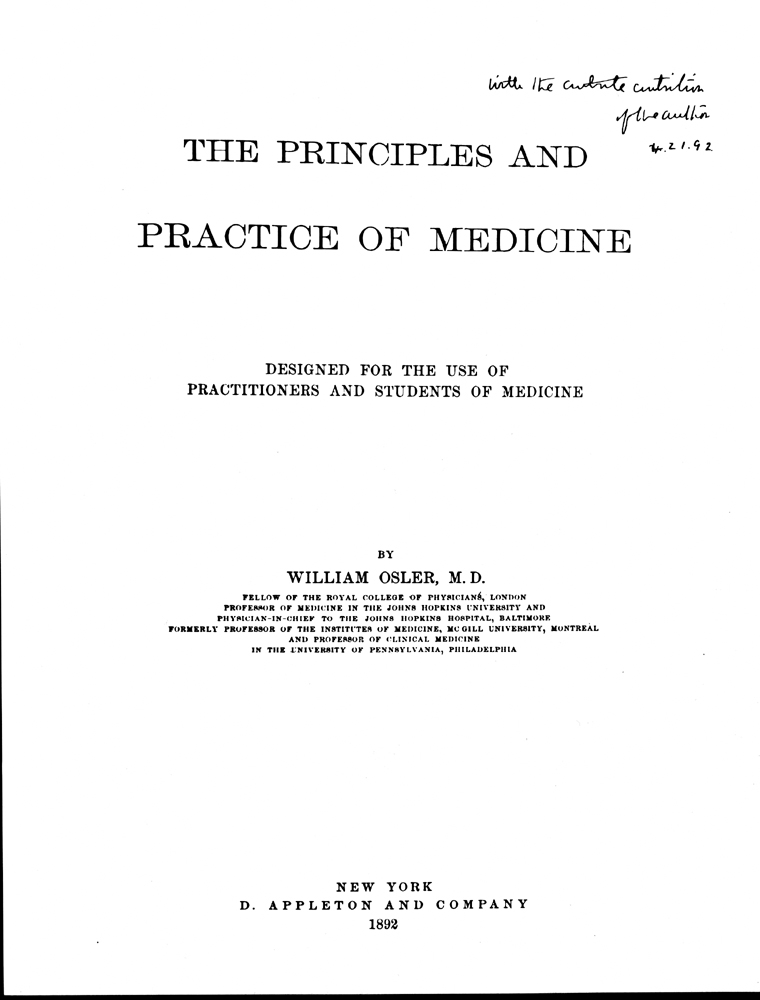
Dr. Osler's book "The Principles and Practice
of Medicine" was first published in 1892, and
was continually updated until 2001. 
Dr. William Henry Osler's recommended treatment for asthma didn't sway much from what other physicians of his day prescribed.  Since there really was no one medicine to resolve an asthma attack, which medicine to recommend was mainly based on personal preference.

However, Osler was among the first to note the urgency of treating asthma.  He said "immediate and prompt relief is demanded."  Remedies include any of the following:
  • A few whiffs of chloroform will produce prompt but temporary relief
  • Perles of nitrite of amyl may be broken on the handkerchief or 2-5 drops on cotton-wool and inhaled
  • Strong stimulants given hot or a dose of spirits of chloroform in hot whiskey will sometimes induce relaxation
  • Morphia or morphia with cocaine will produce more permanent relief (requires hypodermic injection). Good for obstinate attacks.
  • Antispasmotics, such as belladonna, stramonium, and lobelia in solution or cigarettes
  • Solanacae with nitrate or chlorate of potosh (common in most remedies)
  • Any form of asthma cigarettes (one form benefits one pt while another benefits another)
  • Nitre paper made with strong solution of potash.  "Filling a room with the fumes of this paper may sometimes ward off a nocturnal attack."
  • Tobacco smoke:  sometimes as potent as the prepared cigarette
  • Large meals early in the day as opposed to later
  • Coffee is better than tea
  • City is better than country
  • High and dry altitudes are more beneficial than sea shore
  • Oxygen may also be tried
  • City living was better than country living
Osler was among the first to recommend oxygen for the treatment of asthma, yet while epinephrine (adrenaline) was discovered in 1901, updated editions of his book prior to his death did not mention this quick acting medicine.

Many historians have  noted that Osler was unique in that he mentioned that "death from the attack is unknown."  However, many asthma experts during the 19th century, including Henry Hyde Salter, made similar observations.

References:
  1. "Sir William Osler At Seventy -- A Retrospect," The Journal of the American medical Association," 1919, Saturday, July 12, pages 106-108
  2. Osler, William, "The Principles and Practice of Medicine," 1892, New York, pages 497-501
  3. Bliss, Micheal, "William Osler:  A Life in Medicine," 1999, New York
Further readings:
  1. Jackson, Mark, "Asthma: The Biography," 2009, New York, pages 211-12
  2. Brenner, Barry E, ed., "Emergency Asthma," 1998, New York, pages 212-14

Friday, March 10, 2017

1981: Sus-Phrine: The greatest asthma medicine ever

"When we vacationed to California in 1976.
Dr. Gunderson gave us this to take along." Mom wrote
I think that the world's greatest medicine was Sus-Phrine (brand of epinephrine). It was actually a long acting version of epinephrine. It gave you your breath back within five minutes. I was given this medicine many times in the emergency room. It was a lifesaver.

A few years ago, as I began my quest to learn more about this medicine, a doctor told me that he liked it because a person would come in with status asthmaticus (asthma non-responsive to treatment), and he would prescribe a Sus-Phrine shot followed by a shot of a systemic corticosteroid.

The steroid would take 1-2 hours to reduce airway inflammation. In the meantime, the Sus-Phrine started working within minutes, and would last up from 6-10 hours. So, he said, the Sus-Phrine would keep airways open long enough for the steroid to take effect. Patients would have to stay in the hospital at least an hour after the shot so they could be monitored for potential side effects. Then they'd be sent home feeling good.

I would surely be feeling good. I would be wired. Sus-Phrine was essentially adrenaline. It's a medicine that essentially mimics the sympathetic (flight or fight) nervous system (sympathomimetic). It narrowed blood vessels to speed up the flow of blood to increase blood pressure. It increased the rate and speed of your heart. It caused palpitations. It made you excited. It made you jittery. It kept you awake for hours. But you didn't care, because it felt so good to be able to breathe.

Since 1901, epinephrine was available to be used for asthma. It started working in 3-5 minutes, but only lasted a few hours. This meant that repeat shots were often needed. It had to be given into the muscles, and this was most frequently the gluteal muscle (the butt). It also had to be given with a very large needle, which made the butt a good spot for injection. And kids were not keen to seeing a large needle, let alone having to drop their drawer and getting poked in the butt.

An An ampule of Sus-Phrine (1)
Sus-Phrine was first introduced to the market in the 1950s. Apparently, according to Emergency Medicine PharmD, it was the first medicine that didn't have to be given by intramuscular injection with a large needle. It was available in a concentration of 1:1200 (aqueous solution), which (if you are a nurse and I am not) can be delivered with any gauge needle and introduced to the body subcutaneously (meaning into the fat), meaning you could just get the shot in the arm with a small needle.

I only mention this because I started getting this shot in the mid-1970s and early 1980s when I would have been 5-10 range. Even though they would always assure me they had seen many naked butts before, it was always better to pull down my sleeve than to pull down my drawers. I'm sure this is the same for any kid.

Sus-Phrine (8)
Sus-Phrine became standard for asthmatics who presented to the emergency room during the 1970s to about the mid-1980s. This would have been about the time albuterol entered the mainstream of asthma treatments. It must have been discovered about this time that albuterol was just as effective as epinephrine in opening airways and ending asthma attacks. Giving 2-3 albuterol breathing treatments would also prove to offer the patient fewer side effects as a bonus.

I must have been given Sus-Phrine many times early on in my life. I know this, because, in 1976, my parents decided to take us to California. It was a three day car ride. This would have occurred just after I finished Kindergarten in June. My mom had my doctor write a note to any random doctor who might have to take care of me in case my asthma acted up. The note, written on a prescription pad, said:
Sus-Phrine (8)
"This boy is a known asthmatic undergoing hypersensitization program. If he has severe asthmatic attack without a fever he will respond well to 0.2cc Susphrine sub-q. Stat & observe 20 minutes."
By the late 1980s, and particularly between 1981 and January 1985, I made regular trips to the emergency room. I remember sitting on the hospital bed. I remember my dad saying, "In five minutes you will feel better."

Of course, they always had to give me an Alupent nebulizer treatment first. After a while I knew this wasn't going to work, but they always did it. As I inhaled the mist, I watched as a nurse would prepare the shot. When the treatment neared completion, the shot was given to me on my left or right arm.

Then I watched the clock. It was an oval clock on the wall right in front of me. It was 8 p.m.  I watched the red second hand go round and round as my shoulders dug deep into the mattress I was sitting on. I'd concentrate on my breathing. At first my breath would only go in half way. My chest was tight. I must have been near panic, or I wouldn't have asked mom or dad to take me.

Five minutes would go slow. But, right on cue: at the five minute mark my breath would start coming back. Each subsequent breath would go in deeper and deeper. Then I'd take in a deep breath and it would be easy. Then I'd take several deep breaths just because I could.

I can tell you with complete honesty that there is nothing better than all of a sudden being able to breathe after several hours of struggling to do so. It is just a great feeling. In fact, it usually created a feeling of euphoria. And, quite frankly, in retrospect, I'm not sure if that euphoria was the result of all of a sudden being able to breathe, or a side effect of the medicine. I imagine it was a little of both.

Nearly all of my ER visits were at West Shore Hospital. I remember going to the emergency room at West Shore Hospital in 1991 for an asthma attack. This was the first time I did this since 1985. I requested Sus-Phrine. The nurse never heard of it. The doctor had a vague memory of it, and consulted the pharmacist. The pharmacist and doctor talked about it for a while, and the pharmacist decided he had a cabinet that might have the medicine I requested.

This was the last time I was given the shot. It was discontinued within the next few years. A study published in 1991 in the Journal of the National Medical Association conclude that "Subcutaneous, long-acting epinephrine (Sus-Phrine) provides no additional benefit to a beta-2 agonist (albuterol) by nebulization for children with acute asthma." (6)

To be honest, I have never been given an epinephrine shot since then either, which spotlights the changing times as far as we asthmatics are concerned.

Further reading and references:
  1. Emergency Medicine Pharm D: Throwback Drug Thursday: Sus-Phrine, An Aqueous Formulation of Epinephrine
  2. Naterman HL. Ephinephrine base suspended in water with thioglycolate. J Allergy 1953; 24:60.
  3. Unger AH, Unger L. Prolonged epinephrine action. Ann Allergy 1952; 10:128-130
  4. Ben-Zvi Z, Lam C, Hoffman J, et al. An evaluation of the initial treatment of acute asthma. Pediatrics 1982; 70:348-353.
  5. Ben-Zvi Z, Lam C, Spohn WA, et al. An evaluation of repeated injections of epinephrine for the initial treatment of acute asthma. Am Rev Respir Dis 1983; 127:101-105.
  6. Kornberg AE, Zuckerman S, Welliver JR, et al. Effect of injected long-acting epinephrine in addition to aerosolized albuterol in the treatment of acute asthma in children. Pediatr Emerg Care 1991; 7:1-3.
  7. Jenkens, Charles M, "A Clinical Study of 'Sus-Phrine,' an Aqueous Epinephrine Suspensionfor Sustained Action," Journal of the National Medical Association, March, 1953, 45, pages 120-122
  8. Bezzant, John L., "Epinephrine: Comparison of short vs long acting," http://library.med.utah.edu/kw/derm/pages/ni18_3.htm, accessed 3/10/17
  9. "Sus-Phrine (brand of epinephrine), Physician's Desk Reference," 1991, page 1006
  10. Feldman, B. Robert, "The Complete Book of Children's Alergies: A Guide for Parents," 1986, Times Books
  11. Brenner, Barry E., editor, "Emergency Asthma," 1999, New York, Marcel Dekker, Inc., page 322

Monday, February 6, 2017

1875: Bleeding STILL recommended to cure your asthma

No one knows for sure why this was ever practiced, yet for thousands of years in the annals of human medical history, diseases were treated by a remedy called bleeding, or venesection.  This involved intentionally slitting a vein with a sharp object to induce bleeding.  It was the ideal remedy when all else failed, even for asthma or difficult breathing.

Hippocrates generally recommended subtle remedies for asthma, although when all else failed, bleeding remained an option.  So assuming Hippocrates picked up his medical wisdom from the stone tablets at the Aesclepeon of Cos, the practice must have been known to the priests of Ancient Greece since the early days.  And considering the Greeks gained much of their medical wisdom from the ancient Egyptians, it probably goes back much further.

Historian Edward Withington, in his 1894 book "Medical History from its earliest times" proposed an interesting theory regarding bleeding.  He postulated the idea that it may have been picked up by primitive humans, the same humans who would eventually settle in Mesopotamia and Egypt.  He wrote:
Ever since vital activity has existed on the earth, it has, in all probability, been liable to those perturbations which we call disease; wounds and injuries must have occurred wherever there were weapons to inflict them, and fragments of diseased fossil bone are to be found in our museums. We may well suppose that the earliest efforts of intelligent beings were directed towards the avoidance or cure of these disorders, and the older writers amused themselves by searching for instances of medical or surgical practice which they thought might be derived from animals. Thus the most ancient and widely spread of surgical operations, that of bleeding, is said to have been taught mankind by the hippopotamus. "That intelligent animal," says Pliny, "finding himself plethoric, goes out on the banks of the Nile, and there searches about for a sharp-pointed reed, which he runs into a vein in his leg, and having thus got rid of a sufficient amount of blood, closes the wound with clay."  Similarly the use of emetics is said to have been learnt from the dog, that of hellebore from the goat, while the assertion that stags healed their wounds by means of the herb dittany is supported by many authorities, including Aristotle himself. Nor are these stories to be entirely rejected, for have we not lately been told that Count Mattei* discovered the basis of his alleged remedies by observing the plants eaten by a mangy dog in the Apennines? (2, page 7)
Of course Withington was just speculating, yet his theory is interesting.  If nothing else, his theory shows just how far back the practice of bleeding goes back.

Primitive people had no concept of anatomy or diseases, so they probably bleed as a means of purging evil spirits or demons from sick people.  It may also have been a means of pleasing the gods through sacrifice.

S.D. Gross, in his 1875 article "The lost art of medicine," said there was a variety of methods of blood letting, which included, but were not limited to: (1, page 430)
  1. Venesection:  Slitting open a vein 
  2. Cupping:  Placing cups on he skin that cause blistering and bleeding
  3. Leeches:  The leeches to the work of sucking out blood
  4. Scarification
  5. Puncture
  6. Arteriotomy:  Due to difficulty, few practice it.
Gross estimated that the diseases hat benefited the most from bleeding were those of inflammation.  For example, he noted that "Hippocrates and his immediate followers bled largely in pneumonia and pleurisy; and Sydenham, Rush, Louis, Drake, and many others often took immense quantities of blood in the treatment of these maladies."  (1, page 430)

He wrote:
In chronic inflammation, blood-letting is often an indispensable remedy. Even the most ultra advocate of the stimulant method of treatment will hesitate to employ it when destructive action is gradually but surely undermining structure and function. The abstraction of five eight, or even ten 'ounces of blood in chronic pneumonia and pleurisy, especially when associated with severe pain and obstructed respiration, often acts like a charm, relieving suffering and promoting the beneficial action of other measures. (1, page 430)
He continued:
To draw blood to the greatest possible advantage, the quantity should be measured, not by ounces, but by the impression it makes upon the system, as denoted by the pallor of the countenance, the reduction of the heart's action, the softened state of the pulse and skin, the abatement of pain and of other symptoms, as headache, thirst, and restlessness, so universally present in all severe inflammatory attacks. To insure this result in the mor. speedy and decided manner, the blood should be drawn from a large orifice in a large vein at the rate of two and a half to three ounces in the minute, while the patient is in the erect or semi-erect posture. If the body be recumbent during the operation, a much larger quantity of blood will be required to be drawn to produce the desired effect than whet the reverse is the case. While, therefore, the bleeding should be spoliative, care should be taken not to waste the fluid unnecessarily.
 To prevent undue reaction after the operation, the bleeding should not be carried to complete syncope, but merely to an approach to this condition, the effect of the operation being carefully watched by a reference to the countenance and the pulse, lest it should exceed the proper limits, and thus do harm instead of good. Violent reaction, however, in any case, after the abstraction of blood, may generally be effectually prevented by a full dose of some diaphoretic anodyne, as ten grains of Dover's powder with one-fourth of a grain of morphia, given immediately after the operation.  (1, page 430)
He further explains he mode at which bleeding helps with inflammation:
In the first place, the abstraction acts spoliatively, diminishing, as the name implies, the quantity of blood, both in the part and system. Secondly, it weakens the power of the heart, and thereby prevents it from sending the blood with the same force and velocity into the suffering structures. Thirdly, it unlocks all the emunctories, and thus promotes secretion. Fourthly, it disgorges the vessels at the seat of the disease, restores the circulation, and places the absorbent vessels in a better condition for the removal of effused matter. And, last, but not least, it favours the action of other remedies, as purgatives, diaphoretics, diuretics, and anodynes.
So experts had bleeding down to a science, so to speak.

Now, say you were short of breath in ancient Greece, desperate for a solution, and your priest/ physician is pent on cutting your skin to make you bleed. This may not have sounded so irrational to you, as your priest/ physician was equally ignorant of anatomy and disease as you were.  By now there was the belief that such a practice would somehow help to balance the humors of your body to heal your ailing lungs.

The practice was heavily used among all the healers of the world -- from the primitive medicine man, to the ancient priest and priest/ physician, to the medieval physicians, surgeons and barbers -- until it was given a black eye of sorts in the minds of commoners due to certain abuses.

According to historian Fielding Hudson Garrison, the remedy perhaps was used to extremes in France around the time of Napolean, after his war surgeon, Francois Joseph Victor Broussais, recommended all sickness be treated by covering the body with leeches.  Yet when Pierre-Charles-Alexandre Louis realized leeching was useless during a diptheria epidemic, the remedy of Broussais faded away.  Louis later became the first to prove that bleeding had no effect for pneumonia, and this stopped bleeding for pneumonia, at the very least. (3, pages 340-342)

Gross suspected the end of the practice may have been a result of lost faith among the public and medical professions due to overuse.  He wrote: 
The indiscriminate employment of the lancet in former days did much to bring blood-letting into discredit, not only with the better thinking class of physicians, but the public at large. 'We cure the sick,' says Gui Patin, a professor in the Royal College of France,' when over eighty years old, by blood-letting, and also infants of not more than two or three months, with as much success and as little inconvenience.' (Benjamin) Rush, the great champion of this operation on this side of the Atlantic, bled indiscriminately and remorselessly at all periods of life, the young, the middle-aged, and the old; in all kinds of diseases, in the eruptive fevers, in fever and ague, in puerperal fever, in inflammations, in injuries, in hemorrhages, and even in anaemia, often taking immense quantities of blood, and repeating the operation six, eight, or even a dozen times in the same patient. In short, he and his followers used to bleed in every possible disorder until, in many cases, no more blood would flow, because there was none left That such a practice would at length work out its own destruction is what might reasonably have been expected. It rang its own knell. (1, page 429)
He continued:
I have said that general bleeding can be successfully practised only at the beginning of an inflammatory attack, a fact which, I repeat it, is not to be lost sight of in weighing the propriety of such a procedure. Let it be borne in mind also that bleeding is not to be practised indiscriminately, but judiciously, and with proper regard to the condition of the system. Our fathers grievously erred, because they bled in every stage of disease, and in all states of the system, the plethoric and the anaemic, the strong and the weak. Of course there were exceptions, but as a rule this was the practice; the harm, hence, as a natural consequence of the abuse, the abandonment of the treatment. (1, page 431) 
By the middle of the 19th century old medical theories were replaced by scientific method, and bleeding was basically phased out, going the same way as dilapidated medical theories.  However, there remained a few physicians (as there always are) who refuse to let go of old fallacies, ones who wish to continue using old ideas and remedies regardless of lack of evidence to their usefulness.  One of these physicians was S.D. Gross, who recommended bleeding even into the 1870s.

In an article fittingly titled "The lost art of medicine," Gross explains not only that bleeding should still be recommended for asthma, he recommends that it be performed with a lancet.  Man, could you imagine going to your doctor because you couldn't breath, and have him have you sit on the examining table as he whipped out a lancet from his closet?  He's sharpen it and say, "Well, I don't want to do this anymore than you, but it has to be done if you want to get better."

Of bleeding for asthma, Gross wrote the following:
For bleeding should not be restricted to the treatment of inflammatory disease... In asthma, bleeding is frequently of inestimable value, in relieving engorgement and spasm of the lungs, the causes of the terrible dyspnoea so often present in the more aggravated forms of the disease. I recall to mind the case of a lady who was the subject of asthma from the age of fourteen up to that of eighty six, when she died of pneumonia, whom I repeatedly bled with the greatest advantage in attacks of this kind, which nothing else could relieve. In another case, that of a tall slender gentleman of this city, nearly eighty years of age, in which a severe attack of asthma was complicated with great congestion and slight inflammation of the lungs, the abstraction of less than ten ounces of blood by the lancet led to a speedy convalescence and a complete cure. I verily believe that if this gentleman had not been bled he would have died.
Gross was confident that bleeding would be recaptured as an art of the medical profession.  He wrote:
I well remember the time when the use of cold water was interdicted as highly improper, especially in the treatment of the so-called eruptive fevers, and when ventilation of a sick man's chamber was considered as fraught with danger.  Bleeding will again come into fashion; history constantly repeats itself, and knowledge runs in a circle. No sensible man can fail to read the signs of the times; but it will not be indiscriminate bleeding, but bleeding performed for a reason, early, and, if need be, freely, to save tissue and promote resolution; in the robust and plethoric, in the young and middle aged, not in the weak, the anaemic, the intemperate, the broken-down, and the decrepit. Practitioners, during the last third of a century, have laboured under a delusion and a dream, from which they are gradually emerging to a sense of their duty; and, although I am not a prophet or the son of a prophet, I venture to predict that the day is near at hand, if, indeed, it has not already arrived, when this important element of treatment, so long and so shamefully neglected, will again become a recognised therapeutic agent, and will thus be instrumental in saving many lives, many an eye, many a lung, many a joint, and many a limb.
So if you were an otherwise healthy individual, Gross firmly believed bleeding should not only be recommended for diseases such as asthma, but that he benefits, as he has witnessed, would offer "great, if not permanent, relief."

Gross was not the only physician to continue to find a medical use for bleeding.  Even the great William Henry Osler noted in his 1894 book, "The Principles and Practice of Medicine," that bleeding was useful for certain medical conditions.  Surely the practice ultimately fell out of favor, although it would be another several years before bleeding truly was "a lost art."

Count Cesare Mattei (1809-1896)

References:
  1. Gross, S.D., "The lost art of medicine," The London Medical Record a review of the progress of medicine, surgery, obstetrics, and the allied sciences, volume III, 1875, London, Smith, Elder and Company,  page 432
  2. Withington, Edward, "Medical History from its earliest times," 1894, London, ,Aberdeen University Press, page 407
  3. Garrison, Fielding Hudson, "An introduction to the history of medicine," 1913, 1st edition, Philadelphia and London, W.B. Saunders and Company, pages 340-342
RT Cave Facebook Page
RT Cave on Twitter
Print Friendly and PDF

Friday, February 3, 2017

1881: Recipes for inhaled medicine

There were many inhalers available during the second half of the 19th century that allowed patients with various respiratory disorders to inhale medicine.  Which inhaler used, and which medicine used, depended on the desires of the physician and patient.

The recipe for making the medicine was usually found in a pharmacopoeia.  The ingredients were usually purchased by the patient and prepared using the recipe, which was usually given to the patient by the physician.

While the physician would recommend a dose and frequency, he would probably give the patient some leeway to titrate them for desired effect. Once a patient received relief with minimal side effects from a particular medicine, he probably gained confidence in adjusting both the dose and frequency.  In this way, many patients became their own physicians.

Dr. Morell Mackenzie recommended steam powered inhalers, particularly the Eclectic Inhaler.  This was a small inhaler that allowed the patient to easily inhale steam in any position.

A pharmacopoeia he edited contained many recipes inhaled medications for breathing disorders.  Usually a pint of boiling water was poured into a steam inhaler with about a teaspoon of the medicine.  However, in some instances other means of inhaling the medicine were indicated (as in recipe #5 below).

Here is a small sample of some recipes for inhaled medicine that were found in the 4th edition "The Pharmacopoeia of the Hospital for Diseases of the Throat and Chest" published in 1881.

1.  Vapor Amyl Mitritis:
Nitrate of Amyl...8 minims
Reflected Spirit... to 1 ounce
Mix
A teaspoon in a pint of water at 100° F for each inhalation
Use.—Anti-spasmodic. Very valuable in some cases of asthma and spasm of the glottis.
Note.—This remedy has also been recommended as a dry Inhalation, but in this form it occasionally produces giddiness, &c.
2.  Vapor Ammonise:  Mix 4 drachms of a solution of Ammonia (exact dose given) and mix with 4 drachms of water.  
Mix. A teaspoonful in a pint of water at 80° F. for each Inhalation.
Use.—Stimulant; useful in chronic laryngitis and functional aphonia. This Inhalation may be advantageously employed in combination with any of the volatile oils, or with Camphor or Thymol. In such case Prepared Kaolin is to be used for keeping the oils in suspension in place of Light Carbonate of Magnesia.
Note.—The strong salts of Ammonia, employed as smelling-salts, are very useful in cases of obstinate sneezing, as in hay-fever, influenza, &c. The patient should be directed to smell the salts directly a disposition to sneeze is felt.
3.  Vapor Acidi Hydrocyanici:  
Dilute Hydrocyanic acid (dose given) and mix 1 drachm of it to 1 drachm of water.  
A teaspoon in a pint of water at 80° F for each inhalation
Use.—Sedative. Very useful in the cough of laryngeal phthisis, and in some spasmotic affections.
4.  Vapor Etheris:
Mix 1/2 ounce of ether with 1/2 ounce of Rectified Spirit.
A teaspoon in a pint of water at 80° F for each inhalation.
Use.—Sedative and antispasmotic
5.  Vapor Ethyl Iodidi:
Iodide of Ethyl, a sufficient quantity
Five to ten drops on a piece of lint or handkerchief for Inhalation.
 Use.—For cases of bronchial asthma
There were many other medicinal recipes, although I think this will suffice for our purposes.   

References:
  1. Mackenzie, Morell, editor, "The Pharmacopoeia of the Hospital for Diseases of the Throat and Chest," 4th edition, 1881, Philadelphia, Plesley Blakiston
RT Cave Facebook Page
RT Cave on Twitter
Print Friendly and PDF

Monday, January 30, 2017

1873: Lebert creates new asthma theory

Herman Lebert (1813-1878)
In 1873, Herman Lebert came up with an interesting theory about asthma that lasted for several decades, and into the 19th century.  

Lebert was born in Germany, and later became professor of pathology in Paris and Zurich.  As a pathologist he spent hours in a lab investigating tissues under the microscope.  

Steven I. Hajdu, in a 2004 article in Annals of Clinical Laboratory Science, said Lebert was one of the first clinical pathologists who often goes unrecognized by pathologists, when he should be a household name to them.  (1)

Hajdu said he sliced"fresh tissues with a razor-like knife and prepared cell samples (smears) by scraping, washing, or by squeezing the tissue slices. Samples from fluids were placed on glass slides without preservatives. Most microscopic preparations were unstained, but occasionally a drop of iodine was applied as a stain." (1)

It was by this approach that he learned about cancerous tumors.  Hajdu said:
In his text on cancer (1851), Lebert gave concise summaries and organ specific descriptions of all forms of tumors. The book consists of 885 pages and discusses the dietary, surgical, and medical treatment of cancer. In 1857, Lebert published a comprehensive pathology text in two volumes that covered everything that was known at that time about anatomic pathology, as well as discussions on clinical pathology. (1)
Hajdu said it was Lebert's work, along with fellow pathologist Julius Vogel (1814-1880) who developed the "concepts of cellular pathology.  Vogel and Lebert established the solid basis on which Rudolph Virchow, in the 1860s, built his general theory about cells."  (1)

Despite his accomplishments, Hajdu said, Lebert (and Vogel too) does not get the credit he deserves, at least as far as pathologists are concerned.  This is yet another example of how history is not always written fairly.

Along with his other accomplishments, Lebert also did research on lungs and vessels, and he used this to establish opinions about asthma.

In 1873, he supported both the spasmotic theory of asthma and the diaphragmatic theory of asthma. However, he  believed asthma was caused by dilation of the blood vessels in the lungs. (2, page 45)

In fact, this theory was still believed to be true when epinephrine was later invented in 1900, as the vasoconstricting (vasopressor) component of epinephrine was thought to increase blood flow to the lungs to make breathing easier. (3, page 38)

Lebert also offered an interesting remedy for asthma. Rene Laennec, among other asthma experts of the 19th century, observed asthmatics often developed asthma at night, or in the dark.  Based on this observation, "Lebert advised the use of as many candles as possible in the rooms of asthmatics," said Orville Brown in 1917.(3, page 38)

References: 
  1. Hajdu, Steven I, "The first cellular pathologists," Annals of Clinical Laboratory Science, 2004, http://www.annclinlabsci.org/content/34/4/481.full, accessed 3/11/14
  2. Berkart, J.B., "On Asthma: It's pathology and treatment," 1878, London, J. & A. Churchill
  3. Brown, Orville Harry, "Asthma, presenting an exposition of nonpassive expiration theory," 1917, St. Louis, C.V. Mosby Company
RT Cave Facebook Page
RT Cave on Twitter
Print Friendly and PDF

Wednesday, January 4, 2017

1870: Briante's remedies for common respiratory ailments

John Goodale Briante published a book in 1870 listing natural remedies he said he learned from the Indians, and which are available to over "the whole surface of the earth." (1, page 10)

He said there was no need to see a physician, quack doctor or to purchase patent medicine.  He said: 
Any man'can tell when a medicine gives him relief, as well as a physician, and if he only knows the name and dose of the medicine, and the name of the disease he is enabled in many cases to defend himself from imposition.
At the present day, people have become so accustomed to patronizing Quack Doctors and Patent Medicines, that it has become proverbial that it is easier to cheat a man out of his life, than out of a dollar. This book is designed to meet the wants of the class referred to above, and is not the production of one who has a new system fo introduce, or a remedy for all aches and pains to sell, tut gives advice, founded on common sense, and Nature furnishes the remedy...
The best time to collect roots is late in the Fall, after the tops have died, or else in the Spring before they have started up. 
Herbs should be gathered when in full blossom, and should be dried in the shade. After they are well dried, they should be packed in something tight, as they will lose strength if exposed to the air. (1, page 17)
The following are some of his listed remedies for some of the most common ailments that a person might seek a physician or quack doctor for, or purchase patent medicine:

1. Cough:
Take one ounce of Elecampane, half an ounce of Hoarhound, an ounce and a half of Liquorice root, two ounces of Sulphur. Pulverize them, and add honey. Take a tea-spoonful, at intervals, as needful.
2.  Cough Mixture:
Take one ounce of Blood Boot, one ounce ot Senna leaves, one ounce of Anise Seed, one ounce of Senega Root; boil these together in one quart of water until half evaporated, then strain itand add four ounces of loaf sugar. Dose: one tea-spoonfid, three times a day. This is one of the best remedies ever used by any one, and should be kept in every family where there are children.
3.  Cough Mixture:
Take two ounces Tincture of Blood Root, one ounce Elixir Asthmatic, two ounces Hive Syrup; m:i thoroughly and give one tea-spoonful two or three times a day. The above ingredients can be obtained at any Drug Store.
4.  Cough:
Take 1 pound of Cumfrey, 1 pound of Spikenard, 1 pound Motherwort, 1/2 pound Oak of Jerusalem, 1/2 pound Balmonia, steap them together and give a wine-glassful, 3 times a day before eating. A half pound Hoarhound may be used in place of the Oak of Jerusalem. (1, page 31-32)
5.  Cough:
Take six drachms Tine. Bloodroot, six drachms Wine of Antimony, six drachms Wine of Ipecac, eight ounces Syrup Tolu, six ounces Mucilage of Gum Arabic, ten grains Sulph. Morphine. Mix these and giveone tea-spoonful three times a day. (1, page 47)
6.  Dropsy (edema):
Take blue or white Vervain, steep it and drink the decoction freely—this will carry away the water. Then give a Syrup made of the following:
Three pounds Sweet Fern, 2 ounces Pulsely, Yellow Dock; 1/4 pound, Pipsissewa or Wintergreen, 2 pounds: white Snake-root, 1/4 pound, or of the herb, 1 1/2 pounds; Bitter Sweet, 1/4 pound. Steep together, and, for an adult, give a wine-glassful, sweetened, 3 times a day or 5 times if it is a severe case. The above quantities are for one gallon, and it should be kept in a cool place. (1, page 29)
7. Whooping Cough
Take a quarter of a pound of Elecampane root, ground fine, mix with half a pint of strained Honey and half a pint of water—put them in a stone jar and place it in the oven with half the heat required to bake bread, let it remain till as thick as Honey. Dose for a child; one tea-spoonful before eating, for an adult, double that quantity. (1, page 32-33)
8.  Whooping Cough:
Take two ounces Wild Snow Ball park, and steep it in a quart of water. Dose:  One tablespoon, three times a day. (1, page 39)
9. Whooping Cough
Take three ounces of Chesnut leaves,'and boil in a pint of water for a short time only, then pour the whole into a teapot, without straining, and drink often, especially at bed-time, either cold or warm, with or without sugar.
10.  Whooping Cough:
Take one drachm Carb. Potass., ten grains of powdered Cochineal, one half pint boiling water, and refined sugar sufficient to form a syrup.
Dose: For an infant, one tea-spoonful, three times a day. In violent cases, the following Liniment should be well rubbed, morning and night, over the whole course of the Spine. One half ounce Aquai Ammonia and one half ounce Oil Amber, mixed.(1 page 53)
11.  Consumption:
Take Tamarack bark, without rossing, 1 peck; . Spikenard root, | pound, Dandelion root, J pound; Hops 2 ounces. Boil these together long enough to extract the strength, in two or three gallons of water —when it is lukewarm, put in 3 pounds of Honey, and 3 pints of good Brandy. Dose: a wine-glass three times a day before eating. It is not expected that all cases of Consumption can be cured, but many cases, called Consumption, have been cured by the use of this Syrup,and it is certainly worth a trial, and if the disease is not inherited there is great hope.
7.  Consumption:  Hoarhound—Very good in Coughs, Colds and all consumptive complaints. (1, page 91)

8.  Catarrh (common cold):
Take Red Clover blossoms, perhaps a double handful, put them in a pint and a half of water and steep very strong, strain off the liquor and boil it down very thick, till it is like wax, let it cool, then dry it in the sun or an oven till it is hard, then pound it very fine and use it for snuff.
This has cured many persons. (1, page 39)
These were all natural remedies available to all who had the wisdom to find and prepare them.  Prepare them for yourself and let us know how they work for you.

References:
  1. Briante, John Goodale, "The Old Root and Herb Doctor, or the Indian Method of Healing," 1870, New Hampshire, Granite Book Company

RT Cave Facebook Page
RT Cave on Twitter
Print Friendly and PDF

Friday, December 30, 2016

1870: Briante's Indian methods of healing asthma and bronchitis

On the title page of his book "The Old Root and Herb Doctor" published in 1870, John Goodale Briante said that he lived "for many years with the St. Francis Tribe of Indians, at Green Bay; also for several years with the Pottawattamies and other tribes. "otanic

He said his book contained "directions for preparing and using their most valuable remedies, as used by him (Briante), in his extensive practice throughout the Eastern and Middle States." (1, page 136-7)(2, title page)

In the preface of his book, he said:
The Remedies given may be relied upon, and are the result of a long and careful study of the system followed by the natives of this country, whose singular success in the treatment of disease is well known;and are the same used by the Doctor, during a successful practice of thirty years.
If the directions here laid down are carefully followed it will, in many cases, save the expense and trouble of calling upon the family physician and prove of the greatest value at times when his attendance cannot be procured.
Did he really learn from the Indians?

We may never know.

It is possible, however, that many of the remedies he described were actually Indian remedies.  Yet it is also possible they were simply made up remedies, or remedies borrowed or stolen from Aborigines of some other nation.

Most Indian remedies were simple, containing only one or two roots or herbs. Most remedies containing more than this were probably just made up remedies. 

Regardless, he profited by selling his products, and his book, during the later course of the 19th century, providing hope for millions of people seeking the all mighty cure for the ailments that plagued them, while at the same time avoiding the costly trip to a medical doctor's office.

He did this near the end of the hey day of Indian, or botanic medicine, before there were laws regulating it.

The following are his remedies for asthma and bronchitis:

1.  Asthma:
Take one half ounce Elecampane root (good for diseases of the chest), pulverized, one half ounce of Flos Sulphur, four scruples of Belladonna leaves, pulverized, one Drachm of Senega root; Mix them well and divide into ninety powders, one of which is to be taken three times a day. (1, page 27, 91)
2.  Asthma:
  • DROPS FOR ASTHMA. Take two ounces Syrup of Orange Pee, on-e half ounce Wine of Ipecac, one half drachm Tr. Stramonium, one drachm Tr. Opium. In severe attacks, give one tea-spoonful every hour. (1, page 53)
  • Indian Turnip, or Dragon Root,  Poplar Bark and Owen's Root (2, page 90-91).
2. Bronchitis:
Take Blue or White Vervain, steep and give a wine-glass full three times a day. Rub the neck and stomach with "Specie of Oil." (See Receipt.)
All of the ingredients could easily be found in their natural environment and prepared by anyone.

References:  
  1. Vogel, Virgil, "American Indian Medicine," 1970, London, Oklahoma University Press
  2. Briante, John Goodale, "The Old Root and Herb Doctor, or the Indian Method of Healing," 1870, New Hampshire, Granite Book Company
RT Cave Facebook Page
RT Cave on Twitter
Print Friendly and PDF

Friday, November 11, 2016

1860: Salter's Asthma Remedies

If you suffered with asthma during the second half of the 19th century the chances were pretty good you tried, at one time or another, one or more remedy recommended by the famous asthma physician, Dr. Henry Hyde Salter. 

Salter divided asthma remedies into two different types:
  • Treatment of the paroxysm (treatment of the symptoms that occur during an attack of asthma)
  • Treatment of the intervals of the paroxysm (the real treatment of the disease; preventing asthma)
As you approached a physician for the first time with symptoms of asthma, he would, if he was following Salter's recommendations, follow a series of three steps:

1.  The very first thing he will do is question you to try to determine what was the exciting cause that set off your asthma.  Once the exciting cause was determined, he recommended removal of it.  For instance:
  • Is the cause a cat? Remove the cat.
  • Is the cause a new feather pillow? Remove the pillow.
  • Is there a hay field nearby? Remove the patient from the area
  • Is there dust in the room? Smoke? Remove it
  • Is the air new, such as a visit to the country? Remove patient to some place that is agreeable
  • Is there ipecacuanha powder in the room? Remove it.
  • Is the cause an undigested meal? Give an emetic.
  • Is the cause a full rectum? Give an enema.
2.  He would then position you into a "favorable position":
  • Get him out of bed
  • Bolster him up in an arm-chair
  • Place before him a table of convenient height, with a pillow on it, on which he may rest his elbows and throw himself forward.
Salter said:
"It is quite surprising, almost incredible, how much comfort this will give, and not only so, but how it will actually relieve the breathing and dispose the spasm to yield. Sometimes the patient's breath is so bad that he cannot sit; the same arrangements must then be made for him in a standing posture."
3.  If the above doesn't work, it is now time to try some "remedy by which we may hope to cut it short. In our choice of this we shall be very much influenced by our patient's former experience. Few asthmatics suffer long from their disease without having discovered what particular remedy is most efficacious in their case, and in this respect different cases of asthma vary so much, and display such a caprice, that I really know of no other guide except the patient's experience."

There were three classes of asthma remedies:
  • Depressants: Lower intervention, depressing nervous irritability, and enfeebling the contraction of the bronchial muscle, and weaken the hearts action (relax spasm of bronchial tube). The remedy should be given as soon as the attack occurs for best results:
    • Ipecacuanha: 20 grains of ipacacuanha powder.  Relief takes place before vomiting, so it's the depressent effects more so than the vomiting that relieved the asthmatic fit. This was the most manageable of the depresant remedies.  Ipecacuanha lauzenges also work well, especially for children.
    • Tobacco: For those not tolerant of it, faintness, nausea and vomiting often result.  It is this effect that can break a fit of asthma.  This is a good remedy for children (smoke until you puke). "It renders spasm impossible by knocking down nervous power. (doubtless by poisoning the nervous centers)." (1, page 115)  Usually 20 whiffs of a pipe or cigar will cause collapse.  Usually you will feel breathing relief before the vomiting, and you can stop at that time. Generally takes 20-30 minutes. Works well for hay asthma. To prevent asthma smoke a cigar during the hay fever season just before bed. However, for it to be a remedy it must not be a habit, because it's the poisonous effect that is the remedy.  This is the most speedy and effectual of the depressant remedies. For children, a couple puffs of a cigarette may do well. (1, page 99-104)
    • Tartar-emetic:  Another alternative to the above depressants.
  • Stimulants:  They dispel depressions in the mind and restore the will to a wonted activity.  It thus disfavors the of excito-motory action, and thereby relieves the fit of asthma.
    • Coffee: A most common and most reputed remedy. Most asthmatics have tried it as one time or another. It works because sleep favors asthma.  It causes "mental vivacity and activity, of acuteness of perception and energy of volition." This is a "reverse of the abayance of will and perception which, in drowsiness or sleep, so favors the development of asthma. In sleep will and sence are suspended; after taking strong coffee they are not only active, but exalted." Dose should be one cup of very strong, hot coffee, with no milk or sugar, on an empty stomach.   (1, page 106-107)
    • Strong tea:  Works similar to coffee
    • Ammonia:  Works similar to coffee
    • Indian Hemp:  Works similar to coffee
    • Alcohol: Curative influence of violent emotion.  It works by creating a "new nervous condition other than asthma; it gives a "shock or shakeup of the nervous system."  It should be recommended only when all else fails, and used judiciously.  Side effects can be worse than asthma, such as habit and tolerance. The alcohol must not be taken as part of a diet, or taken every day; Brandy, whisky and gin work best because they are the most concentrated form; 
    • Mental excitement:  Allows you to forget asthma; set your mind on a different course
  • Sedatives:  Since asthma is the result of some nervous stimuli that causes nervous irritability that results in spasm of the air passages, sedatives often work as a nice remedy by allaying this "nervous irritability; destroying for that time the morbid sensitiveness of the pulmonary nervous system that constitutes so essential part of the disease." They ease the mind and east the spasm at the same time.  They work as both a treatment and preventative.  (1, page 114)
    • Tobacco:  For tobacco to cure as a sedative it merely produces the composing and tranquilizing condition with which smokers are so familiar.  It allays spasm by "temporarily effacing a morbid sensitiveness to certain stimuli, and inducing a normal indifference to and tolerance of them." When recommending this effect to the delicate and young the dose must be carefully measured. Note:  "Any one may experience the sedative effects of tobacco, and all smokers do habitually; but the production of its full depressant action is almost impossible in those who have long accustomed themselves to its use; in others, however, as in women and children, it is so easy that the difficulty is to prevent sedation from running into depression. It is for this reason that it is necessary, in administering tobacco as a sedative only, to the uninitiated, the delicate, or the young, to give the very mildest form, in carefully measured quantities, and to insist on its slow and deliberate exhibition.  Asthmatics are very commonly smokers, and many of them find in the habit an almost unfailing antidote to their disease. But in almost all the cases that I have met with, it is rather as a prophylactic that it is used— to secure immunity when under dangerous circumstances, or to meet the first threatenings of an attack—than as a veritable curative to cut short spasm."(1, page 115)
    • Chloroform: "One of the most valuable remedies for asthma that we possess; the inhalation of its vapor putting a stop to the asthmatic paroxysm more speedily and more certainly than even tobacco."  For the safety of the patient, a presence of a second person is necessary.  The medicine "dissipates the asthmatic spasm by relaxing muscular contraction... and acts through the general nervous system." In some the relief is produced without any insensibility whatever; and in some a very small dose is sufficient to give relief, the patient immediately passing into a tranquil sleep, which may continue for hours, and from which he will wake with the asthma gone, although the original dose was far short of enough to produce the true chloroform sleep. This remedy should be given as soon as the attack commences for best results. The dose is usually 2 drops of chloroform on a handkerchief.*  Side effects include: insomnia, deafness, apathy, tremulous of hands, an increase of the asthmatic tendency.  (1, page 115-117)  
    • Opium:  One of the less worthy asthma remedies, or what Salter refered to as "positively worthless." (1, page 115) It induces sleep, and sleep favors asthma.  Therefore, opium has a tendency to make the asthma worse.  It may work to help with bronchitis, but not asthma. (1, page 122-123)
    • Stramonium: (Datura Stramonium, thorn-apple) The powder of stramonium will be rolled into cigarettes or cigars, stuffed into pipes, or simply ignited on a plate.  If you use a plate, you may roll up a magazine to act as a funnel to better direct the smoke to your airway.  It was introduced in 1802 by General Gent from India, and was initially tried by all asthmatics.  However, due to the capriciousness of asthma it does not work as well as it was once thought for every asthmatic the same, and for the same asthmatic over time.  So, as with many newer remedies, "It's original reputation greatly exaggerated its merits, but that it has undoubted, though very unequal value, and will probably always maintain its place among the real remedies of asthma." Some asthmatics smoke it only to allay the fit, and smoke it daily even when the breathing is normal to fend off an attack. However, in most cases, it "mitigated rather than cured the spasm," giving only temporary relief.  Although it works different for different asthmatics. Likewise, the inhaling of smoke from Datura seeds is much more potent than inhaling smoke from other parts of the plant. Salter recommended smoking a mixture of both the leaves and seeds "as to administer by smoking a reliable preparation of an uniform strength." A direct inhalation of the smoke will allow much of the medicine to be directly applied as a topical to the lungs, and some small amount to be absorbed by the mouth and by swallowing saliva to the system.  Salter said: "I may say, in conclusion, with regard to this drug, that its great value in some cases would, in spite of its too frequent impotence, always induce me to give it a trial in cases in which it had not been tried; that I do not believe it is attended with any danger except from the most egregious overdosing."  He also recommended smoking a nightly pipe as opposed to waiting for the asthmatic paroxysm to occur.  (1, pages 123-6)
    • Lobelia: If it doesn't work you may try "sufficiently" larger doses. The Americans recommend "two drachms every two or three hours till some decided effect is manifested," and "it's effect is almost identical to tobacco-poisoning -- giddiness, faintness, sickness, cold sweat and complete muscular relaxation." Dr. Elliotson prefered to prescribe "frequent and gradually increased doses... ten minums every quarter or half hour, increasing each dose a minum till the disease yields, or the drugs tend to disagree with the patient." Side effects are vomiting, faintness and headache.  If these occur, the next time you use it never exceed above that point in dosing.  He warned that one must be careful, because some preparations are stronger than others.  Dr. Salter recommended to "give it in repeated doses every half hour, increasing the dose five minums each time, till some result is obtained."  By "some result" he meant a side effect or cessation of the asthma.  The next time start with the dose that gave the desired effect.  (1, page 127)
    • Indian hemp:  (Cannabis Sativa) It is used by the natives in India as an anti-asthmatic and had a great reputation.  It is a stimulant and a sedative.  In small stimulant doses has the "same effects as coffee, only in a marked degree." Due to its "hypnotic tendency" when given in high doses, Salter had the same objections to is as he did with opium.  
    • Ether: A very common asthma remedy written about by nearly all writers of the disease.  Some speak well of it, although many others say it does more harm than good.  (1, page 128)
  • Other Options:  When the above medicines do not work, the following have worked for some and may be worthy of a trial.
    • Inhalation of fumes of burning Nitre Paper: "This remedy consists in the inhalation of the fumes of burning nitrepaper—bibulous paper which has been dipped in a saturated solution of nitre (nitrate of potass), and dried. How or by whom it was discovered, or exactly when, I know not; but I find from the references made to it by different authors that it must have been in use for nearly twenty years, and its great value and efficacy are now beyond question, although for some time past it seems to have hybernated, and never to have attained a general notoriety." (1, page 129)  According to one referenced doctor, "the room becomes "almost instantly filled with a dense smoke" that is "always mitigating and sometimes completely relieving the spasmotic contractions of the air-tubes."  Such paper only works to relieve dyspnea from pure asthma, and in cases where both bronchitis and asthma are causing dyspnea, relief may only be partial as only one of the maladies is remedied.  "The paper must be moderately thick and very porous and loose in its texture (red blotting paper of moderate of moderate substance works best), so as to imbibe a sufficiency of the solution." Strammonium may be added to the solution for increased effect.  The goal was to produce "light, clear, white fumes," as opposed to black smoke. The nitre paper should then be stored in a dry place.  The best recipe was as follows, and was provided by one of Salter's patients: "Dissolve four ounces of saltpetre in half a pint of boiling water; pour the liquor into a small waiter, just wide enough to take the paper; then draw it through the liquor and dry it by the fire; cut it into pieces about four inches square, and burn one piece in the bedroom on retiring to rest at bedtime." (1, page 130-133)
    • Iodide of Potassium: It's a very common remedy that many physicians think highly of and recommend often for asthma.  "But I must say, that according to my own experience, it does not deserve so high a place as has been given it... in those which its success is complete are comparatively few." Although it does work in one case out of five, and therefore "I should not think it right to omit its trial in any case in which it had not been fairly tried." (1, page 160) Dose should be "five grams of iodide of potassium and twenty minums of aromatic spirit of ammonium, in a wineglass of water, three times a day." How it works Salter did not know, but he suspected it might be most adventitious in asthma associated with gout.  
    • Inhalation of Powdered Alum:  Works better for chronic bronchitis than asthma.  (1, page 166)
    • Inhalation of nitre-hydrochloric acid vaporThe inhalation of nitrohydrochloric acid diluted with aqueous vapor.   Treatment:  "Nitro-hydrochloric acid, a teaspoonful in a quarter of a pint of water, to be raised to a temperature of 150°, and inhaled in an inhaler for a quarter of an hour three or four times a day." (1, page 166)
    • Inhalation of oxygen gas:  The theory here was that bronchospasm caused blocked air passages that stopped oxygenation, thus this oxygen "suspended" in the lungs, resulting in "pulmonary congestion and a condition of partial asphyxia."  Supplemental oxygen would allow for the "blood to be "oxygenated and freely pass on, the vessels would unload themselves, congestion, the distress, and the effort would cease." Of course the problem with this theory was that asthmatics would have trouble getting air in, an trouble getting carbolic acid out. Until the passages could be open and the carbolic air allowed to freely escape, the oxygen could be of little service. Salter believed that the main problem with asthma was not the want of oxygen, but the desire to exhale carbolic acid. Because of this, the inhalation of oxygen for the treatment of asthma did little good, or so he suspected. Other physicians of the era came to a similar conclusions. (1, page 166-7)
    • Compressed air:  Inhaling oxygen by sitting in a compressed air chamber was still in the experimental stages at the time Salter did most of his writings on asthma.  However, he believed some asthmatics received benefits from this by it making breathing slightly easier. He believed this would probably end an asthma attack.  Studies, however, were ongoing, and Salter said he preferred to wait until making further judgement on it.  (1, page 167)
    • Galvanism It's the passing galvanic shock through the chest. This was sort of an ongoing trend for various ailments during the mid 19th century. Salter warned against it for the treatment of asthma. He said: "What idea could have originally suggested it I am at a loss to imagine, unless it were the paralysis theory (emphysema theory) of the disease—that asthma depended on loss of power of the bronchial muscle, or the muscles of the thoracic parietes. I have known it do great harm; I have known it bring on an attack in a patient at the time free from asthma, and I have known it aggravate existing spasm; but I have never known it do any good." (1, page 167): 
  • Other important remedies:
    • Dietetic:  That of which is determined by intake of food.  Basically, a diet should consist of three qualities: it should be small in quantity, highly nourishing, and of easy digestion. 
      • Regiminal: Eating should be done only at certain times during the day, and meals should be small.  The food eaten should be regulated as to not eat any food that has in the past caused a fit of asthma, such as peanuts.  Very important:  food should not be taken too late in the day, as  sleep can play a major part in causing dyspepsia. Most important: let no food be taken after such a time in the day as will allow digestion being completed and the stomach empty before going to bed.(1, page 135-142)
      • Quality:  "Never eat foods that are generally indigestiblethe food should be plain, well cooked, and containing the proper proportion of animal and vegetable elements."
      • Variety:  Do not give the same food over and over again; foods should vary
      • Nutritious:  As much so as possible (important because some asthmatics eat as little as two meals in a day
      • Quantity:  Large meals cause a full stomach that makes it impossible for the body to digest it all, and this results in asthma (a myth is that it causes asthma because a full stomach presses up on the diaphragm.  It does press up on the diaphragm, but this does not contribute to asthma).
      • Avoid certain foods:  Mainly, avoid unwholesome foods as follows:
        • cheese (especially if old), 
        • Preserved food (sausage, potted meats, dried tongue, stuffing and seasoning)
        • Preserved fruits (ginger, candied orange peel, dried figs, raisins)
        • Meat pies, beef steak, kidney pudding 
        • Strong coffee with sugar (undigestible)
      • Breakfast:  Rarely does an asthmatic attack occur after breakfast, so if you are going to eat a large meal, this is the time to do it.  The asthmatic may eat all the food, at any quantity, that he craved for the days prior, during the morning hours. Although they should be of the "most nutritious materials."(1, page 141)
    • Locality: Locality may determine onset of asthma, so change in the type of air breathed may also be the remedy (getting away from offending air).    For some asthmatics the disease only shows itself in one location, in others it is only remedied in one location. It is not possible to predict what locality, or what air, will benefit one asthmatic as compared to another.  In fact, "the cure is often an inexplicable surprise." The asthma only stays at bay as long  as the person stays in said area, for as soon as he returns home the asthma will reappear.  The only rule Salter and his fellow physicians could think of was: "The air will probably cure which is the opposite of the air in which the patient is worse."
      • Urban Air:  Country asthmatics benefit by city air.  Any city air may benefit asthma, even that of which is densely populated, low lying, smoky, damp and dense.  This remedy is beneficial to the most asthmatics
      • Seaside:  City asthmatics benefit by visiting the seaside or country
      • Dry inland:  Moving away from damp, low lying areas with vegetable life, either seaside or dry inland
      • Dirty air:  The worse the air for the general health the better, as a rule, for asthma (such as smoky air of London)
    • Hygienic:  He recommended that an asthmatic must stay active. 
      • Exercise:  He said: "I have seen several cases in which prolonged bodily exertion has been of great benefit, indeed, some in which it has been the best remedy to which the asthmatic could resort. This, at any rate, proves one thing—the compatibility of asthma with perfect organic health of lung; for if there were any structural defect in the organ—emphysema, bronchitis —or any heart-disease, it would be impossible to meet such extraordinary respiratory demands without embarrassment. It does not indeed show that asthma has never such organic disease for its cause, but it shows that asthma may exist without any organic basis, because it shows that in these cases such organic disease must clearly be absent.  This treatment is, of course, rather prophylactic than curative—it must be taken in the intervals of the attacks: but when so taken it seems to have a marvellous efficacy in keeping them off, and in giving to the asthmatic a lightness and freedom of respiration to which at other times he is a stranger.... it may act by the vigor and activity that it gives to the function of the skin... it may well that exercise, by increasing the amount of work done by the skin, throws less on the lungs, and gives that ease and freedom and sense of surplus power of breathing." Also, after prolonged fasting and exercise, the blood may be free of the poisons of certain foods that may travel through the lungs and cause "irritation of the pulmonary nervous system, and cause the bronchial tubes to spasm." (1, page 163-164)
      • Shower bath: "I think it is a law without an exception that nervous affections are less prone to occur in proportion to the general bodily vigor, and what, for want of a more definite term, we must call the tone of the nervous system. Anything, therefore, that corroborates and invigorates renders asthmatics less prone to their attacks. In this way the shock of the cold shower-bath, or sponge-bath, or sea-bathing, is often of great service to asthmatics. By raising the standard of the general health they also tend to prevent those humoral derangements which are often the exciting cause of asthma."
      • Tonics: "Of all tonics in asthma I think quinine the best, and next to quinine, iron. Whether the especial value of quinine depends at all on its antiperiodic power I cannot say, or whether the periodicity of asthma is one which quinine would not be likely to control. The tonic that I commonly order, and from which I think I have seen the best effect, is a combination of quinine, iron, and a mineral acid."
      • Avoidance of cold "Exposure of the external surface to cold is apt to induce asthma in two ways—immediately and directly, or remotely, through the intervention of bronchitis. Some asthmatics are at once conscious of an asthmatic tightening of their breathing if they venture out of doors with their chests imperfectly covered, or if their feet get damp and cold... But the most frequent way in which asthmatics suffer from cold is by its producing catarrhal bronchitis. In these cases the asthma is not immediate; it is accompanied by all the signs and symptoms of bronchitis, find is proportionate to the intensity of the bronchitic affection, of which, indeed, it is but a complication, and without which cold never produces it..There is yet a third way in which cold generates asthma—by its direct application to the bronchial tubes by the inspiration of cold air. I have lately had under my care a lady of whose asthma this appears to be the one sole cause. Whenever she breathes cold air the wheezing immediately comes on, and no amount of warm clothing makes any difference. If a fire is kept up all night in her room she sleeps uninterruptedly till the morning, quite free from asthma, but if it goes out her dyspnoea shortly wakes her. A respirator (handkerchief or other covering over the mouth and nose to prevent the inhalation of fine particles, such as dust) is a perfect cure. I should mention that she has no symptoms of bronchitis...The practical rules that I draw from these facts are: That asthmatics should wear flannel next to their skins; that they should vary the amount of their clothing in proportion to the temperature ; that they should immediately change wet garments, avoid cold after perspiring, and take all other precautions for precluding catarrh."
      • Uniformity of life:  This is one of the best ways of controlling asthma. "It is, to establish a rigorous uniformity of life, to make one day the exact counterpart of another, and to avoid irregularities of every kind. Asthma often seems as if it were lying in ambush watching its opportunity, or on the lookout for some loophole through which to make its attack, and there is hardly any change of life or habit of which it will not, as it were, take advantage—change of air, change of sleeping apartment, alteration of meal hours."
      • Good nights rest:  Restores digesting power of the stomach.  
Dr. Salter listed many remedies for asthma. Finding which one worked best for which asthmatic was generally a matter of trial and error, much like it is today.

*Dr. Robert Bentley Todd (Salter's mentor) warned that chloroform should never be self administered.  An attendant should administer the remedy "gradually and cautiously, and not in a full dose -- not to produce insensibility. A person should never give it to himself."

References:e
  1. Salter, Henry Hyde, "On Asthma: It's Pathology and Treatment," 1882, New York, William Wood and Company, pages 97-168  (original publication of chapters in magazines during the 1850s. The articles were compiled and published as a book, the first edition of which was in 1860 in London)
RT Cave Facebook Page
RT Cave on Twitter
Print Friendly and PDF