|
| Sir William Henry Osler |
The turn of the 19th century was the dawn of modern medicine. So medicine needed a father, and the man to step into that role was Sir William Henry Osler.
Due to the significance and respect for his character, the ideas he wrote about were seriously considered by the medical community, including what he wrote about asthma
The growth of a legend:
Willie Osler was born to a family with a prominent history. His father was an Anglican minister, and Osler's goal was to follow in his father's footsteps It was this goal that landed him in 1867 at Trinity College in Toronto.
Yet this was also a time when physicians and scientists were using science to disprove some old ideas about science and medicine. Charles Darwin proposed an idea that challenged the age old idea of natural selection, and chose to believe science instead. Science was in direct competition with religion.
Perhaps it was for this reason that Osler's heart just wasn't in the ministry. He spent most of his free time reading about medicine. His heart, and perhaps fate, lead him ultimately to switch from studying ministry to medical school where he excelled.
He started Medical School at Trinity College where the methods of teaching medicine were primitive and left to the desires of each respective professor. The college hospital admitted only 25 patients at a time, and medical students could only see patients taken care of by their own physician. (3, page 54)
Once Medical School was complete after three or four years young physicians had little experience working with real patients, and the young Olser took acceptance to this.
 |
Osler believed pathology was essential to improving medical wisdom.
Like other physicians before him, he would have been befuddled by the
lack of scarring caused by asthma. This must have been what caused him
to deduce, as others had before him, that asthma must be nervous.
For this reason, much of the treatment focuses on the nervous component |
Much of his time was spent studying and performing autopsies. He was often so involved in his work that he ate in the same room he performed these autopsies. His goal was to learn as much as he could about the human body and medicine.
Most of the classes were taught by local physicians, and payment for these classes was given directly to the professor. Lectures were mainly given from old medical textbooks and were "flung at us pellmell without word of guidance, and leaving us standing helpless, bewildered, and starved in the midst of what seemed a superabundance of wealth," wrote Osler. (3, page 54)
He ultimately transferred to McGill University where his writings, research and ideas quickly won the attention of his fellow students and professors. He continued to study, research and perform autopsies (while eating in the same room).
During his final year in med school he worked so hard on his graduation thesis on pathologic anatomy that he was rarely seen by his fellow students His theses would ultimately win accolades "because it was greatly distinguished for originality and research." (1)
It was partly because of this work and the potential in the young Osler that he was offered a job as a teacher at McGill University. But he declined, choosing instead to attend school in Europe to further his medical wisdom. He did his studies in Vienna and Germany, which were considered to be leading nations in medicine and science at that time.
In 1874 he returned to Canada, and, coincidentally, one of the medical professors at McGill University had resigned. At the young age of only 25, and with very little experience as a physician, Osler was offered and accepted his first teaching job. Within a year he was named as a professor of medicine.
He wasn't paid enough money to make a good living as a teacher, so he had to start a practice. Yet he ultimately became so rapt in his job as a teacher that he gave little attention to his medical practice and other opportunities to make money. However, he did manage to see patients, including many famous ones.
His enthusiasm allowed him to get the most out of his students, and he became an instant hit as a teacher. A year later he became one of the seven founders of the Association of American Physicians, and in 1889 he became one of the first physicians at John Hopkins University. It was here that his career took off.
A transformation in medicine:
John Hopkins was built on the idea that it would be the best medical hospital in the world. To run its medical school Henry Osler was hired based on his reputation and his bold ideas for the medical profession.
This turned out to be a wise decision, because it was Osler who came up with the idea that medical students learn best when working with actual patients. He often repeated the maxim: "
Listen to your patient, he is telling you the diagnosis."
While other medical schools were unorganized and offered two or three year programs, John Hopkins would offer a four year program that required a year as an intern working alongside physicians in the medical ward to obtain experience working with real patients. .
 |
Osler became rapt in medical wisdom, and loved to share this wisdom.
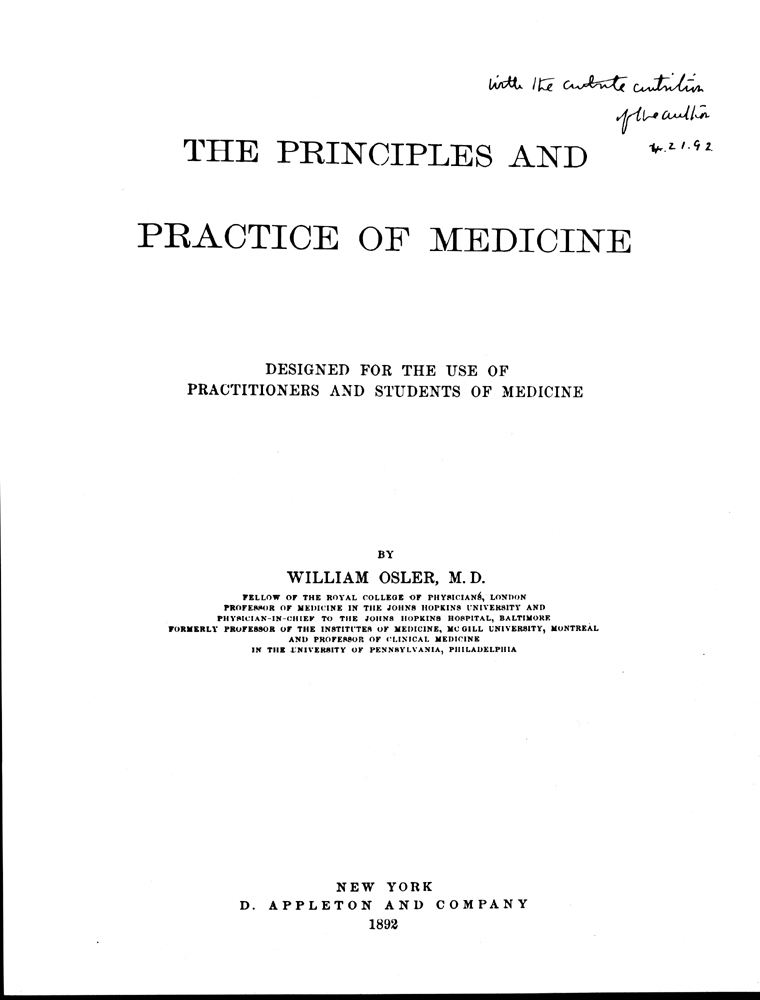
Here he is writing "The Principles and Practice of Medicine" |
This was the first time this was ever done, and it was a big hit. It was such a big hit that within a few years many medical school were transforming the way they taught medicine. No longer would physicians graduate from medical school when their only experience was from lectures, textbooks, and a few random patients.
Through all this time Osler continued to do what he loved best, and that was to study the human body by performing autopsies and reading books. He spent a ton of time in the morgue, laboratory and library. He likewise continued to write about what he learned through his experiments and observations.
During his career he wrote over 750 contributions to the medical world of literature, including a the first textbook of Internal medicine published in 1892: "The Principles and Practice of Medicine." While he didn't know it at the time, it would end up being the last medical book written by just one person.
Osler would continue his work until his death in 1919, yet not before he became a legend in his own time. His name was known by physicians throughout much of the world. The debate had already begun as to whether he was the greatest physician to ever have lived.
Click here for more asthma history.
- "Sir William Osler At Seventy -- A Retrospect," The Journal of the American medical Association," 1919, Saturday, July 12, pages 106-108
- Osler, William, "The Principles and Practice of Medicine," 1892, New York, pages 497-501
- Bliss, Micheal, "William Osler: A Life in Medicine," 1999, New York
Further readings:
- Jackson, Mark, "Asthma: The Biography," 2009, New York, pages 211-12
- Brenner, Barry E, ed., "Emergency Asthma," 1998, New York, pages 212-14