Showing posts with label ancient China. Show all posts

Friday, October 9, 2015

1281-1348: Xi defines asthma for China

InZhu Dan Xi (1281-1348)
The next person to make a significant impact on the "flow" of asthma wisdom through Ancient China was InZhu Dan Xi (also known as Zhu Zhenheng). 

He lived from 1281-1348 A.D, and was born to a medical family.  He believed his family received poor medical care when he was young, and therefore became determined to learn about medicine.  (1)

He believed over indulgence depleted the essence of yin and caused chronic diseases.  His most significant recommendation was temperance. (2)

He continued to describe diseases as an imbalance of the humors as was described in the Nei Ching some 2,000 years earlier, and as described in Ancient Egypt and Western Civilizations.

Xi is often regarded as the first Chinese physician to provide a modern description of asthma. He combined chuan and Xiao to come up with chuan xiao, which many historians believe is similar to the Western world's description of asthma. (3, page 41)


From this time on Chinese physicians believed Chuan xiao was caused by an imbalance of yin and yang, which are polar opposites, and "obstruction to the flow of Qi by phlegm in the airways, said asthma historian Mark Jackson.

Ma Huang continued to be a common therapy for the treatment of any respiratory ailments along with "Qi supporting" liquorice and gypsum decoction, "Yin syndrome asthma was treated with Yin Returning elixer."  (3, page 41)

Since Ma Huang was a much better bronchodilator than any western treatment for asthma, Chinese asthmatics had it at least a little better off than their contemporaries in the rest of the world, or so one might imagine.

References:  
  1. Beijing Medical Museum of TCM
  2. "Chu Tan-chi [Zhu Danxi/Zhu Zhenheng; 1280-1358 A.D.," Chinese Medicine History,  http://www.taijichinesemedicine.com/zhudanxi.htm
  3. Jackson, Mark, "Asthma: The Biography," 1998, New York, page 41
RT Cave Facebook Page
RT Cave on Twitter
Print Friendly and PDF

Monday, August 3, 2015

206-220 A.D.: Quack Chinese doctors kill people

Ma Huang (Ephedra) was a viable asthma remedy
if you trusted your physician enough
to gain access to it.
If you had asthma in Ancient China in the 3rd century A.D. you had access to some rational treatment for your asthma, most significantly Ma Huang, which was an asthma remedy discovered for the west at the beginning of the 19th century. It's a medicine almost as potent as epinephrine with the ability of quickly ending an asthma attack.

Yet chances are you were very hesitent to see a doctor. Some historians speculate, based on writings from the era, the Chinese feared physicians.

According to Plinio Prioreschi, in his 1991 book "A History of Medicine:
Little is known about the social position of physicians in the earlier times. We know that later, and throughout Chinese history, they were often the object of derision and scorn. In the Spring and Autumn Annals of the State of Lu (one of the feudal states in which Confucius was born in 551 B.C.), for example, we read: (Physicians) employed poisonous drugs to expel diseases, hence ancients despised and assigned them a low position in society.
Prioreschi listed many ancient proverbs that show the inferiority of doctors, such as:
  • Doctors cannot cure their own complaints. (Huai an Tsu)
  • What the doctor says is all right, but what he sells is false.(Proverb)
  • Quack doctors kill people (proverb)
  • Do not take medicine compounded by a doctor who is not backed by the experience of three generations.
  • Medicine does not kill; the physicians kill (Proverb)
  • To take no medicine is the best cure. (Proverb)
However, some debate that doctors were held to such a low status in China. Some believe these were just proverbs warning people to be careful, and not to seek medicine if they could resolve their medical problems on their own with household remedies that you trusted.

If you lived in Ancient China during the Han Dynasties of 206-220 A.D. you would have been wise to be wary of quack medicine, although you'd also be wise to seek a doctor who was knowledgeable of the medicine called Ma Huang. 

Hopefully you'd learn to find the plant yourself, to prepare it into a powder, and to mix it into a tea to drink when your asthma acted up.

Reference:
  1. Prioreschi, plinia, "A History of Medicine," volume I "Primitive and Ancient Medicine," 1991, The Edwin Mellen Press, New York, chapter II, pages 124-5

Sunday, August 2, 2015

150-219: The Chinese Sage of Medicine

Zhang at work
If you had asthma in China prior to the 3rd century A.D. your doctor may have recommend a remedy of drinking a bitter tasting tea made from dried stems of the Ma Huang plant.

This remedy made your breathing better, and your cough often subsided too. The trick was your physician would have to remember it and the formula to concoct it.

You see, there were few books with medical wisdom for your physician to reference. Most medical knowledge, especially regarding herbal remedies, were passed on from one generation to the next to anyone who wanted to learn about it.

This all changed around 220 A.D., and it all changed because of a war that caused a virus to strike the village of a man named Zang Zhong Jing (also known as Zhang Ji).

Legend has it he was 50 when two-thirds of his village died of a fever in a short span of ten years, and that inspired him to become an expert on ancient medical text, such as the Nei Ching  and the Hippocratic Corpus.


This resulted in him writing a medical book that helped shape Chinese medicine, and resulted in him becoming well known to the Chinese medical community by giving birth to Traditional Chinese Medicine. (1)

His book was called "Shanghan Zabing Lun" which translates in English to "Treatise on Cold Pathogenic and Miscellaneous Diseases."  It's a compilation of the medical wisdom from all those who lived before him.

Yet his book was lost in a war, and was not available until 1065 when the rulers of China saw a need for the wisdom contained in these old books and formed the Bureau for Collation of Medical Books of the Song Dynasty.  Wang Shu-He collected what he could of Zhang's writings and recompiled them into two books he called the "Shang Lun," which translates into "Treaties on Cold Induced Fevers."

The two books were:
  • Shan Han Lun (On Cold Damage), a compilation of herbal remedies to treat infectious diseases that cause a fever
  • Jinkui Yaolue (Essential Prescriptions of the Golden Coffer), which records his clinical experiences
These books describe methods of diagnosing, treating, and monitoring the effect of treatment. He recommended the importance of using the pulse not only to diagnose as Huang Ti recommended 1000 years earlier in his book "Nei Ching," but to monitor the course of treatment.

He was also the first to mention artificial respiration.  And he also recommended forcing water down a person's throat who attempted suicide by poisoning to bring up the poison, and this is a technique similar to what is used in hospitals today. (3)

Like Hippocrates, Zhung recommended against the practice of physicians taking advantage of patient  naivety for the purpose of making a profit.  He noted that some physicians concocted bogus formulas and sold them as viable remedies.  He berated this practice and encouraged good medical ethics.  

So his books were very helpful to Chinese physicians and their patients.  Yet of most importance were the formulas he calculated for collecting and concocting herbal remedies for many of the ailments of his day, especially those that are contagious and cause fevers like what wiped out his village.

One of the neatest things about Zhang's herbal formulas is that many are still used to this day, and many have even been proven by science to be effective remedies. This includes a description of asthma-like symptoms in Jinkui Yaolue and a formula for creating a remedy using Ma Huang. He described breathlessness or panting as chuan, and wheezing as xiao. (2)

His works have earned him the respect of Chinese Historians as one of the best physicians of all time, so much so that he's often referred to as the sage of medicine.  Actually some consider him to be a god, and others believe his existence was merely a legend.

While revered in China, his works also influenced and forever changed the way medicine was practiced in Japan, Korea, Vietnam and Mongolia. 

He's such a significant "legend" that his books continue to be required readings for any student of Traditional Chinese Medicine.  (4)

Considering this fame, little is known about his life, nor exact dates associated with his life.  It's estimated he lived from 150-219 A.D, yet many historians continue to debate these dates.

References:
  1. Selin, Helaine, ed., "Encyclopedia of the History of Science, Technology, and Medicine in Non-Western Cultures," 1997, Netherlands, page 893
  2. Jackson, Mark, "Asthma: The Biography," 1998, New York, page 41
  3. Selin, Op. Cit, page page 893
  4. "Chinese Herbal Formulas and Application," chapter 1, page 31

Saturday, May 23, 2015

331 B.C- 619 A.D..: The School of Alexandria

Figure 1 --Alexander the Great had a vision of creating
a great city, and compiling all the science and wisdom of
the world in one place.  He died before he was 32, thus
not living to see his dream come true. 
The evolution of medicine was slow moving through most of history.  One of the reasons for this was that it was illegal to touch a human corpse except in preparing it for burial or cremation.  This was one of the main reasons Galen's ignorant explanations of the human body were worshiped as the medical Bible for over a thousand years after his death.  This created a roadblock for learning about diseases like asthma and allergies.

This roadblock made it so it was nearly impossible for there to be any major advancements in medicine.  If someone learned something about the human body by dissecting, it was usually done by stealing a corpse from a graveyard, or from a prison, and performed illegally.  And the information learned was kept secret from a monarchy that might kill you, or at least throw you in prison, for learning something that opposed the view of the establishment. So even if something was learned, it was probably never published.  And if it was published, it was so posthumously. 

Thankfully, however, there were a few places scattered around the world where it was legal to perform autopsies.  It was at these places where physicians would flock to obtain medical knowledge, and patients would flock to get the best treatment.  Among the first such place was the great city of Alexandria in Egypt. (1)

Alexander the Great is considered one of the greatest military leaders of all time.  Born in 356 B.C. in Macedonia, a city just north of Greece (Macedonia was not a city-state like Athens and Sparta).  He spent his childhood watching his father, Phillip II, build Greece into a great military power, winning battle after battle. (1)

When he was 13 Aristotle was hired to be his personal tutor.  Like other Greeks, he learned about science, medicine, and philosophy.  (1) Aristotle taught him to read and speak Greek, and taught him to respect philosophy the way the Greeks did.  He loved Greece, it's gods, it's history, and he dreamed of teaching it's culture to people all over the world. (2)

Figure 2 -- A rendering of Ancient Alexandria.  The lighthouse
you see depicted here was one of the seven wonders of the
ancient world.  This was one of the most beautiful cities ever.
His father, Phillip, conquered most of the Greek city-states, and when his father died, Alexander went on to conquer many nations, including Egypt.  As he did in other places he conquered, he championed Greek culture.

As noted by historian John Watson:  "The rapid extension of Grecian arms under Alexander the Great, lead to the diffusion of taste and learning among the surrounding nations.  Pergamus and the new capital of Egypt (Alexandria), became points of scientific attraction second only to Athens; and with the spread of general knowledge, the study of medicine extended to these cities."  (4, page 74)

The Asclepion of Pergamus was surrounded with architecturally amazing structures that "were occupied as places of public instruction and scientific intercourse. Here the orators, sophists, and philosophers of the city held their daily conferences, and sometimes amused themselves in expounding to the sick the vaticinations of the priests. As a school of medicine, the Asclepion of Pergamus enjoyed a long continued celebrity." (4, page 74)

Alexander died in 323 B.C. of a mysterious illness in the palace of Nebuchadrezzar II of Babylon.  He was only one month shy of his 32nd birthday.  At this time the Egyptian portion of Alexander's empire was given to Ptolomy Soter (367-282 B.C.), the brother of Alexander. 

Figure 3 -- The library of Alexandria was one of the largest libraries
in the ancient world.  Physicians came from all over the world
to study here.  Unfortunately it was destroyed by barbarians.
Can you just imagine if this was never destroyed?  Perhaps medical
knowledge would have been advanced faster, and there would be
better asthma and allergy knowledge today, and maybe even better
medicine, or a cure.  If I could go back in time, I'd want to go to the
City of Alexandria during its glory days and peruse ancient writings
Like Alexander, Ptolomy loved arts and sciences, and he formed the great library of Alexandria, and he placed Aristotle in charge of it.  (3, page 33) The flow of knowledge through this city was so abundant its great library "rendered Alexandria the great repository of science and wisdom." Some estimate that by the reign of Ptolomy Philadelphus (36-29 B.C.) the library had accumulated a collection "about two hundred thousand rolls of papyrus, equal to about ten thousand of our modern printed volumes." (4, page 79)
Ptolomy also started Museum of College of Philosophy, or the school of Alexandria, in 331 B.C., which was described best by John Watson in 1856:
It's chief apartment was a lecture room and place of general concourse.  Around the main building, on the outside, was a covered walk or portico.  And connected with it was an Exhedra, in which the philosophers sometimes sat in the open air... This noble institution was originally designed to serve in part as a school for the training of  youth in the higher walks of learning, and in part as a retreat within which men of genius and acquirements, free from the necessary and providing for their daily wants, might have leisure and opportunity, each in his own way, for extending the domain of science, or for increasing the enjoyments of improving the condition of their fellow beings. (4, pages 77-8)
Figure 4 -- Ptolomy
By the time of Ptolomy Philadelphus, the school "had already risen to the highest rank among the Greek schools. (4, page 79)

One of the main reasons for this was that for the first time in the ancient world, dissection was legal in Alexandria.  This was significant, because religion made even touching a human corpse illegal in Ancient Egypt, Greece and Rome.  Now, for the first time in history, the human body could be studied, and it was.  In this way Aristotle was able to describe the insides of the human body by actual dissection. (3, page 33)  

The school was also a place for public lectures and readings, which were very important in Alexandria, as in all ancient civilizations.  This was because books were expensive and few could read.  Great minds would orally educate about the common wisdom of the day, and readers, or orators, would "familiarize" people with the writings of Homer and other great authors of the day. (4, page 82) Watson explained:
Among the Greeks this had been the common mode of enlightening the people, of amusing them, and of molding their opinion.  Most of the poetry, and much of the written history of the nation, were prepared for public recitation.
Placed in charge of medicine at the school were Erasistratus and Herophilus.

Erasistratus (304-250 B.C.) was from the Isle of Chios, and was the grandson of Aristotle.  He was the founder of the school of anatomy at the school of Alexandria, performing many autopsies.  Herophilus (335-280 B.C.) was a native of Chalcedon and was educated at the school of Cos. He also performed many autopsies at the school. (4, page 85

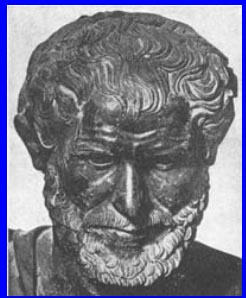
Figure 5 -- Aristotle
Along with Aristotle, they both made stunning observations from their inspections of the internals of the human body, and postulated various hypothesis based on these observations.  For instance, Erasistratus discovered that the trachea was a passageway for air (pneuma) to the lungs, and he discovered veins and arteries both originate from the heart.  Only he, like Aristotle,  believed the arteries were filled with air not blood, and hence the name 'arteries.'  And the passage of pneuma from the veins to arteries was the cause of disease(3, page 35-6, 4, page 86))

He disregarded the four humors of Hippocrates and the four elements of Empedocles, and instead postulated that fevers were caused by inflammation.  He was not a believer in purgatives and most medicine, and instead preferred a good diet and gymnastics.  Some believe he was the first to recommend exercise as a means to stay healthy and for healing.  (4, page 86)

Herophilus was among the "first of the Hippocratic school to distinguish himself as an atomist."  He was the first to use the pulse as an "index of varying conditions of health and disease."(4, page 84)

He properly attributed the pulsations of the arteries to the heart. 


Figure 6 -- Herophilus
Of interest is that Herophilus was charged with opening "the bodies of living criminals, to discover the secret springs of life."  (3, page 35)

Unlike Erasistratus, he was a believer in the hypothesis that imbalances of the four humors cause most diseases.  (4, page 85)

He revered Hippocrates to the point that "when obliged to contradict him he always avoided mentioning his name."   Also, unlike his counterpart, he placed a "high value on drugs, which he called, 'the hands of the gods,' and used them in great variety.  (5, page 62-3)

Erasistratus was an empiracist.  Herophilus was a rationalist. In this way, "the same rivalry which existed in Greece between Cos and Cnidos arose also between Alexandria and Pergamus, in which later place Galen was born, and Aesculapius was held in great respect as one of its most celebrated divinities."  (3, page 36-37)

Regardless, anyone who wanted to be a physician in the ancient world was eager to learn at the school of medicine in Alexandria, as "to have studied medicine at Alexandria, was everywhere considered a passport to the confidence and patronage of the public."  (4, page 92)

The school continued "its celebrity as a seat of learning and as a school of medicine, until it was taken by Saracens in 638 of the Christian era."  (3, page 36)

Figure 7 -- 1532 woodcut showing Herophilus (L) and Erasistratus (R)
Alexandria would fall in 619 A.D., and that ended whatever medical wisdom came out of it.  Many of it's wonders were destroyed by barbarians, including it amazing library.  As the library went up in flames, so to did all medical wisdom except for random scrolls scattered here and there.  (6, page 150-2) (7, page 28)

Until the  School of Salerno was established in the 10th century, there were no known autopsies performed, and medicine was left in limbo, or what historians like to refer to as the dark ages of medicine.  (6, page 150-2) (7, page 28)

References:
  1. "Alexander the Great Alexander of Macedon Biography: King of Macedonia and Conqueror of the Persian," historyofmacedonia.org, http://www.historyofmacedonia.org/AncientMacedonia/AlexandertheGreat.html
  2. "Alexander the Great: Ancient Greece for kids," mrdonn.org, http://greece.mrdonn.org/alexander.html
  3. Meryon, Edward, "History of Medicine: comprising a narrative of its progress from the earliest ages to the present and of the delusions incidental to its advance from empericism to the dignity of a science," volume I, London, 1861,
  4. Watson, John, "The medical profession in ancient times," 1856, Baker and Godwin, New York
  5. Withington, Edward Theodore, "Medical history from the earliest times,"
  6. Garrison, Fielding Hudson, "An introduction to the history of medicine," 1922, Philadelphia, W.B. Saunders Company
  7. The John Hopkins Hospital bulleton," (volume XV 1904), "From the epoch of the Alexandria School (300 B.C.)"
RT Cave Facebook Page
RT Cave on Twitter

Print Friendly and PDF

Saturday, April 11, 2015

1500 B.C.: Asthma in Ancien Egypt: the Ebers Papyri

Thoth: Scribe of the Gods ( The British Museum)
Thoth was the Egyptian moon god, and he had a significant role in medicine that was eerily similar to that of Apollo a thousand years later in ancient Greece

It is believed he talked to an Egyptian priest (or priests) during the early ages of Egypt, and this priest (Imhotep perhaps?) wrote down the wisdom he learned from the god. There are various references to these documents by various physicians, although the original texts have long disappeared. (2, page 19)(4, page 49)

However, this theory, while garnishing some excitement, was ultimately believed to be untrue, as experts now figure the document to be an encyclopedia of all sorts of medical wisdom from various ancient documents. (9, page xv)

Smith Quotes Warren R. Dawson from his 1929 book "Magician and Leech" as saying the Ebers Papyrus is basically a compilation of recipes for the various ailments of that time taken from various other books that are "many centuries older."  (9, page xv)

Dawson, referencing Smith, said the Ebers Papyrus... (9, page xv)
"...is not a book in the proper sense of the word: it is a miscellaneous collection of extracts and jottings collected from at least forty different sources. It consists mainly of a large collection of prescriptions for a number of named ailments, specifying the names of the drugs, the quantities of each, and the method of administration." (9, page xv)
As noted above, a few sections deal with diagnosis, symptoms and anatomy. (9, page xv)

This theory may be supported by the fact the papyrus has scribbles in the margins, such as "this is a genuine remedy," or "Excellent. I have often made it, and also proved it," said medical historian Edward Withington. (2, page 17) 

Perhaps notes similar to these were scribbled next to the description of our first inhaler:
Thou shalt fetch 7 stones and heat them by the fire, thou shalt take one therof and place (a little) of these remedies on it and cover it with a new vessel whose bottom is perforated and place a stalk of a reed in this hole; thou shalt put thy mouth to this stalk, so that thou inhalest the smoke of it. Likewise wit all stones. Thereafter thou shalt eat something fat, of fat meat or oil." (6, page 9)
It is unclear exactly what herbal preparations were used, although it's probable that they used stramonium, belladona, henbane, and bitumen to "alleviate catarrh and coughs, and ease breathing," said Mark Jackson in his article, "'Divine Stramonium': The Rise and Fall of Smoking for Asthma." (14, page 174)

One major difficulty with interpreting these old documents, or so the experts say, was that it may sometimes be difficult to translate Egyptian writing into our modern language. This in mind, I think, therefore, I can honestly say there is scanty evidence this Egyptian "inhaler" was used for anything more than a priest-physicians's trick to fool a patient into thinking something was being done, perhaps by the magic of the gods.

Henry Sigerist, in his 1951 book "A History of Medicine: Primitive and Archaic Medicine," said that "Fumigations were not infrequently used in the treatment of anus and vagina and a recipe of the Berlin Papyrus (and Ebers Papyrus) tells us what the technique was. Seven bricks were heated, and the cold drug was poured over one after another while the patient was held over the developing fumes."

My point here is we must be careful in thinking any inhalers or fumigations used by the ancient Egyptians were anything more than just something that was not understood being used for an ailment that was not understood. 

Jackson said:
While (Eber's) specific interpretation has been challenged by other translators, the papyrus certainly appears to list remedies to remove phlegm, alleviate catarrh, coryza, and coughs, and to ease breathing. Significantly, Egyptian treatments for respiratory conditions included not only the oral consumption of a variety of concocted vegetable, mineral, and animal products but also the delivery of active substances directly to the lungs by inhalation. (13, page 38)
So, as you can see, we could easily use our imaginations here as it comes to the treatment of asthma in ancient Egypt. You are short of breath, you call for a priest/physician, and a specialist comes to your house. You hope he's an Internist who specializes in diseases of the chest, and you hope he has knowledge to this primitive inhaler, and that he also has a medicine called Belladonna that he tosses on those heated bricks. Belladonna would take the edge off by easing both your breathing and your mind.

Sigerist said the teeth, where food enters, and the anus, where food exits, were highly regarded by the ancient Egyptians. Sigerist even notes various references to "the holy anus," and "shepherd of the Anus." (5, page 317, 335)

These shepherds were probably physicians who specialized in ailments of the anus, such as "hemorrhoids, prolapsus recti, inflammation and pruritus of the anus." (5, page 317, 335)

The pharaoh had his very own anal physician to take care of it, and perhaps this physician recommended this inhaler for hemorrhoids, a remedy we might think of as purely irrational, although to the Egyptians, it was most surely rational. (5, page 317, 335)

We must realize that Egyptian physicians had scanty knowledge of anatomy, and this is true despite the fact they prepared animals for food and sacrifice, and humans for mummification. They knew about the inner organs, and they knew about vessels and blood, but they didn't know about the relationship with these and ailments of the body. They did not make that connection.

So they would have no idea about diseases like asthma, nor other diseases that would make a person short of breath. Basically, all physicians could do was note the symptoms -- chest pain, short of breath, wheezing -- and what remedies seemed to work.

Likewise, it must be understood here that Egyptian medicine was based on mythology, and ailments were caused by the wrath of gods, particularly the god Isis. So remedies, in a sense, were believed to be gifts from the gods of health and healing, such as Isis, Thoth, Sekhmet, Heka, Serket, and Ta-Bitjet. They worked by magical means. So while these remedies may seem irrational to the modern reader, they were quite rational given the medical wisdom of the time.

Once translated, the Ebers Papyrus scroll was learned to contain over 700 magical formulas as remedies for the most common ailments of that time, with various incantations randomly assorted through the text. Some of the remedies included pills in the form of dough, herbs and minerals that were put into beer and wine, salves and oils to rub onto the skin and wounds, a salve made from honey was put over wounds, and gargles and inhalations.

If you had complained of an ailment, a physicians would be summoned. Egyptian physicians specialized in particular symptoms, so you would see a physician who specialized in treating your symptoms. If your specialist was an internist, perhaps you would be provided with the remedy above, which may actually contain breathing relief, considering Belladonna was later proven to contain a mild bronchodilator component.

Yet, more than likely, your treatment would be a general treatment. Since the Egyptians were among the first society to attribute sickness to good health, he might suggest something simple to cleanse your body, which may involve any of the following:
  • Enemas (the stomach was believed to be a cause of most diseases, including breathing problems)
  • Emetics (to vomit out the poisons)
  • Animal excreta (including crocodile and camel)
  • Herbs such as squill and henbane
  • Fumes of burned sundried and crushed Belladonna leaves and roots (as noted above)
  • Eating foods such as figs , grapes, frankincense, cumin and juniper fruit
  • Drinking wine and sweet beer 
Along with the above treatments, the following were considered routine in order to keep your body clean: (11, page 18, 23)
  • Daily baths
  • Abstinence from certain foods (like cow flesh, pigs, flatulent beans, etc.)**
  • Gymnastics
  • Linen clothing worn for cleanliness
  • Purgatives and emetics every three months to cleans body***
  • Friction and inunction of the body (basically involves rubbing certain parts of the body)
  • Fumigations (usually during epidemics to "purify the air."  
  • Inhaling steam from inhalations 
  • Careful system of nurturing from childhood
  • Incantations (magic words)
  • Amulets (to wear or keep close to you and or your home to ward off spirits and for healing)
Or, if your asthma-like symptoms were diagnosed as being caused by witchcraft, the following remedy may be used:
"Against all kinds of witchcraft -- a large beetle; cut off his head and wings, boil him, put him in oil, and apply to the part. Then cook his head and wings, put them in serpent's fat, warm it, let the patient drink it." (2, page 18)
If your physician didn't heal you, you might consult a priest or magician who would provide you with an amulet or incantation to say each morning. Or he might place his gentle palm over your throat or chest and chant an incantation to induce healing and scare away the evil demons that were causing you to breathe heavy. Perhaps the good feeling of hope by this method was more healing to you than what your physician might recommend.

Another neat thing to note here is that by dating the Ebers Papyrus to around 1500 or 1550 B.C., this would place it as being written about the time of the Exodus. That means it was probably written around the time Moses walked the earth, and the wisdom it contained was available to him. So the Bible may provide us with another good source for learning what life was like for Asthmatics in Ancient Egypt.

Further reading:
*Hieratic is a form of Egyptian cursive, and was used "chiefly on sacred and medical papyri and on wooden coffins... the characters are written from right to left... about 300 A.D. all knowledge of the meaning of the characters had died out, and it was not until the discovery in 1799 of the Rosetta stone (by Boussard, a French artillery officer) that any real progress was made in the decipherment." (10)

** Note that the upper classes of Egypt did not eat pig, and despite this, historians note a high incidence of hardened arteries.  One study of Egyptian mummies found hardened arteries in three fourth of the mummies studied.  While this was a recent study, some historians noted this as far back as the 1930s. You can read more about this here

***While many historians have noted the Egyptians to drink to excess, others speculate, that while beer and wine was consumed during meals (and mostly wine), it was watered down and not very potent.   

 References: 
  1. Selin, H., "Encyclopedia of the History of Science, Technology and Medicine in Western Cultures," 2nd edition, 2008, Springer
  2. Withington, Edward Theodor, "Medical History from its earliest times," 1894, London, Aberdeen University Press
  3. Nunn, John F, "Ancient Egyptian Medicine," 1996, University of Oklahoma Press
  4. Garrison, Fielding Hudson, "An introduction to the history of medicine," 1922, Philadelphia and London, W.B. Saunders Company
  5. Sigerist, Henry E, "A History of Medicine," vol II, "Primitive and Archaic Medicine," 1951, New York, Oxford University Press
  6. Ebell, B.,  translator, "The Papyrus Ebers: The Grea)test Egyptian Medical Document," 1937, Copenhagan, page 67.  I found references to this passage by Mark Jackson (Asthma: A biography," 2009, New York, Oxford University Press, page 39), and Henry E. Sigerist (see reference immediadely above, page 339).  Sigerist says that a similar passage can also be found in the Berlin Papyrus.  
  7. Reference Pending
  8. Osler, William Henry, "The evolution of modern medicine," 1921, New Haven, Yale University Press
  9. Smith, G. Elliot, introduction to Cyril, Bryan,s book, "The Papyrus Ebers," 1930, London, The Garden City Press, Bryan's book was an English translation of the German translation of the papyrus. 
  10. Von Klein, Carl H., "The Medical Features of the Papyrus Ebers," The Journal of the American Medical Association, December 23, 1905, Volume 45, page 1928, George H. Simmons, editor, volume XLV, July - December, 1905, Chicago, American Medical Association Press.  This article provides a fuller story of how the document ended up in the hands of Georg Ebers, how it came to existence, etc.  
  11. Baas, Johann Herman, author, Henry Ebenezer Sanderson, translator, "Outlines of the history of medicine and the medical profession," 1889, New York
  12. Libby, Walter, "The history of medicine in its salient features," 1922, Boston and New York, Houghton Mifflin Commpany
  13. Jackson, Mark, Asthma: A biography," 2009, New York, Oxford University Press
  14. Jackson, Mark, "'Divine Stramonium': The Rise and Fall of Smoking for Asthma," Medical History, 2010, 54: 171-194
  15. "Medicine in Ancient Egypt," Indiana.edu, http://www.indiana.edu/~ancmed/egypt.HTM, accessed on 6/5/14

Saturday, November 29, 2014

2838: Chinese discover worlds best asthma remedy

While Nei Ching is the oldest known recorded Chinese medical treaties, Shen Nung, who lived from 2838-2698 B.C., is often considered as the founder of Chinese Medicine as well as the "Fire Emperor."  (1) 


Shen Nung (2838-2698)
Shen Nung created the Pen Ts'ao, or "Divine Husbandman's Materia Medica."  It's basically a pharmacopoeia describing how to create remedies from drugs and plants to treat various diseases. He was the first to mention using the plant Ma Huang for treating respiratory disorders.

The leaves and/ or stems of the Ma Huang plant were dried prepared in such a way that it was served as a drink, often as a bitter tasting tea. Nung believed Ma Huang worked by reversing the flow of Qi.

Leaves of the plant were crushed and served in a bitter tasting yellow tea.

Western medicine reached China early in the 17th century. But, another 300 years would go by before ephedrine was discovered by the modern world. (2).

We might fairly assume that the Chinese had the best asthma remedy in the ancient world. It was taken by mouth and offered quick breathing relief.

So, while Ancient Chinese asthmatics obtained quick asthma relief by using ephedra, the rest of the world (except for maybe Japan and Korea) would have to wait.

References:
  1. Saunders, M, J.B. Dec, "Huang Ti Nei Ching Su Wen -- The Yellow Emperor's Classic of Internal Mediciner,"  Calif Med1967 July; 107(1): 125–126
  2. Veith, Ilza, author /translator, "The Yellow Emperor's Classic of Internal Medicine," 2002, Los Angeles, pages 4-6
  3. Ibid, page 97-8
  4. Ibid, pages pages 98 and 10-14
  5. "Qi Theory,  damo-qigong.net,  http://damo-qigong.net/qi-theory1.htm
  6. Ibid, http://damo-qigong.net/qi-theory.htm
  7. Veith, op cit, pages 49 and 50
  8. Veith, op cit, pages 57-8, also see chapter 26 beginning on page 217
  9. Navara, Tova, "The Encyclopedia of Asthma and Respiratory Disorders," 2003, New York, page 177
  10. Veith, op cit, page 1
References:
  1. Navara, Tova, "The Encyclopedia of Asthma and Respiratory Disorders," 2003, New York, page 177
  2. Veith, Ilza, author /translator, "The Yellow Emperor's Classic of Internal Medicine," 2002, Los Angeles, pages 4-6

2697 B.C.: The oldest description of asthma (sort of)

The oldest recorded medical document is the Nei Ching Su Wen (Classics on Internal Medicine) which was written about 2697 B.C. by the Yellow Emperor Huang Ti or, according to some sources, by sometime around 1000 B.C. and attributed to Huang Ti to give the document more value.

The document mainly consists of dialogue between Huang Ti and his physician Ch'i Pai. Whether Ti truly existed or was a work of legend is still debated to this day.
While diseases weren't mentioned in the Nei Ching, there were definitely several references to breathing disorders. One such example can be found in chapter 34, or final chapter of the document. The discussion between Ti and Pai went like this:
The Yellow Emperor said: " Man is afflicted when he cannot rest and when his breathing has a sound (is noisy) -- or when he cannot rest and his breathing is without any sound. He may rise and rest (his habits of life may be) as of old and his breathing is noisy; he may have his rest and his exercise and his breathing is troubled (wheezing, panting); or he may not get any rest and be unable to walk about and his breathing is troubled. There are those who do not get a rest and those who rest and yet have troubled breathing. is all this caused by the viscera? I desire to hear about their causes."
Ch'i Po answered: "Those who do not rest and whose breathing is noisy have disorders in the region of Yang Ming (the 'sunlight'). The Yang of the foot in descending causes the present disturbance and is ascending it causes the breathing to be noisy. The pulse of the stomach is located in the region of the 'sunlight'. The stomach is the ocean of the five viscera. If the breath (of the stomach) does not function there is a disorder in (the region of) the 'sunlight' and it cannot follow its course; the consequence is inability to rest. In ancient classics it is said: 'If there is no harmony within the stomach, there is no peace (contentment, comfort, ease).
"Hence if the habits of life are as usual and the breathing is noisy, then the veins of the lungs are in disorder. The vessels are not in harmony with the main vessels which ascend and descend. Hence the main vessels are restrained and cannot function, and the man suffers from a disease of the veins.
"If, however, the habits of life are as usual and breathing is noisy; and if one cannot rest, or if one rests there is troubled breathing, then something has temporary residence in the breath; water follows the saliva and moves. The water of the kidneys influences the saliva, disturbs the rest, and causes the troubled breathing."
The Emperor said: "Excellent!"
Now, if that's not a line a B.S. I don't know what is, but it was a legitimate theory regarding medicine in Ancient China.  It was based on this that breathing disorders, like asthma, were diagnosed and treated. To the health experts living at the time this explanation was completely rational.

Reference:
  1. Veith, Ilza, "The Yellow Emperor's Classic of Internal Medicine," Los Angeles, 2002, page 252-3 (Veith wrote the introduction and translated for us the Nei Ching as written by Huang Ti, the Yellow Emperor.)