Wednesday, May 25, 2016

1879: Asthma cigarettes become a craze

Figure 7 -- Potter's Patient Inhaler (funnel device) (3)
By the mid 19th century the market for inhaling ingredients and powders grew steadily. Some pharmacists gathered the ingredients and sold them to individuals. Some tossed powders on plates and ignited it to inhale fumes. Some stuffed it into homemade pipes and others rolled it into cigarettes

Some pharmacists gathered the ingredients and further prepared them into powders to be further prepared by the patient.  Some pharmacists went a step further and rolled the powder into cigarettes that could be purchased in packs.  So there were a variety of options.

By 1879 an asthma cigarette craze struck America and Europe. (1)

More and more companies entered the market in an attempt to benefit off the plight of asthmatics.

Belladonna, stramonium, lobelia, henbane, atropine, and even cannabis were packaged in cans and placed on shelves in pharmacies.

The products were marketed for just about any respiratory condition, including asthma, chronic bronchitis, whooping cough, cholera, croup, catarrh, and hay fever.

By the 1880s technology progressed so some companies pre-rolled cigarettes, packaged them, and sold their product at pharmacies.

Asthma cigarettes from a variety of companies could be found on pharmacy shelves like the A.H. Lyman Company, a privately owned pharmacy on River Street in Manistee, Michigan.  When the business closed during the 1950s, the building and all its contents were donated to the Manistee Historical Society, and since turned into a museum.

Among the contents of the pharmacy, the shelves of which are still intact and filled with antique prescriptions, is a box of asthma cigarettes.

According the Mark Sanders at inhalatorium.com, the most famous brands were:
Figure 8 -- Potter's Asthma Cigarettes (3)
  • Schiffmann’s 
  • Asthmador
  • Blosser’s
  • Potter’s 
  • Marshall’s
  • Kinsman’ 
  • Dr Guild’s green   Mountain
  • Kellogg’s  
  • Page’s
  • Regesan’s
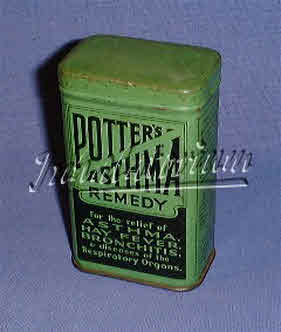
In my studies the brand I've come across most often was Potter's Asthma Cigarettes, which you can see in the picture to the right or by clicking over to inhalatorium.com.  This was among the most popular brands in Britain.

Figure 9 -- Potter's Asthma Pills (3)
The main ingredient in Potter's cigarettes were stramonium, belladonna and atropine.  Mark Sanders over at Inhalatorium.com notes that Potter's also had a variety of asthma remedies that included cigarettes, incense, pills and powders to be inhaled by Potter's funnel device (see figures 7, 8 and 9)

An asthmatic patient of mine who grew up in 1950s in Manistee, Michigan said she remembered her dad smoking cigarettes from a green package.  We later figured the produce was probalby Dr. Schiffmann's Asthmador Cigarettes.

References:
  1. "The Scarcity of Cubebs," The Chemist and Druggist," 1887, Feb. 26, page 268 of  Chemist and Druggist: A Weekly Trade Journal, 1887, Vol. XXX, January to June 1887
  2. Sanders, Mark, inhalatorium.com, http://inhalatorium.com/index.html, accessed on various dates
  3. Picture used with permission from Inhalatorium.com
  4. Jackson, Mark, "'Divine Stramonium': The Rise and Fall of Smoking for Asthma,"  Med Hist., 2010 April; 54(2): 171–194.
RT Cave Facebook Page
RT Cave on Twitter
Print Friendly and PDF

Monday, May 23, 2016

1805: American Indians smoked asthma weed

American Indians smoked dried herbs stuffed into pipes too.  Now, did they get this wisdom from travelers from far off lands, or did they come up with the idea on their own?  No one knows for sure, and either theory is a possibility.
Figure 5 -- Kellog's Asthma Relief
contained both lobelia and strammonium (2)

Either way, American Indians had access to another member of the nightshade family called lobelia inflata.  Various people experimented and observed it's effects when ingested and inhaled, and soon it was learned of the hallucinogenic effect.

At first it must have been tossed into fires, later on heated bricks or in pots, and ultimately the herbs were stuffed into pipes and smoked, just as they were in ancient India, and probably Egypt and Mesopotamia before that.

While American Indians mostly smoked their pipes for the hallucinogenic effect, or to benefit other ailments, the medicine was, at some point, recommended for asthma-like symptoms too. It is for this reason that Indian Hemp is often referred to as Indian Tobacco or Asthma Weed.

American physicians were introduced to lobelia and used it for asthma releif, yet they also used it to make some patients vomit.  The idea here was that along with vomit, toxins would be removed from the body to balance the humors and cure the ailment.

For this reason it was often referred to as pukeweed and vomitwort.  (1)

References:
  1.  University of Maryland Medical Center, "Lobelia,"  http://www.umm.edu/altmed/articles/lobelia-000264.ht
  2. Picture used with permission from Inhalatorium.com
  3. Jackson, Mark, "'Divine Stramonium': The Rise and Fall of Smoking for Asthma,"  Med Hist., 2010 April; 54(2): 171–194.
RT Cave Facebook Page
RT Cave on Twitter
Print Friendly and PDF

Friday, May 20, 2016

1802: James Anderson discovers asthma cigarettes

figure 5 --Kellogg's Asthma Cigarettes (4)
A long time passed before British physician and asthmatic James Anderson visited India and enjoyed the mild breathing relief he obtained after smoking a cigarette containing datura strammonium.  The year was 1802.  (1)

Anderson returned to England and reported his find to his friend Dr. Sims in Edinbergh.  Sims trialed it, noted the benefits, and published a report in the Edinbrugh Medical and Surgican Journal. (2) (3, page 55)

After this report asthma cigarettes were entered into British and American pharmacopoeia, and ultimately became popular for the treatment of asthma in these western nations.  (2) (3 page 55)

Of course it also should be noted here that there were no standards or regulations regarding dosing in those days, and no recommendations as to how much of a medicine should be consumed, or in this case inhaled.  (3, page 55)

Perhaps for this reason, Dr Sims reportedly died a year after his report from an apparent overdosing of Belladonna.  (3, page 55)

References:
  1. Sneader, Walter, "Drug discovery: a history, 2005, England,
  2. Sneader, ibid
  3. Smyth, Hugh D.C, Anthony J. Hickey, "Controlled Pulmonary Drug Delivery," 2100, Springer New York Dordrecht Heidelberg London
  4. Picture used with permission from Inhalatorium.com
  5. Jackson, Mark, "'Divine Stramonium': The Rise and Fall of Smoking for Asthma,"  Med Hist., 2010 April; 54(2): 171–194.
RT Cave Facebook Page
RT Cave on Twitter
Print Friendly and PDF

Wednesday, May 18, 2016

100 A.D.: Pipes made inhaling herbal remedies easy

Figure 4 --Ad for Schiffmann's Asthma Cure (1899) (3)
Again, it's impossible to know who carved out, let alone smoked, the first pipes.  It's also impossible to know for whom the first pipe was carved for, nor what herbs were stuffed inside them.

It's possible the idea of using a sharp tool to hollow out a piece of wood for smoking herbs may have occurred to various inventors in various societies at different times.  The component smoked depended on what herbs were available.

For example, in India the incentive to carve out pipes was to smoke strammonium, belladonna, or Indian hemp for it's hallucinogenic effect. The fact the herb had other medicinal properties may have been learned later, or earlier.  Who knows?

Either way, inhaling smoke directly from a pipe would have allowed direct inhalation of the smoke, resulting in a greater effect. It would also have improved convenience, meaning that herbs could be smoked anywhere and anytime.

What we know for sure is the first medicinal use of pipes to smoke a medicine for asthma-like symptoms was recorded in ancient India around 100 A.D.  There were many herbs the Indians had access to, and one such was datura strammonium. (1)

The herb produces an unpleasant smell and grows to be about five feet tall with a pale green stem with spreading branches and puplish leaves coarsely sedated along the edges.  Its flowers are white or purple.  (1)

By empirical means its entertaining effect was learned, as well as its poisonous qualities when too much was inhaled or ingested, which mainly included hallucinogenic effects.  At times it must have been observed the medicine made you mad, which may explain the name.

Datura comes from the ancient Hindu word for plant, dhatura.  Stramonium is a New Latin word meaning thornapple.  Strammonium originally came from the Greek word strychnos which means nighshade and mankos meaning "mad."  (2)

Other than thornapple, common names I've found during my research that refer to strammonium are jimsonweed, Jamestown weed, drowny thornapple, Devil's trumpet, angel's trumpet, mad apple, stink weed and tolguacha.  It was obvious by these names the side effects of inhaling too much was well known

Like belladonna, the leaves, stems and roots were dried and crushed into a fine powder the Indians stuffed into their pipes and smoked it.  The benefits obtained must have been of higher quality than simply inhaling fumes from igniting the herbs on bricks.  Although either technique may have been used, depending on what the patient had access to.

Obviously the herb may have been used for entertainment, although medicine men and physicians ultimately learned of the medicinal benefits.  By 100 A.D. Indian physicians recommended smoking  strammonium for diseases of the lungs and throat, or simply for its hallucinogenic effect.  Again, the hallucinogenic effect may be desired when no other remedy was applicable

The famous Greek physician Hippocrates wrote about stramonium and belladonna, so we know Greek physicians had access to such wisdom.  With the fall of Cordova Greek medicine made its way to Rome, so we know the Romans had access to it too.   With the fall of Rome all such knowledge was lost for over a thousand years in Europe. 

Although, shortly thereafter, all medical wisdom made its way to the Arabia, where medicine, including including the inhalation of herbs, was saved for mankind. 

References:
  1. "Plants poisonous to livestock," Cornell University's Department of Animal Science,  http://www.ansci.cornell.edu/plants/jimsonweed/jimsonweed.html
  2. "Plants poisonous to livestock," ibid
  3. Picture used with permission from Inhalatorium.comJackson, Mark, "'Divine Stramonium': The Rise and Fall of Smoking for Asthma,"  Med Hist., 2010 April; 54(2): 171–194.
  4. Jackson, Mark, "'Divine Stramonium': The Rise and Fall of Smoking for Asthma," Med Hist., 2010 April; 54(2): 171–194.
RT Cave on Twitter
Print Friendly and PDF

Monday, May 16, 2016

4000 B.C: Inhaling herbs was a great asthma remedy

Figure 1 -- Elliot's Asthma Cigarettes*
Growing up with hardluck asthma, I knew darn well the danger of tobacco smoke, or any other kind of smoke for that matter. So you can understand my amazement when I discovered asthmatics used to inhale smoke intentionally.

I made this discovery during a visit the Manistee County Historical Museum in Manistee, Michigan.  The museum is housed in the old A.H. Lyman Company building, which was a pharmacy until the mid 1950s when the building was donated.  In the back the old pharmacy shelves classic medicines.  On the box of one of these boxes was written: "Elliotts Asthma Cigarettes."  What I saw was similar to what you see figure 1.

Figure 2 -- Potter's Asthma Remedy
Photo by permission from inhalatorium.com (1)
My interest was piqued by this sight.  I thought:
If smoking was supposed to be so bad for asthma, why would any doctor recommend smoking for asthma?
I asked the museum curator if this was really a remedy for asthma, and he said that it was.  He said it was very common remedy during most of the 19th century.

It would be many years before I further investigated this, yet I never forgot about those asthma cigarettes.  My quest began in 2010, and it didn't take me long to find a ton of articles and advertisements in old newspapers and magazines and books about asthma cigarettes.

I learned that the cigarettes didn't contain tobacco, but crushed and dried herbs from the nightshade family of plants called solanaceae, which included datura strammonium, atropa belladonna, the hyoscyamus niger, Lobelia inflata and similar herbs such as Indian Hemp and Cannabis.

Such herbs contained an alkaloid called Atropine that caused mild bronchodilation, and in this way eased breathing.  The medicine also had a slight halucinogenic effect, and in this way took the edge off the feeling of air hunger by easing the mind.

So, while we think of cigarettes as hazardous, for most of history they were actually perceived as beneficial. This was, in fact, essentially the only way of inhaling medicine to obtain the greatest effect.

Figure 3 --
Kinsman's Asthma Cigarettes
(2)
It's difficult, if not impossible, to know exactly when mankind first discovered the benefits of smoking certain herbs. In fact, chances are pretty good that the first medicinal use of inhaled herbs had nothing to do with breathing and more to do with magic. 

The hallucinogenic effect allayed the mind of the medicine man so he could speak speak with the spirits or gods.  Yet other benefits must have been perceived, and at some point the quality of the medicine was shared with other members of the society. Yet even then it was probably prescribed for ailments other than asthma.

Still, at some point in the primitive world, or early on during the time civilizations were forming in Egypt and Mesopotamia, someone must have observed the medicine worked not just as a hallucinogenic but also as a mild bronchodilator, easing the mind and allowing for deeper inhalation.

In all likelihood, it occurred by chance as the herbs were tossed onto hot coals and incidental inhalation resulted in hallucinogenic effects.  Later on an asthmatic -- or someone suffering from dyspnea -- inhaled these fumes and felt relief.  This was an obvious gift from the medicine man, or more specifically, from the spirits or gods.

The first recordings of inhaling the herbs was around 4,000 B.C., which marked the dawn of the bronze age. Ancient city states of Sumeria and the empire of Egypt were in their infancy, and the discovery of papyrus and cuneiform soon allowed societies the ability to communicate from one generation to the next by writing, perhaps with a reed stick.

The Ancient Egyptians had plentiful access to atropa belladonna. It was a pungent smelling herb that grew to be about three feet high with oval shaped, pointed leaves that grew about three to six inches long with reddish or purplish flowers.   (1)

Folks experimented with this herb and discovered its poisonous effect. When too much was inhaled the person died. This gave the plant the reputation as the "deadly nightshade."

Egyptians soon learned the best recipe involved picking the leaves, stems and roots, drying them under the hot sun, crushing what was left, and using the byproduct in a variety of ways.

Egyptian women squirted drops in their eyes "for the allure given by large, black pupils: hence the name belladonna — ‘fine lady'." It made pretty eyes prettier and helped beautiful Egyptian women woo men. (1)

Medicine men, or early preist/physicians used it as a remedy for just about any respiratory ailment.

The dried and crushed herbs were tossed on bricks preheated on hot coals, and the smoke was inhaled to provide temporary breathing relief.  Over time a funnel was sometimes added to channel the smoke toward the patient's airway.

Inhaling the herb also provided a hallucinogenic effect, especially if enough was inhaled.  This may have been beneficial to the asthmatic as well, considering it helped take their minds of their trouble. Inhaling the smoke may have been beneficial to anyone suffering from a chronic illness, and was probably smoked regularly simply for recreational hallucinations.

However, there were risks, such as dry mouth, increased heart rate, dilated pupils, nausea and headache. If ingested or inhaled in high enough quantities, it may even cause death, hence the name deadly nightshade.

References:
  1.  "Belladonna," Encyclopedia.com,  http://www.encyclopedia.com/topic/belladonna.aspx
  2. Picture used with permission from Inhalatorium.com
  3. Jackson, Mark, "'Divine Stramonium': The Rise and Fall of Smoking for Asthma," Med Hist., 2010 April; 54(2): 171–194.
References:
  1. Picture used with permission from Inhalatorium.com

Friday, May 13, 2016

1890: Blodgett first to recommend continuous oxygen

Throughout most of the 19th century, when oxygen was prescribed by physicians, which wasn't very frequently, it was prescribed intermittently, which meant that it was only inhaled by the patient for 2-3 hours a day for a few days or weeks.  So when Dr. Albert Novatus Blodgett proposed the idea of inhaling oxygen continuously in 1890, it was a new idea. (2)

He described in the Boston Medical and Surgical Journal a woman who presented with all the symptoms of severe pneumonia, including cyanosis and air hunger.  His patient was a 46 year old woman suffering from pneumonia.

He said the recommended administration of oxygen that he was aware of was "two or three gallons at a time, several times daily." He decided this recommendation was the next proper course of action.  He said: (3, pages 482-483)
At this time I advised the use of oxygen gas, in the hope to increase the respiratory function by furnishing the limited lung-area with an augmented amount of oxygen, so that the condition of the circulation might be improved, and possibly the constant apprehension of asphyxia be relieved. I cannot say that I looked for any permanent good from it, but I hoped to at least gain for the patient the comfort of euthenasia. The gas employed was diluted with ten per cent, of nitrous oxide, and in this form caused no appreciable sensation of discomfort to the patient. The amount given was limited to a few gallons, the exact quantity not being ascertained, owing to a leak in the holder, but the effect was soon noticeable in the appearance of the patient, who became much more quiet, and was relieved to a great degree of the embarrassment in respiration. The face soon became less dusky, the con- junctival clearer ; the intelligence of the patient was much benefited, and she expressed herself as feeling better. The oxygen was now withdrawn, and the patient fell into a gentle sleep. (3, page 482)
However, by 3 a.m. the next morning the patient was in respiratory distress once again.  At this time Dr. Blodgett said he recommended oxygen again.  The patient benefited from this as before, and then the oxygen was withdrawn.

Yet the symptoms returned again by 8 a.m. later that morning.  This time, he decided to do administer the oxygen for a longer period of time. However, when he discussed this idea with the dealer of the oxygen, he was concerned about the risks of doing so.  Of this, Blodgett said:
The dealer who supplied the gas was astonished at the amount re- quired, and, thinking to do me a service, sent me a cautionary message, implying that no human being could possibly stand so great an amount of oxygen, on account of the dangerous degree of stimulation to the system and the increased combustion of tissue.
However, he decided to go forward with it anyway, noting that he did this...
...under the positive conviction that the patient was irrevocably doomed, and the best result that I looked for, was simply relief to the sensation of suffocation, and not any curative action. (3, page 483)
So, he said:
At this time I directed the continuous employment of oxygen, as the only means of prolonging life, and averting the paroxysms of distress which recurred at intervals. The gas was conveyed from the tank in which it is supplied through a wash-bottle directly to the mouth of the patient, and a constant stream of gas was flowing through the tube all
the time, so that with each of the rapid respirations the patient was obtaining a constant increased amount of oxygen. This method of administration, of which I have thus far found no account in the means of information at my command, seemed to afford considerable
relief in a short time, and after watching the case for an hour, I left, giving directions to continue the gas. (3, page 482)
The patient was kept on oxygen for a period of 106 hours, which amounted to about 200 gallons in 24 hours.  The modern equivalent to the amount of oxygen given by Blodgett would have been 6lpm, or about 44% oxygen. (2) (3, page 483)

This was the longest amount of time a patient had ever been on supplemental oxygen prior to this time.  Blodgett said that while "judicious employment" of oxygen in similar situations will not cure a patient, "I think that many cases will be found in which the period of greatest danger may be safely tided over,which would otherwise unquestionably be lost." (3, page 483)

While this experiment proved the usefulness of continuous oxygen, it would be another 30 years before it would be adapted by the medical profession as a recommended treatment for anoxia.

References:
  1. Brainbridge, William Seaman, "Oxygen in Medicine and Surgery -- a contribution with report of cases," New York State Journal of Medicine, 1908Vol. 8, June, No. 6, pages 281-295
  2. Grainge, CP, "Breath of Life: the evolution of oxygen therapy," Journal of the Royal Society of Medicine, October, 2004, 97 (10), pages 489-493
  3. Blodgett, Albert Novatus, "The continuous inhalation of oxygen in cases of pneumonia otherwise fatal, and in other diseases," Boston Medical and Surgical Journal, 1890, 123 (21), pages481-484

Wednesday, May 11, 2016

1800-1900: Thomsonian remedies for asthma

Samuel Thompson (1769-1843)
Samuel Thompson did not fashion himself as an Indian Physician, nor did he claim to get his inspiration from the Indians. He did, however, fashion himself as a botanic physician, an expert on herbal remedies. (1, page 131)

Despite his lack of formal education, and lack of knowledge regarding anything medical, he was able to convince many people that his medicine worked, and he earned himself quite a following.

This was contrary to licensed physicians, who endured several years of formal education to learn about the anatomy of the body, the diseases that plague it, and the remedies proven to work.

In fact, it was highly unlikely Thomson, nor any of his followers, knew any more about anatomy and diseases than the people he sold his products to.

Michael Flannery, in an article he wrote for Journal of the Medical Library, said:
In 1834, Thomsonians claimed one and a half million adherents; by the 1840s, optimistic estimates placed their number at between four and six million. (2) 
So Thomson became a very successful botanic physician.  Yet as he earned his success, he also earned the ire of the the medical profession.

In his 1970 book "American Indian Medicine," Virgil Vogel said Thomson...
...managed to become a bete noire to much of the medical profession of his time. (1, page 131)
But there was nothing any licensed physician could do to stop him, at least in most instances.  Not only did Thomson have many followers, there were also many copycats who pretended to be his followers.  Perhaps some had noble intentions, but many simply intended to make some money.

Vogel said:
In those days, no licensing laws or other legal impediments hindered them from plying their trade.  Some of them were fakers and charlatans, while some others were doubtless honest men who imagined themselves to be human benefactors."  (1, page 131)
In this way, Thomson helped create a profession of uneducated people who called themselves doctors and physicians, although licensed physicians called them nothing more than quacks or quack doctors.

The truth is, however, that while many of them were indeed quacks, some of their remedies worked just as well, if not better, than the remedies offered by licensed physicians.

While many botanic physicians, often claiming to be root and herb doctors, claimed to have obtained their remedies from the Indians, Thomson never made such claims.

Instead, Vogel said Thomson claimed to have spent time with...
...an elderly female 'root and herb' healer in his father's neighborhood.  When, to avoid the hard labor of scratching a living from a Vermont homestead, he took to doctoring, he promoted the idea that herbs and natural remedies were superior to mineral and exotic drugs, and was much devoted to 'steaming' or sweating patients in all kinds of ills" (1, page 131)
Thomson said he learned about his favorite remedy, lobelia, which many refer to as Indian tobacco, while "looking for the cows at the age of four."  (1, page 131)

These were obviously good stories, although no one will ever prove whether he was telling the truth, or just fibbing to increase the credibility of his products.

A 2002 article in  Journal of the Medical Library Association, Michael Flannery suggests Thomson was simply playing on the theme set forth amid the nation by the then President of the United States, Andrew Jackson. (2)

Flannery said that while Jackson preached that an uneducated man can run government, Thomson preached that an uneducated man could administer medicine. (2)

Thomson ultimately obtained a patent for his product "that Dr. William Thornton of the U.S. Patent Office termed a 'Fever Medicine,' said Flannery.  He continued:
The duly authorized patent was both a blessing and a curse. On the one hand, it gave Thomson some legal protection and remedy against those who deigned to usurp his system for their own, on the other hand, it became so jealously guarded by Thomson that it more often than not served merely as a source of contention and division within his growing circle of followers, divisions that turned friends into foes. Thomson quickly came to regard many agents not as allies but as enemies. He became convinced that duplicitous agents sailing under the Thomsonian banner were making unnecessary “improvements” to his system, were out to steal the profits for themselves, or were selling inferior, bootlegged products for quick profit. Thomson's fears were both real and imagined, but he tried to give added protection to his patent as well as create a vehicle for its expansion with the publication of his New Guide to Health, or Botanic Family Physician in 1822.  But even this became a source of difficulty as pirated editions began to dot the countryside." (1)
This provides me a segue into Thomson's asthma remedy.  It is listed on page 77 of volume II of the Botanic Family Physician . He notes in his book to have various correspondents around the United States who are always on the lookout for ideal Botanic Remedies.  Thus, his prescription for asthma is as follows:
THE ASTHMA. A correspondent remarks that, always wishing to do good and to be communicative to the great botanic community, and having been conversant with asthmatic affections, that he has found the following prescription uncommonly successful:
  1. A thorough course of medicine several times repeated.
  2. An emetic, either by the mouth or by injection, or both, daily, and always during a paroxysm.
  3. Use a drink made of the white or silver-colored moss that grows on the limbs of sugar trees—The bark off of or near the roots of the beech tree, cleared of the outward surface—sarsafarilla roofs, spignard roots, wild valerian, of each equal parts—pour on boiling water and make a strong decoction— strain oft' the decoction and sweeten pleasantly with honey—scald and scum. Dose a tea-spoonful at a time every two hours, using a little occasionally if dry, at other times.— This method will seldom if ever fail of effecting a cure in asthma, which appears to be always attended with some obstructions of the bronchia and with some "spasmodic condition of the lungs and diaphragm.
We have no doubt of the efficacy of the prescription, having undo trials of a course very similar with remarkable success. It is a mode of treatment truely Thomsonian in principle, and with pleasure we give it a place in the Recorder.
The Paris Academy of Medicine lately reported the case of a man who died in July last, in that city, delirious, and in the right ventiele of whoso heart was found imbedded a needle, which extended into the cavity. No trace of a cicat rix, by which the needle might have entered, could be discovered on the exterior of the body. He had been sutfering for fomc months from pain in the side. (1, page 77-78)
There you go, there's your Botanic Remedy for asthma. If you want to believe it came from natives, so be it. Chances are, if you were desperate for something to remedy your asth ma, you'd give Mr. Thomson's asthma remedy a whirl.   

References: 
  1. Vogel, Virgil, "American Indian Medicine," 1970, London, Oklahoma University Press
  2. Flannery, Michael A., "The early botanical medical movement as a reflection of life, and literacy in Jacksonian America,"  Journal of the Medical Library Association, October, 2002, 90 (4), pages 442-454
  3. Thomson, Samuel, "The Thomsonian Recorder or Impartial Advocate of Botonic Medicine: and the principles which govern the Thomsonian Practice," 1834, Volume II, Columbus (Ohio), Printed at the Thomsonian Botonic Office by Jonathon Phillips, page 77-78