Showing posts with label Meryon. Show all posts

Saturday, May 23, 2015

331 B.C- 619 A.D..: The School of Alexandria

Figure 1 --Alexander the Great had a vision of creating
a great city, and compiling all the science and wisdom of
the world in one place.  He died before he was 32, thus
not living to see his dream come true. 
The evolution of medicine was slow moving through most of history.  One of the reasons for this was that it was illegal to touch a human corpse except in preparing it for burial or cremation.  This was one of the main reasons Galen's ignorant explanations of the human body were worshiped as the medical Bible for over a thousand years after his death.  This created a roadblock for learning about diseases like asthma and allergies.

This roadblock made it so it was nearly impossible for there to be any major advancements in medicine.  If someone learned something about the human body by dissecting, it was usually done by stealing a corpse from a graveyard, or from a prison, and performed illegally.  And the information learned was kept secret from a monarchy that might kill you, or at least throw you in prison, for learning something that opposed the view of the establishment. So even if something was learned, it was probably never published.  And if it was published, it was so posthumously. 

Thankfully, however, there were a few places scattered around the world where it was legal to perform autopsies.  It was at these places where physicians would flock to obtain medical knowledge, and patients would flock to get the best treatment.  Among the first such place was the great city of Alexandria in Egypt. (1)

Alexander the Great is considered one of the greatest military leaders of all time.  Born in 356 B.C. in Macedonia, a city just north of Greece (Macedonia was not a city-state like Athens and Sparta).  He spent his childhood watching his father, Phillip II, build Greece into a great military power, winning battle after battle. (1)

When he was 13 Aristotle was hired to be his personal tutor.  Like other Greeks, he learned about science, medicine, and philosophy.  (1) Aristotle taught him to read and speak Greek, and taught him to respect philosophy the way the Greeks did.  He loved Greece, it's gods, it's history, and he dreamed of teaching it's culture to people all over the world. (2)

Figure 2 -- A rendering of Ancient Alexandria.  The lighthouse
you see depicted here was one of the seven wonders of the
ancient world.  This was one of the most beautiful cities ever.
His father, Phillip, conquered most of the Greek city-states, and when his father died, Alexander went on to conquer many nations, including Egypt.  As he did in other places he conquered, he championed Greek culture.

As noted by historian John Watson:  "The rapid extension of Grecian arms under Alexander the Great, lead to the diffusion of taste and learning among the surrounding nations.  Pergamus and the new capital of Egypt (Alexandria), became points of scientific attraction second only to Athens; and with the spread of general knowledge, the study of medicine extended to these cities."  (4, page 74)

The Asclepion of Pergamus was surrounded with architecturally amazing structures that "were occupied as places of public instruction and scientific intercourse. Here the orators, sophists, and philosophers of the city held their daily conferences, and sometimes amused themselves in expounding to the sick the vaticinations of the priests. As a school of medicine, the Asclepion of Pergamus enjoyed a long continued celebrity." (4, page 74)

Alexander died in 323 B.C. of a mysterious illness in the palace of Nebuchadrezzar II of Babylon.  He was only one month shy of his 32nd birthday.  At this time the Egyptian portion of Alexander's empire was given to Ptolomy Soter (367-282 B.C.), the brother of Alexander. 

Figure 3 -- The library of Alexandria was one of the largest libraries
in the ancient world.  Physicians came from all over the world
to study here.  Unfortunately it was destroyed by barbarians.
Can you just imagine if this was never destroyed?  Perhaps medical
knowledge would have been advanced faster, and there would be
better asthma and allergy knowledge today, and maybe even better
medicine, or a cure.  If I could go back in time, I'd want to go to the
City of Alexandria during its glory days and peruse ancient writings
Like Alexander, Ptolomy loved arts and sciences, and he formed the great library of Alexandria, and he placed Aristotle in charge of it.  (3, page 33) The flow of knowledge through this city was so abundant its great library "rendered Alexandria the great repository of science and wisdom." Some estimate that by the reign of Ptolomy Philadelphus (36-29 B.C.) the library had accumulated a collection "about two hundred thousand rolls of papyrus, equal to about ten thousand of our modern printed volumes." (4, page 79)
Ptolomy also started Museum of College of Philosophy, or the school of Alexandria, in 331 B.C., which was described best by John Watson in 1856:
It's chief apartment was a lecture room and place of general concourse.  Around the main building, on the outside, was a covered walk or portico.  And connected with it was an Exhedra, in which the philosophers sometimes sat in the open air... This noble institution was originally designed to serve in part as a school for the training of  youth in the higher walks of learning, and in part as a retreat within which men of genius and acquirements, free from the necessary and providing for their daily wants, might have leisure and opportunity, each in his own way, for extending the domain of science, or for increasing the enjoyments of improving the condition of their fellow beings. (4, pages 77-8)
Figure 4 -- Ptolomy
By the time of Ptolomy Philadelphus, the school "had already risen to the highest rank among the Greek schools. (4, page 79)

One of the main reasons for this was that for the first time in the ancient world, dissection was legal in Alexandria.  This was significant, because religion made even touching a human corpse illegal in Ancient Egypt, Greece and Rome.  Now, for the first time in history, the human body could be studied, and it was.  In this way Aristotle was able to describe the insides of the human body by actual dissection. (3, page 33)  

The school was also a place for public lectures and readings, which were very important in Alexandria, as in all ancient civilizations.  This was because books were expensive and few could read.  Great minds would orally educate about the common wisdom of the day, and readers, or orators, would "familiarize" people with the writings of Homer and other great authors of the day. (4, page 82) Watson explained:
Among the Greeks this had been the common mode of enlightening the people, of amusing them, and of molding their opinion.  Most of the poetry, and much of the written history of the nation, were prepared for public recitation.
Placed in charge of medicine at the school were Erasistratus and Herophilus.

Erasistratus (304-250 B.C.) was from the Isle of Chios, and was the grandson of Aristotle.  He was the founder of the school of anatomy at the school of Alexandria, performing many autopsies.  Herophilus (335-280 B.C.) was a native of Chalcedon and was educated at the school of Cos. He also performed many autopsies at the school. (4, page 85

Figure 5 -- Aristotle
Along with Aristotle, they both made stunning observations from their inspections of the internals of the human body, and postulated various hypothesis based on these observations.  For instance, Erasistratus discovered that the trachea was a passageway for air (pneuma) to the lungs, and he discovered veins and arteries both originate from the heart.  Only he, like Aristotle,  believed the arteries were filled with air not blood, and hence the name 'arteries.'  And the passage of pneuma from the veins to arteries was the cause of disease(3, page 35-6, 4, page 86))

He disregarded the four humors of Hippocrates and the four elements of Empedocles, and instead postulated that fevers were caused by inflammation.  He was not a believer in purgatives and most medicine, and instead preferred a good diet and gymnastics.  Some believe he was the first to recommend exercise as a means to stay healthy and for healing.  (4, page 86)

Herophilus was among the "first of the Hippocratic school to distinguish himself as an atomist."  He was the first to use the pulse as an "index of varying conditions of health and disease."(4, page 84)

He properly attributed the pulsations of the arteries to the heart. 
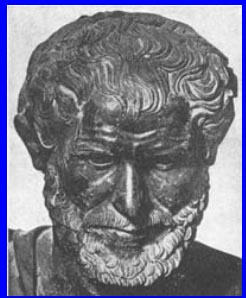

Figure 6 -- Herophilus
Of interest is that Herophilus was charged with opening "the bodies of living criminals, to discover the secret springs of life."  (3, page 35)

Unlike Erasistratus, he was a believer in the hypothesis that imbalances of the four humors cause most diseases.  (4, page 85)

He revered Hippocrates to the point that "when obliged to contradict him he always avoided mentioning his name."   Also, unlike his counterpart, he placed a "high value on drugs, which he called, 'the hands of the gods,' and used them in great variety.  (5, page 62-3)

Erasistratus was an empiracist.  Herophilus was a rationalist. In this way, "the same rivalry which existed in Greece between Cos and Cnidos arose also between Alexandria and Pergamus, in which later place Galen was born, and Aesculapius was held in great respect as one of its most celebrated divinities."  (3, page 36-37)

Regardless, anyone who wanted to be a physician in the ancient world was eager to learn at the school of medicine in Alexandria, as "to have studied medicine at Alexandria, was everywhere considered a passport to the confidence and patronage of the public."  (4, page 92)

The school continued "its celebrity as a seat of learning and as a school of medicine, until it was taken by Saracens in 638 of the Christian era."  (3, page 36)

Figure 7 -- 1532 woodcut showing Herophilus (L) and Erasistratus (R)
Alexandria would fall in 619 A.D., and that ended whatever medical wisdom came out of it.  Many of it's wonders were destroyed by barbarians, including it amazing library.  As the library went up in flames, so to did all medical wisdom except for random scrolls scattered here and there.  (6, page 150-2) (7, page 28)

Until the  School of Salerno was established in the 10th century, there were no known autopsies performed, and medicine was left in limbo, or what historians like to refer to as the dark ages of medicine.  (6, page 150-2) (7, page 28)

References:
  1. "Alexander the Great Alexander of Macedon Biography: King of Macedonia and Conqueror of the Persian," historyofmacedonia.org, http://www.historyofmacedonia.org/AncientMacedonia/AlexandertheGreat.html
  2. "Alexander the Great: Ancient Greece for kids," mrdonn.org, http://greece.mrdonn.org/alexander.html
  3. Meryon, Edward, "History of Medicine: comprising a narrative of its progress from the earliest ages to the present and of the delusions incidental to its advance from empericism to the dignity of a science," volume I, London, 1861,
  4. Watson, John, "The medical profession in ancient times," 1856, Baker and Godwin, New York
  5. Withington, Edward Theodore, "Medical history from the earliest times,"
  6. Garrison, Fielding Hudson, "An introduction to the history of medicine," 1922, Philadelphia, W.B. Saunders Company
  7. The John Hopkins Hospital bulleton," (volume XV 1904), "From the epoch of the Alexandria School (300 B.C.)"
RT Cave Facebook Page
RT Cave on Twitter
Print Friendly and PDF

Monday, May 18, 2015

760-370 B.C.: Hippocrates redefines medicine


What did Hippocrates really look like. Some historians speculate
most busts of him were made after his lifetime. Prioreschi said:
"It is highly probable that physicians of the Periclean Age wore
their hair and beards as much like the figures of Jove or
Aesculapius as possible, and were otherwise not lacking in the
self sufficiency which characterized the Greeks of the period.
We may therefore infer that the supposed portraits of Hippocrates
are only variants of the busts of Aesculapius. (1, page 92)

There are only a few people in our history whose contributions were so significant they end up being deified. One such man was the great physician Hippocrates.

While he may not have done all the work himself, his name is on one of the first and most significant medical treaties of all time: the Hippocratic Corpus. It would mold the image of Hippocrates, establishing him as the greatest physician of his time and of all time.

The Hipporcratic Corpus, often simply referred to as the Corpus, is a compilation of over 60 medical treaties which are essentially compilations of all the knowledge learned by Hippocrates from his "immediate ancestors," said medical historian Edward Meryon in his 1861 book "A history of medicine." (6, page 22)

The name Hippocrates is a reflection of all the great physicians that formed Greek medicine.  The Corpus is a reflection on the era he was born into.

Pericles (495-429) was in charge of the Athenian
Military during the Pelopannesian War, and
became a leading statesman and orator for Athens. 
Hippocrates was born on the island of Cos, near modern day Turkey, around 460 B.C., during the peek of Athenian democracy, an age when Pericles (495-429) walked the earth as a famous Greek general, statesman, and orator.   (1, page 21-22) (2, page 86)

It was an era of ancient Greece where the citizens of Rome had little work to do, and therefore had plenty of time to read, learn, and think.  This was made possible because most citizens had many slaves who did all the work for them.  This, it is said, gave rise to the Age of Philosophers in ancient Greece.

Of this time in our history, medical historian Fielding Hudson Garrison, in his 1922 book "An introduction to the history of medicine," said:
Never before, or since, had so many men of genius appeared in the same narrow limits of space and time. (2, page 86)
Medical historian Edward Meryon, in his 1861 history of medicine, said:
He lived at the most remarkable epoch of intellectual development, having as contemporaries the philosophers Socrates, Plato, and Xenophon; the statesman Pericles; the historians Herodotus and Thucydides; the poets Pindar, AEschylus, Euripides, Sophocles, and Aristophanes; and last, though not least, the sculptor Phidias. (1 page 22) (also see 8, page 126)
Garrison said Hippocrates was born into an era where the primary role of the physician was "either an associate of priests in times of peace, or a surgeon in times of war."  (9, page 87)

He was also born into an era where medicine was a blend of superstition and mythology, and was esoteric wisdom known only to the priest/ physicians at the Asclepions.  Those who were sick would spend time among the priest/physicians there, and the remedy would be revealed, and often involved magical elements such as incantations and amulets.  Yet these Asclepioins were not hospitals per se, merely places where the sick could learn the healing wisdom from the god Asclepius.

Those who were sick might also summon for a physician, men who, like the priest/physicians, were trained at the Asclepions. Yet these physicians were free from the bonds of the Asclepions, and were able to reach out to the general population, most often visiting their patients at their homes.

Medical historian Max Neuburger said:
From Homer's time (about 800 B.C.) and onward poets and historians make mention of lay physicians who freely exercised their profession untrammeled by temple medicine. In very early times the custom arose for communities to appoint official physicians whose duty it was, for a fixed salary, to to attend the poor gratis, to make the necessary sanitary arrangements in the presence of epidemics, and as experts to give evidence in court: it is equally certain that a medical corp accompanied armies and fleets... and that Greek physicians accepted posts as court and personal medical advisers to foreign princes. (8, page 97)
Natural medicine made it's way into the priesthood at the temple of Cos at an early date, and such medicine was learned by physicians who would then take their medicine outside the temple.  So this provided more options for the sick.  For those who were perplexed by the puerile medicine at the temples, they could summon a physician who practiced natural medicine.

Neuburger said that over time, particularly at Cnidos and Cos, there was a complete separation at the Asclepiades of all temple magic. So the priests and their magic ultimately gave way to physicians and their natural remedies. In the meantime there was a mixture of both types of medicine. (8, page 99)

Once summoned, the physician would then pack his bag of medical supplies and travel to the sick person's home.  Of these medical bags, Neuburger said:
On medical journeys a portable case was taken with indispensable instruments, bandages, ointments, plasters, emetics and purgatives. Such cases have been discovered (8, page 98)
Neuburger said there were also medical homes with sick rooms where the sick could see a physician for temporary treatment, although these homes were mostly reserved for people who required surgical intervention, such as for fractures and open wounds.  (8, pages 97-98)

Since there were no medical treaties at the time, there were no regulations and no standards as to how a physician was instructed. For this reason medical studies varied from one school to the next.

The result was often physicians who were ignorant of their trade, rough with their patients, and painful by their remedies. Many Greeks eventually recovered from their ailments without the guidance of a physician, and therefore it was often suspected that when a physician cured he was merely lucky.

As Hippocrates would later describe, this situation was exacerbated...
...under the pretext that physicians never undertake the care of those, who are already overpowered by disease. They say, that he cheerfully attends on such as would recover without him—but not a step will he take in behalf of those who are most in need of his assistance. If there was an art of medicine, they moreover say, it ought to cure these as well as the former. (3)
So it was no wonder that the sick would prefer to travel long distances to an Asclepion, or stay at home, tucked in their cozy beds, waiting their fate, as opposed to risking a call for any random physician.

Meryon said that most of what is known of the school of Cos, and later about Hippocrates himself, comes from biographies written after the death of Hippocrates.  From these we learn he was the "scion" of a family of physicians at the school of Cos "which had followed the pursuit of medicine at least 300 years." (1, page 21-22)

These physicians were well aware of the poor image of physicians.  They believed this poor image was due to the practice of physicians who graduated from the school of Cnidron.  This school was about 20 miles from Cos, and these physicians didn't care about the poor image, and did little if nothing to improve it.

Medical historian Edward Withington, in his 1894 book "Medical history from its earliest times," said physicians at the school of Cnidron were aggressive with their treatment. He said this is exemplified by the their motto: (4 ,page 52)
"Accurate diagnosis and vigorous treatment."  (4 ,page 52)
Medical historian Max Neuburger said Cnidian physicians focused on diagnosis, and then finding cures for these. He said: (8, page 114)
Their therapeutic methods, in accordance with their ideas upon localisation, appear to have been mostly topical, more radical than expectant and individualising. With knife and cautery to hand they were nothing loth to perform excision of a rib in empyema or nephrotomy in renal abcess and did not hesitate to order excessive purgation, dietetic cures or exhaustive walking exercise. (8, page 115)
Some of their therapeutic methods included: (8, page 115)
  • Injection of fluids in the air passages to produce coughing
  • Inhalations to promote the expulsion of mucus or pus from the lungs
  • Application of leather bags for the purpose of fomentation, swinging movements, etc. (8, page 115)
He wrote about a case described by Caelius Aurelianu in which a prominent physician named Euryphon at the school of Cnidus (a contemporary of Hippocrates) "tries to show that pleurisy is an affection of the substance of the lung."  (4 ,page 52)

Withington said Aurenlianu described the patient as being "thin as a skeleton, his legs like reeds, his chest still full of pus, and his ribs covered with scars from the cautery irons of Euryphon." (4, page 52) 


Neuburger said the writings of Euryphon, all of which have been lost, are believed to have influenced some Hippocratic writings. (8, page 115)

Physicians of Cnidron were also known to take bribes and use poisons to kill the enemies of their patients. To the physicians at Cos, this must have been the culmination of what was wrong with the profession, and what their potential patients must have feared the most.  So their aim was to change this image.  

The physicians at Cos frowned upon the act of using medicine to kill.  They frowned upon the act of being rough with their patients, and using aggressive treatment that was painful, and sometimes killed.  They were very concerned about the image of the profession and they aimed to improve upon it.  They aimed to create a kinder, gentler approach to medicine. This approach is later exemplified by the Hippocratic Treaties "On the Art of Medicine." (3)  

Hippocrates described a family of physicians who impressed upon their students that good bedside manner was essential.  They encouraged the use of gentle hands and gentle remedies. They were encouraged to assess their patient and their surroundings, and to "compare his disease with such as he had previously seen, either the same, or approaching thereto, and which he has cured by the admission of the patient himself." (3)

Like the Cnidian physicians, Con physicians performed accurate assessments, and even accurately described diseases and their treatments.  But the Con were more interested in prognosis than diagnosis, with their cures being based on this prognosis. (8, page 117)

Born into the Con family of physicians was Hippocrates II, a man history knows as the great Hippocrates.

Hippocrates II was the son of Heraclides, and the grandson of Hippocrates. Some historians said he was a direct descendant of Asclepius, and perhaps it was for this reason that Galen (2nd century A.D.) would later say of Hippocrates that "his writings should be reverenced as the voice of a deity." (6, page 21)(also see 5, page 23)(also see 6, page 203-204)

John Watson, in his 1856 book "Medical history from the earliest times," said it was from his father that Hippocrates learned much of his skill, technique and work ethic.  As a child he also had access to the "ablest masters in science and philosophy," and all the best physicians in the world. (5, page 46)(6, page 204)

Watson said that after the death of his father, he traveled to many countries before pursuing his profession in Macedonia, Thrase and other parts of Greece before settling in Thesally where he spent the later portion of his career.  He probably also taught at the School of Cos. In fact, some accounts have him starting the school.  (7, page 46)(8, page 86)

Neuburger said religion prohibited the examination of the internal organs of the human body for the purpose of science.  The only time a person's insides could be examined would be by the wounds obtained during fights in the gymnasium or on the battle field, or during the rare surgery that was performed.  For this reason, Hippocrates must have spent some time in the gymnasia, either as a student or as an observer.  (8, page 150, 156)

Physicians also spent time examining the naked bodies of the men, and so they would have learned, by observation and palpation, what was normal and what was abnormal.  By palpating abdomen's they would have learned what what normal and abnormal abdominal organs, such as the liver and spleen, felt like.  (8, pages 146, 150)

The only other means a physicaians might have learned anatomical knowledge was by dissecting animals, or spending time in slaughter houses or watching sacrifices. (8, page 150)

So, that in mind, it was unlikely Hippocrates observed an autopsy, although highly likely, perhaps with the guidance of his father, that he spent time at slaughtering houses, or observing sacrifices, or observing surgical cases, in order to obtain anatomical knowledge.  It's also highly probable that he spent time in the gymnasium at Cos to observe his father at work, but also to learn about the human body.

Neuburger said:
With regard to the respiratory tract, the Hippocratists knew the trachea, epiglottis and bronchi, and described the lungs as having five lobes... The circulatory system is described in the various writings in a most confused manner.  The starting-point was at first supposed to be the head, later the aorta and vena cave, which were thought to spring from the spleen and liver; according to the book De morbo sacro, all arteries enter the heart.  
He would have learned that the trachea, bronchi, and arteries were hollow and contained air.  He would have learned various bones, joints, bone marrow, and sutures of the skull.  Knowledge of the viscera (heart, liver, stomach, esophagus, intestines, liver, bladder, spleen, and kidney) was "scanty," said Neurburger, although he would have learned what was known about them. (8, page 151)

He would have learned of the nervous system, but sometimes nerves were confused with tendons, said Neuburger.  He would have learned about the four humours, the four qualities, and the four elements, and that their balance was what maintained health, and their imbalance what caused maladies.  (8, page 152)(9, pages 268-270)

He would have learned about a vital principle that was inhaled by the pneuma (breath), and that the "fundamental principle of life is the 'inherent' warmth of the body which has its seat in the left heart. Under the influence of this inherent warmth elementary fluids of the body are formed from food, and from variable admixture of these fluids solid parts of the body are formed." (8, page 152-153)

Organs are "built up" by nutrients obtained from the blood, which was created in the liver, warmed in the left ventricle, and circulated by means of the beating heart through the veins.  Cool air was taken in by the lungs to cool the heart.  (8, page 153)

He learned that the pneuma originated in the heart, or brain, and circulated through the body from one of these organs.  This pneuma would have been responsible for sensation and movement.  The brain may have been responsible for many of the ailments of the body, including diseases of the lungs, colds, catarrh (inflammation), etc. (8, page 153)

Of this, Neuburger wrote:
The brain is, for the most part, looked upon only as a gland, as the seat of cold and phlegm, entrusted with the task of attracting to itself the superfluous water of the body.  (If, in the functions, a disturbance sets in, abnormal accumulations of phlegm occur in other organs, i.e. catarrh.)
When an imbalance of the functions of the body occurs, such as an imbalance of the humours, the brain loses its ability to control the flow of fluids to it, and excessive phlegm flows to one or another organ of the body. For instance, excessive phlegm flowing to the lungs causes asthma, pneumonia, pleurisy, empyema, and phthisis. The same to the nose causes catarrh and coryza.

So through his studies he would have learned the basic anatomical structures of the body, and how they worked together in unity to create life, maintain health, and restore health.  He would have learned how nature assisted in this process.

Thomas Bradford, in his 1898 book "Quiz questions on the history of medicine," said that, at the school of Cos, Hippocrates would have learned from the theories and cures recorded on the stone tablets, or votives, that were stored there.  (5, page 23)

Bradford said he participated in...
"...careful study of the medical records found in the votive offerings that hung in great profusion about the walls of the Aesclepiads.  He soon began to have a reputation as a physician, and his name was known not only in Greece, but in foreign courts also. (5, page 23)
He used the wisdom he learned from his father, at the school of Cos, and from the sages during his travels abroad, to become a very gentle and skillful physician. He would win the hearts of both his patients and his fellow physicians, thus improving the image of the profession, said Withington (4, page 50)

References:
  1. Meryon, Edward, "The History of Medicine," Volume I, 1861, London,  (6)
  2. Garrison, Fielding Hudson, "An introduction to the history of medicine, 1922, (9)
  3. Hippocrates, "The Art of Medicine," Section I, Treaties III, translated by John Redman Coxe, "The writings of Hippocrates and Galen," 1846, Philadelphia, Lindsay and Blakiston (10)
  4. Withington, Edward Theodore, "Medical History from the Earliest Times: A Popular History of the Art of Healing," 1894, London, The Scientific Press. (3)  (7)
  5. Prioreschi, Plinio, "A history of medicine: Primitive and ancient medicine," v (1)
  6. Watson, John, "The Medical Profession from the Earliest Times: an anniversary discourse delivered before the New York Academy of Medicine November 7, 1855," 1856, New York, Baker & Godwin  (4)
  7. Sigerist, Henry, "A History of Medicine," volume 2, 1961, Oxford University Press  (2)
  8. Neuburger, Max, writer, "History of Medicine," 1910, translated by Ernest Playfair, Volume I, London, Oxford University Press
  9. Coxe, John Redman, translator, "Hippocrates, the Writings of Hippocrates and Galen," 1846, http://oll.libertyfund.org/titles/1988, accessed 7/6/14, also see the book online at Google books, Philadelphia, Lindsay and Blakiston
    RT Cave Facebook Page
    RT Cave on Twitter
    Print Friendly and PDF
