Primitive people and ancient societies didn't know about air, let alone about oxygen. However, as far back as 1000 B.C., ancient Hindu physicians who wrote the Charaka and Sustrata recognized both the presence of the lungs and the 'prana vayu,' a substance in the air that many historians believe was oxygen. (5)
"Charaka (500 B.C.) mentions the head, the chest, the ears, the tongue, the mouth and the nose as the seat of 'prana vayu.' Sustrata (1000 B.C) spoke of 'prana vayu' as flowing in the mouth. What else can this 'prana vayu' be identified with," said S.K. Jindal in his 2008 book, "Oxygen Therapy." (5)
Anaximenes of Miletus (585-525 B.C.) believed that air "was the primary principle," and he referred to it as the pneuma, or "the breath of life," said William Henry Osler, the father of modern medicine. He said the "pneuma was described by Anaximens as the "psychic force that animates the body and leaves it at death -- 'our soul being air, holds us together'" (9, pages 38-39)
Yet it was Empedocles (490-430 B.C.), a pre-Socratic Greek philosopher, who first conceived the idea that air contained a substance that was vital to life. He defined air as one of the four basic elements: air, water, earth and fire. Everything that we see is made up of these substances, and health of animals and humans was determined by the equilibrium of these four substances. (9, page 40)
He was also the first to describe respiration:
"As soon as that humidity, of which there is a great store on the first formation of the foetus, begins to be diminished, the air insinuating itself through the pores of the body succeeds it; after this the natural heat, by its tendency to make its escape, drives the air out, and when this natural heat enters the body again the air follows it afresh. The former of these actions is called Inspiration, and the latter Expiration." (1, page 47-48)He described how with the inspiration air entered into the body, and that it was circulated through the body by the "continuous motion" of the blood, and that it nourishes the heart and the mind. Empedocles explained that the heart "nourished in the sea of blood which courses in two opposite directions: this is the lace where is found for the most part when men call Thought; for the blood round the heart is Thought in mankind." (2, page 186)
He also may have been the first to observe in the "faetus in utero" that "respiration commenced before birth."
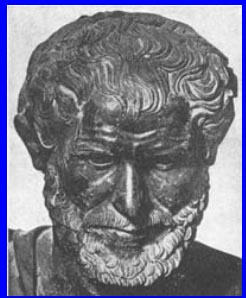
Aristotle (384-322 B.C.), a Greek philosopher and student of Plato (and teacher to Alexander the Great), mentioned "air" as one of the essential elements of life. He observed that air had weight when he wrote that "a bladder filled with air was heavier than an empty bladder." (6, page 19)
He did not know that there was a difference between arteries and veins, although he did know that both were filled with blood. He also knew that the heart was the key to "circulation" of the vital spirit. He actually came up with the term vessels as he noted the vessels contained the blood as in a vase. The lungs inhaled the spirits and pneuma from the air from the trachea (which he referred to as the arteria because it contained air. Hippocrates also referred to the trachea as the arteria). (9, page 72)
Praxagoras of Athens (born 340 B.C.) believed that "pulsation was only in the arteries, and maintained that only the veins contained blood, and the arteries air," wrote Osler. "As a rule the arteries are empty after death, and Praxagoras believed that they were filled with an aeriform fluid, a sort of pneuma, which was responsible for their pulsation." He was among the first to study the pulse. (9, page 72)
Archimides (287-212 B.C.), a Greek mathematician and astronomer, wrote that "air is weighed in air." (6, page 19)
In the 3rd century B.C., Erasistratos (335-280 B.C.) of the School of Alexandria, in Egypt, recognized the relationship between air and blood and that air was essential for life to exist. Around 294 B.C. Erasistratos "taught that arteries carried blood to the various parts of the body; those vessels carried air and air only, and the blood was carried in the other vessels, the veins." (7, page 473)
He also believed the heart contained no blood (8, page 94) In fact, Osler explains, it was for this reason arteries got their name, as the term "artery" comes from the Greek term arteria, or air. The trachea was referred to as the windpipe, or arteria tracheia, also known as "the rough air tube." (9, page 72)
Erasistratos contested that air contained a substance (a pneuma) that, once it entered the body, it was transformed into this "vital pneuma" that was essential for life. This transformation was performed in the "left ventricle of the heart and, together with blood, results in heat, energy, and life.... a part of the vital pneuma enters the brain where it turns into 'psychic pneuma.' This psychic pneuma processes sensory perceptions and renders possible understanding and knowledge." (3, page 8)
Osler said that this "vital pneuma" was also the cause of the heart beat, "the source of innate heat of the body, and it maintained the processes of digestion and nutrition." It was sent to the brain where an animal spirit is formed, and this spirit was sent to the nerves of the body to give the person emotion and sensation and motion. Osler added that when we use the terms "high spirits" and "low spirits," these terms come from the views of Erasistratos and other ancient Greek philosophers. (9, page 73)
By 70-160 A.D. Athenaeus of Cicilia opened what was called the "pneumatic school" of medicine that "flourished" for many years. The pneumatic theory held that there was a pneuma in the air that was inhaled, transported to the heart by vessels, and then transported to the rest of the body by vessels. This pneuma was therefore essential for good health and life, for maintaining a balance of the four humors by maintaining an appropriate level of heat and moisture. (2, page 291)
Aretaeus of Cappadocia (130-200 A.D.), a physician from ancient Greece, believed the heart was "the exciting cause or principle of respiration," according to Hamilton, "being seated in the centre of the lungs, which it inspires with a desire for fresh air. The lungs he did not believe to be susceptible of pain, from being composed of a loose sort of substance like wool; rough cartilaginous arteries, according to him, were dispersed throughout them; they were unprovided with muscles, and furnished only with some small and slender nerves, by means of which their motion was produced." (1, page 32)
 |
| Middle Ages diagram of Galen's concept of blood flow |
Galen also observed, as did Erasistratus, that the veins and arteries communicate by small pores and small vessels that allows for the mingling of spirits and blood. He did not, however, know the blood circulated, as he though it made it's way to the organs by small pores. However, some historians, including Osler, believe he was very close to figuring this out, and if given more time he probably would have. He did not see the heart as a pump, but as a fireplace, said Osler. (9, page 80)
He believed the purpose of the heart was to warm the blood; that it was nothing more than a heater. He believed the left ventricle purified the blood and sent pure blood to the vital organs, such as the liver. (7, page 473)
It should also be known that, according to Phillip Crampton in his 1839 "Outlines of the history of medicine," nothing remained of the writings of Erasistratos, so much of what we know about his anatomical discoveries comes from the writings of Galen. Crampton said that Galen described the views of Erasistratus of the passage of blood and air through the body this way:
According to him, the air passes from the lungs to the heart, which performs the functions of a smith's bellows, attracting the air by the dilatation of the left auricle; from the left auricle it passes by the arteries which contain air, or rather animal spirits, to every part of the body. The veins contain all the blood, and according to this supposition, fever and inflammation are the consequence of any portion of blood passing, by an error loci, from the veins into the arteries. (10, page 519)Galen supported this view and added to it. Crampton said it was Galen who was perhaps the first to describe human respiration:
Some notion of the state of experimental philosophy in the time of Galen, may be formed from the account which he gives of the experiment by which he Convinced the assembled physicians and philosophers of Rome, that air was contained within the cavity of the chest, between the lungs and the pleura costalis; he says he explained to them the manner in which the air passed from the lungs through the cribriform plate of the sethmoid bone into the ventricles of the brain, in which a true respiration was performed, the organ rising and falling in correspondence with the motions of the chest, and the air escaping through the sutures and the palate (10, page 520)So Galen supported the views of Erasistratos and then expanded upon them. He agreed with Erasistratus that some pneuma in the air was inhaled, warmed in the heart, and sent to the body by a series of vessels and cannals and pores. He also believed something of waste was exhaled. He actually proved by experiments Erisistratos wrong when he asserted the arteries contained air not blood. Galen proved arteries contained blood. (7, page 473)(9, page 82)
Arthur John Brock, in the introduction of his 1916 translation of some of Galen's works, explained Galen's thoughts on how blood and air flowed through the body:
In his opinion, the great bulk of the blood travelled with a to-and-fro motion in the veins, while a little of it, mixed with inspired air, moved in the same way along the arteries; whereas we now know that all the blood goes outward by the arteries and returns by the veins; in either case blood is carried to the tissues by blood-vessels, and Galen's ideas of tissue nutrition were wonderfully sound. (10, page xxxvi)He also explained that the "spongy flesh of the lungs acts upon the air we inhale converting it to a subtler product, pneuma. This refined breath passes through very find 'pores' into branches of the pulmonary vein, and thence is 'attracted,' with blood, by the attractive faculty into the left ventricle of the heart, where it encounters more hot blood and becomes metamorphosed into life giving, i.e. 'vital' pneuma." As the pneuma is 'transported' to the various parts of the body it is further metamophosed. (4, page 45)
"Why were there two sets of vessels for the same fluid?" Galen wondered. And he speculated, as historian William Hamilton said that...
...the great vein (vena cava) was the great reservoir of the blood, while the aorta was the recipient of the spirits, and that, notwithstanding the proximity of the mouths of the veins and arteries to each other, the blood, during the continuance of health, did not enter the vessels in which the spirits flow; but, when this arrangement happens to be disturbed by any violence, that the blood forces its way into the arteries, and occasions more or less disorder of the system. The only use which he assigned to the process of respiration was to supply the arteries with air (what he referred to as vital air).Yet this is all just speculation, and there were many theories as to what this 'vital air' contained. Regardless, Galen was so well respected by the medical community that his theory grabbed a hold and held a prominent position in the minds of physicians for the next 1,900 years. This theory held strong even when better wisdom became available.
References:
- Hamilton, William, "A History of Medicine, Surgery and Anatomy," 1831, Vol. I, London, New Burlington
- Prioreschi, Plinio, "A History of Medicine: Greek Medicine," Vol. II, 1994, 2004, 2nd ed., NE, Horatius Press
- Tesak, Juergen, Chris Code, "The History of Aphasia: Theories and Protagonists," 2008, New York, Psychology Press
- Wilson, Nigel, "Encyclopedia of Ancient Greece," 2006, NY, Taylor and Francis
- Jindel, S.K.,Ritesh Agarwal, "Oxygen Therapy," 2009,2nd ed., Jaypee Brothers, pages 5-8
- Tissier, page 19
- Hill, Leonard, "Recent Advances in Physiology and bio-chemistry," 1908, London, Edward Arnold
- Garrison, Fielding H, "An introduction to the history of medicine," 3rd edition, 1922, Philadelphia and London, W.B. Saunders Company, page 95
- Osler, William, "The Evolution of Modern Medicine: A series of lectures at Yale University on the Silliman Foundation in April, 1913," New Have, Yale University Press, 1921,
- Crampton, Phillip, "Outlines of the history of medicine from the earliest historic period to the present time, intended to illustrate the connextion between the progress of anatomy and the improvements of the healing arts," read before the Royal College of Surgeons on November 29, 1838, published in The Dublin Journal of Medical Science, 1839, Volume 14, Dublin, Published by Hodges and Smith, pages 504-533
- Galen, writer, Arthur John Brock, translator, "Galen: On the Natural Faculties," 1916, London and New York, William Hienemann and G.P. Putnam's Sons
RT Cave on Twitter