Friday, May 15, 2015

600-476 B.C Unhappy dead Roman men caused diseases

In the ancient world, which to many historians ended with the fall of Rome in 476 A.D., disease was believed to be caused by spirits.  In Ancient Rome, however, it was, more specifically, caused by the souls of unhappy deceased men.

Historian Harold Johnston explains that the Romans were very much so attached to their families.  Family, however, was not defined as a mother and father and children, as it is today.  In Roman times, a family consisted of one man who was in charge of the entire household, and he was called the pater familias, or Head of Household.  (1, page 21)

Johnston said the pater familias was the legal owner of all the profits made by the rest of the family, and the legal owner of all material possessions, which included all the slaves.  Under his possession was his wife, his children, his children's children, and all the female spouses of his male children.  His female children would be given up in marriage, and given to the pater familias of the house she is marrying into.  (1, page 21)

The descent of the family was traced through males, and all males who could trace their ancestry to a common male were thus called agnati, "and this agnatio was the closest tie in relationship known to the Romans."  (1, page 25)  

The significance of the agnatio is in the Roman belief as to what will happen to every Roman male in the afterlife.  Johnston explains this significance as follows: (1, page 28-29)
The importance they attached to the agnatic family is largely explained by their ideas of the future life. They believed that the souls of men had an existence apart from the body, but not in a separate spirit-land. They conceived of the soul as hovering around the place of burial and requiring for its peace and happiness that offerings of food and drink should be made to it regularly. Should these offerings be discontinued, the soul would cease to be happy itself, and might become perhaps a spirit of evil. The maintenance of these rites and ceremonies devolved naturally upon the descendants from generation to generation, whom the spirits in turn would guide and guard.
So you can see that if a Roman did not perform family life in accordance with tradition, he would therefore be offending the spirit, and this would result in sickness. If appropriate ceremonies and sacrifices were not made, sickness may result. And, as we all know, both allergies and asthma are a sickness that might consume a man or woman.

Johnston continued: (1, page 29)
The Roman was bound, therefore, to perform these acts of affection and piety so long as he lived himself, and bound no less to provide for their performance after his death by perpetuating his race and the family cult. A curse was believed to rest upon the childless man. Marriage was, therefore, a solemn religious duty, entered into only with the approval of the gods ascertained by the auspices. In taking a wife to himself the Roman made her a partaker of his family mysteries, a service that brooked no divided allegiance. He therefore separated her entirely from her father's family, and was ready in turn to surrender his daughter without reserve to the husband with whom she was to minister at another altar. The pater familias was the priest of the household, and those subject to his potestas assisted in the prayers and offerings, the sacra familiaria.
Basically this means that the Head of the Household was in charge of making sure tradition was followed in order to keep the male ancestors happy as they hover over their graves.  An unhappy male soul results in an unhappy household, one full of grief and sickness.

One problem that Roman males had is if they had no children, or if their male child passed away. When this happened, "he had to face the prospect of the extinction of his family, and his own descent to the grave with no posterity to make him blessed." (1, page 30)

To accommodate for this, he had two options open to him: (1, page 30)
  1. He might give himself in adoption and pass into another family in which the perpetuation of the family cult seemed certain, or...
  2. He might adopt a son and thus perpetuate his own
Of course, as Johnston noted, " He usually followed the latter course, because it secured peace for the souls of his ancestors no less than for his own."

Anyway, I found this very interesting.  What do you think?

References:
  1. Johnston, Harold Whetstone, "The Private Life of Romans," 1908, Chicago, Atlanta, New York, Scott, Foresman and company
RT Cave Facebook Page
RT Cave on Twitter
Print Friendly and PDF

Wednesday, May 13, 2015

500 B.C.: The Pythagorean Theory of Opposites

One of the themes in our asthma and respiratory therapy history is that asthma and asthma-like conditions were rarely considered important enough to be studied. For this reason the tree of asthma wisdom was ever so small for most of history, growing ever so slowly through the passing years.  Why this occurred may be best explained by the Pythagorean Theory of Opposites.

Consider that for most of history there were far more apparent and deadly diseases than asthma, such as influenza and tuberculosis.  Plus asthma was thought to be a rare disease that killed very few of its victims.  So if you had asthma, chances are you suffered privately, leaving little or no impression on society of the disease that plagued you.

The Pythagorean Theory of Opposites was made famous around 500 B.C. by a famous philosopher by the name of Pythagoras (535-475 B.C.  The theory states that in order to understand something you have to have experienced its opposite. Since few experienced asthma, then few would understand it, and few would have empathy for the plight of the asthmatic.

However, while Pythagoras is often given credit for the theory, it may have actually been created by the pre-Socratic philosopher Heraclitus of Ephesus (535-475).  

Heraclitus believed the world was not static but dynamic.  He was a follower of the Pythagorean School, and he was one of the first philosophers of ancient Greece, one of the first people who stated that there was more to the world than that it was just created by the gods.

He believed in the unity of the world, and he believed the essential element of change was fire.  Where fire is involved, great changes occur.  Fire in the body causes sickness just like fire in a home destroys the home. He thus believed fire created air, water and earth.

He believed everything came along due to tension and strife, which can be produced by fire.  A good example is war, which is one of the major causes of change.  He believed that all things are moved by an innate force, and from opposite tensions results harmony.

It was by this theory, some believe, that he developed the theory of opposites. He believed everything had an opposite, and when these two opposites were in harmony you had peace. He believed that all things are moved by an innate force, and from opposite tensions results harmony.

Thus, it is in opposites, he believed, that we become aware of things.  By seeing the sick we appreciate health.  By seeing the dead we appreciate life.  By sleeping we appreciate being awake.  By seeing evil we appreciate goodness.  By seeing antagonists we appreciate protagonists. By seeing hunger we appreciate satiation. By seeing asthma we appreciate breathe.  

When changes occur to one or the other opposite, then this is where your conflict occurs. For example, when both hot and cold are balanced in the body, the body remains healthy. Yet when the heat of your body is increased, you become sick. The same can be said of dry and moist, sweet and bitter, and rest and weary.

It was this same theory that was adapted by the Hippocratic writers when they wrote the Hippocratic Corpus.  They used this theory of opposites to describe how disease was created, and how such imbalances can cause the four humours to become imbalanced, thus resulting in sickness.  So the Pythagorean Theory of Opposites may have been the birth of humoral medicine.

The premise of this theory is that in order to understand the plight of mankind, you have to have walked in their shoes.  In order to understand their suffering, you have to have had exposure to their suffering.

It doesn't have to be a major exposure either. For example, you don't have to get asthma to appreciate the person with asthma; all you have to do is meet an asthmatic, or read about his plight.  

References:
  1. Sigerist, Henry E, "A History of Medicine: Early Greek, Hindu and Persian Medicine," Volume II ", 1961, Oxford University Press, pages 88-99
RT Cave Facebook Page
RT Cave on Twitter
Print Friendly and PDF

Monday, May 11, 2015

500 B.C.: Pythagoras introduces Greece to philosophy

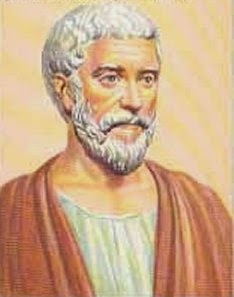
Pythagoras of Samos (570-495 B.C.)
Even though he made no direct impact on medicine itself, Pythagoras of Samos (570-495 B.C.) may well be the most significant figure to our asthma history. The reason is because he might have been responsible for bringing Egyptian and Babylonian philosophy, math, astrology and medicine to ancient Greece.

By no means am I implying here that Pythagoras invented philosophy, for that couldn't be further from the truth: the quest for knowledge, which is what philosophy is, started long before Pythagoras was even born.

Near the beginning of civilization there were a few sages who pondered in secret about the world around them, and doubted it was all created by the gods.  They asked questions and sought answers, and what they discovered became the first theories.

They studied the stars and planets and became the first astrologers.  They studied numbers and became the first mathematicians.  They studied geometry and became the first architects.  They studied medicine and became the first physicians.

Pythagoras celebrates sunrise (by Fyodor Bronnikov)
Such wisdom was only privy to a select few members of the priesthood or aristocracy, and what they learned was used to advance civilization.  An anonymous sage in Sumeria invented the potter's wheel to make clay pots, and and another sage learned how to build channels and aqueducts to irrigate the land. Another anonymous sage invented a language and a system of writing.  An anonymous sage in Egypt invented the material and tools for building massive pyramidal structures, and another learned how to mummify the dead to prepare their bodies for the afterlife.

The problem with this early philosophy was that it was far and few between.  The majority of the people, about ninety-nine percent of them, worked a minimum of twelve shifts everyday, seven days a week.  They did not have time to think and ask questions let alone time to learn.  Yet during the 9th century B.C. things were occurring in ancient Greece that would change all this, thus giving rise to the Age of Philosophy in ancient Greece.

No one knows exactly when this occurred, but sometime before the great poet Homer sat down to write his epic poems, gymnasiums were being built near the temples of various gods,and these were dedicated to shaping the bodies of young men.  (1, page 80)

In these gymnasiums young men would exercise, play games, and otherwise prepare their bodies for battle. Occasionally they ventured off to battle, and they won many wars, and they marched home with prisoners of war.  These prisoners were turned into slaves, and by the 6th century B.C. nearly all the citizens of Greece owned many slaves, and these slaves did all the work.  This allowed the citizens of Greece plenty of time to enjoy the pleasures of life.

Some citizens spent their days pondering about the world around them, and they yearned for answers.  So they traveled abroad to Egypt, and Mesopotamia, and India.  In this way, they spent time with the sages of these places, and they expanded their knowledge.

At this time, the best medical schools were in Egypt, and therefore it was probably at the schools at Heliopolis that the Greeks came into contact with Egyptian medicine. They must have been very impressed with this knowledge that they took it home and shared it with their fellow citizens of Greece. (7, page 22)(6, page 4)

It was in this way that the Egyptian method of healing at temples morphed into Aeslepion temples in Greece.  Apollo was a god similar to Thoth.  Thoth was worshiped as Hermes.  Other Egyptian gods, such as Isis, were worshiped in Greece, and later Rome, until around 50 B.C. (6, page 2)

Pythagoras is perhaps the man responsible 
for bringing Egyptian and Babylonian
math, astrology, and medicine
to ancient Greece.


So this was the world that Pythagoras was born into in 570 B.C., give or take ten years.  Since nothing was written about him during his lifetime, all we know of him comes from second hand accounts after his death.  It's from these accounts that historians learned his dad was Parthenis, and that he was a descendant of the gods.  His mother was Mnesarchu.  (3, page 7-9)

They learned that an oracle at Pythian told Parthenis that his wife was pregnant with a child who would be blessed with great wisdom and who would be of great benefit to mankind. In recognition of the oracle, the child was named Pythagoras.  (3, page 7-9)

In his youth he must have spent quality time in the gymnasium at Samos, as he became a gifted athlete.  He was also a gifted student who loved to learn, and so must have listened to the stories of the orators, and the lectures of the sages.  At one point he listened to a lecture by the philosopher Phercydes about the "immortality of the soul," and he was "so charmed" that he dedicated the rest of his life to philosophy.  (1, page 81)

To satiate his quest to learn more he began his travels around the world, or so legend has it.  He first traveled to Meletus of Anatolia (modern day Turkey), which was at the time the home of philosophers.  While there he learned of the wisdom of three early Greek philosophers.  

Thales of Miletus was perhaps the first Greek Philosopher
1.  Thales of Meletus:  (624-546) He was a Greek citizen who lived in Meletus of Anatolia.  He is often credited as being the first philosopher and scientist.  He was the first who, instead of giving credit of all physical phenomenon to the gods, searched for the true cause.  He asked questions and searched for answers.  The answers were called theories. (3 page 12)

He traveled to Babylon and learned astrology, and used it to predict an eclipse of the sun.  He traveled to Egypt and learned from the Egyptian sages at Heliopolis.  He learned geometry and predicted the height of the pyramids using only its shadow.  He learned Egyptian medicine, which at the time was the best in the world. It's believed that he started the process of blending Egyptian medicine into Greek philosophy. (5, page 89-90)

He concluded that water was the primary element, and that all other elements were derived from it. By his observations he associated life with water.  Of this, historian Henry E. Sigeris said in 1987:
Thales had been in Egypt and saw the Fertilizing effect of water of the Nile that flooded the land periodically. He even ventured an explanation of this natural phenomenon, as Herodotus tells us.  Throughout the East he could see that life was bound to the presence of water.  Where water reached vegetation was abundant, and where it ceased, the desert began. Whatever was alive was moist, and Thales must have noticed that life-giving human and animal sperm was moist.  And so he came to believe that there was a casual relationship between water and life... when water evaporated, did it not become air? Such observations and speculations must have guided Thales in his assumption that water was the primary element.  (5, page 90)
Because of Thales, Meletus is often considered to be the birth place of Greek philosophy. (3, page 12)(5, pages 89-90)

Anaximander was among the world's first scientists, or, among the first
to question why things exist and to seek out answers by empirical means.

2.  Anaximander of Miletus: (611-546 B.C.) He became the pupil of Thales, and together he and his master were the first known philosophers, and therefore the first astrologers, scientists, mathematicians, and physicians. (3, page 12)

He did not believe, however, that water was the primary element.  Of him, Sigerist said:
He believed that the elements commonly thought to constitute the world -- water, earth, fire and air, with their qualities wet, dry, hot or cold -- were derived from one common indeterminate substance.  From this inexhaustible primary substance which 'includes everything in itself and guides everything,' two pairs of elements with opposite qualities were born, which seemed to be in ideal balance. In the beginning of the world these elements were separated with the earth in the center, and covered by a sphere of water. which was surrounded by air and ultimately fire. Everyday experience taught what happens when fire acts upon air, water, and earth. The earth became dry, water evaporated, pressure increased, and the ring of fire burst... Thunder and lightning were not the work of Zeus, but were caused in a perfectly natural way when air was compressed in a cloud and burst forth violently.  All living creatures originated in the water, and some became land animals when the water evaporated.  Man too arose from a fish-like creature. (5, page 91)
Sigerest said Aristotle said that Anaximander said "all things are full of gods."  In this way, Sigerist said, Anaximander began the transition away from believing everything was caused by gods, to the idea that they were caused by naturally occurring phenomena.  (5, page 91-92)

3.  Pherecydes of Syros:  (570-495 B.C.) He was among the first to rationalize Greek mythology.  In this way, he is credited as being the first to establish the idea that the human soul was immortal.  This type of thinking was taught by Pherecydes at the gymnasium of Syros, and it greatly impressed a young Pythagoras. (2)

It is then speculated that Pythagoras traveled abroad, to Egypt, Mesopotamia and India.  It's believed he spent 20 years in Egypt learning from its sages.  Some speculate he even became an Egyptian priest.  He then was taken to Mesopotamia and held captive for 12 years in Babylon. During his time there he learned from Mesopotamian sages.   (3, page 12-14)

Medical historian Max Neuburger said once his travels were done he settled in Crotona, which is now Southern Italy. He said:
(He) founded a guild in Crotona, religious and moral, did pioneer work, not only in mathematics, astronomy and acoustics, but in investigation of the structure of the body, reproduction and development, the functions of the senses and mental activity, as well as in the treatment of the sick. (8, page 105)
Neuburger also said that being that there was also an Asclepion in Crotona, physicians at the medical school at Crotona were probably constantly in touch with the Pythagorean followers, many of whom were physicians. So early on there was a mingling of the different schools of philosophy or medicine. (8, page 106)

His greatest interest was regarding religion, and so he preached that what was learned in this life could be used in the next life when the soul moves on to another body, or to the final resting place.  (3, page 25)

Some speculate he came up with this idea from Phercydes, although some speculate this wisdom came from the Egyptians, who likewise believed the soul traveled into the afterlife.  Although others speculate this wisdom came from the Indians, who believed in reincarnation of the soul, or that once you die you are reborn as another person.

His followers were interested in his ideas about religion, but they were also interested in all his philosophical wisdom.  While historians credit Thales as the first philosopher, Pythagoras was the first person to refer to himself as a philosopher during his own lifetime.

Again, we must understand that philosophy is the quest for knowledge.  So when Pythagoras, and all the later ancient philosophers, lectured, they preached all the wisdom of the day, which included  mathematics, science, astronomy, astrology, music, and medicine.  It wasn't until many centuries later that each of these were extracted from under the rubric or umbrella term philosophy to become natural sciences all of their own.

So by his lectures he shared this knowledge.  His fellow Greek citizens were so impressed that word quickly got out about all the knowledge of Pythagoras, and so he quickly developed a large following. Renouard said his followers became known as Pythagoreans Disciples, or simply Pythagoreans.

Pythagoras established these followers of his into "a well-disciplined school," said Henry Sigerist in his 1922 history of medicine. It was called the Pythagorean Order.  (5, page 94-95)

Renouard said his followers would often sell all they had to dedicate their lives to Pythagoras and the general good.  (1, page 83)  Sigerist said they ate a healthy diet in order to maintain a healthy balance, or equilibrium, within their bodies.

Neuburger said, according to Pythagoras: (8, page 107)
The body was formed from the warm, the breath causes cooling.The causes of disease are bile, blood and phlegm. Predisposition to disease are excess or lack of warmth, nourishment, etc. Inflammation arises from accumulation of phlegm -- in itself warmth producing. (8, page 107)
When they were sick it was because the equilibrium was disturbed, and it was only re-established "physically with medicine, and mentally with music. This was why both medicine and music were greatly cultivated in the Pythagorean school, " said Sigerist. (5, page 96)

Neuburger said:
Health, according to him was a condition upon the equilibrium of materials present in the body (cold, moist, warm, dry, sweet, bitter); sickness results through the predominance of one quality, cure from a restoration of the balance, through the addition of the opposite one. (8, page 107)
Neuburger said he neglected "most surgical procedures, and mostly employed the following as remedies: (8, page 106)
  • Simples
  • Poultices
  • Salves
  • Expiations
  • Spells
  • Magical herbs
  • Incantations
  • Religious music
  • Physical exercise (gymnastics)
  • Dietetic measures (such as limited consumption of meat) (8, page 106)
Renouard said Pythagoras taught a system of numbers that he probably learned from the Egyptians. (1, page 84)
"He designated God by the figure 1, and matter by 2; so he expressed the universe by 12, because this results from the juxtaposition of the figures 1 and 2."  (1, page 84)
Renouard said he explained the three distinct parts of life, or the three worlds: body, soul, and spirit.  So in this way the universe was in "harmony with the body and the soul," which, according to Pythagoras, were "manifested by three distinct faculties: sensibility, thought, and intelligence."  (1)

Renouard said Pythagoras introduced the Greeks to the significance of the number four.  He preached that there were "four spheres from which are formed each one of its three distinct worlds, (that) correspond to four elementary modifications of inert or amorphous matter. These primitive modifications are called fire, air, earth, and water, and are the elements which constitute all material substance." (1, page 84)

He was the first to establish the idea that the brain was the center of human intelligence. (8, page 106-107)(9, page 83)  This was a major step as far as medicine was concerned because physicians of neither Egypt nor Mesopotamia considered this fact.  Egyptians thought it was the heart, and Babylonians thought it was the liver.

He is also credited with creating the Pythagorean Therum, which states that the square of a hypotenuse of a right angle is equal to the sum of its squares. He is also credited with being the first to say the earth was a sphere, among other things.

We  must remember, however, that since most of what is known of him was told by second hand accounts after his death, much of what we know of him was probably exaggerated. Much of what was attributed to him was probably actually invented or discovered by one of his contemporaries or peers.  This was probably because Pythagoras lectured mostly in secret because much of what he taught was radical.  His followers were sworn to secrecy.  Perhaps this explains why Pythagoras was credited with all the wisdom of the Pythagoreans.  (3, page 20)(5, page 95)

Sigerist said that another reason for this was because "loyalty to the master impelled his student to attribute every contribution of any importance to him (Pythagoras)."

This was typical, however, of the ancient world, as most people were forced to, or in most cases willing to, make a humble contribution to the the collective.    (5, page 95)

Many historians also believe much of what he is credited with may even have been known for generations before he was even born, such as the pythagorean therum, which must have been known when anonymous architects were building many of the structures of the ancient world.  It may have been postulated by Egyptian mathematicians, or perhaps even by an anonymous sage from ancient Sumeria.

Pythagoras was well respected in life, although his ideas on mathematics were generally not accepted until well after his death.  However, the teachings of his school would influence many succeeding generations of Greek philosophers, including Plato and Hippocrates.  In fact, his teachings also continue to influence people to this day.

Pythagoras died sometime around 500 or 490 B.C., although his philosophy lived on for many years by his followers. They continued to lecture, and in this way philosophy was learned by many Greek citizens, including Plato and Hippocrates. In fact, his teachings continue to influence people even to this day.

Henry E. Sigerist, in his 1922 history of medicine, said that Pythagoras may simply have been a benefactor of the times he was born into, a time when Greek citizens were becoming better educated about the world around them.  He said:
Many people were no longer satisfied with the naive and primitive worship of the Homeric gods and felt shocked by the many scandals mythology reported about them. We saw that the cult of Asclepius developed in this atmosphere, as did a number of mystery religions under Asiatic influence. Pythagoras is one of the exponents of the great Orphic movement." (5, page 95)
So by the 5th century there was such a demand for wisdom that many of the gymnasiums were transitioned to places of learning, thus becoming the schools and universities. (4, page 39)

Many believe this system of associating education with a temple was learned from Egyptian and Babylonian sages, as both those nations had a similar system of learning.

The most famous of these Greek schools were associated with temples of the god Asclepius, who was the the messenger of the gods and capable of communicating their wisdom with the citizens of Greece.  These schools became known as Asclepions.

Renouard said these gymnasiums were "surrounded by halls and porticos where philosophers, rhetoricians, artists, and physicians assembled to hold their schools and dispute on questions of art." (1, page 80)

So with a lot of time on their hands, and a burning passion to learn, Greek citizens like Thales, Anaximander, Pherecydes and Pythagoras traveled the world in search of the wisdom of the sages.  What they brought back to Greece inspired its citizens, peeking their interest in philosophy.

It was Pythagoras, and Pythagoras alone, whether this is accurate or not, who is given credit for introducing ancient Greece to philosophy.  Of this, Renouard concludes that Pythagoras was: (1, page 90)
"The last celebrated example of distant peregrinations in search of wisdom..." (after him) "the sages of Greece ceased their journeys in search of light in foreign countries, for their own country became in its turn a center of illumination for all nations." (1, page 90)
Pythagoras gave rise to the Age of Philosophers.  This is key to our asthma history because without ancient Greek philosophy, modern medicine would be ages behind where it is today, if it existed at all.

References:
  1. Renouard, Pierre-Victor, "History of Medicine: from it's origin to the nineteenth century," 1867, Philadelphia, Lindsay and Bakiston
  2. "Pythagoras," Encyclopedia Britannica.com, http://www.britannica.com/EBchecked/topic/485171/Pythagoras, accessed 11/1/12
  3. Harkins, Susan Sales and William H. Harkins, "Biography from Ancient Civilizations, Legends, Folklore, and Stories of Ancient Worlds: The Life and Times o Pythagoras," 2007, Mitchell Lane Publishers
  4. Osler, William, "The Evolution of Modern Medicine: A series of lectures at Yale University on the Silliman Foundation in April, 1913," New Have, Yale University Press, 1921,
  5. Sigerist, Henry E., "A history of medicine," 1987,
  6. Sandwith, Fleming Mant, "The Medical Diseases of Egypt: part I," 1905, London, Henry Kimpton
  7. Withington, Edward, "Medical History from the earliest times," 
  8. Neuburger, Max, writer, "History of Medicine," 1910, translated by Ernest Playfair, Volume I, London, Oxford University Press
  9. Garrison, Fielding Hudson, "An introduction to the history of medicine," pages 80-83.  
RT Cave Facebook Page
RT Cave on Twitter
Print Friendly and PDF

Saturday, May 9, 2015

628-330 B.C.: Medicine among the early Persians

So we know now what life was like for asthmatics in ancient Mesopotamia and ancient Egypt, now I'd like explain, if only briefly, what life was like for asthmatics in Ancient Iran.  The simple truth of the matter is it really wasn't much better than anywhere else in the world.  If you had asthma, as with any other disease, your best bet was to have someone pat you on the back, provide you with moral support, and to simply allow nature (or spirits or gods) to heal you.

The first people to live in this area, which was not far from Assyria in Upper Mesopotamia, were the Elamites, the Medes and the Persians.  I think these folks were essential to our asthma history because, when western civilization went into a dark ages of medicine after the fall of Rome in 476 A.D., medicine would rise in the east, and mainly in Persia.  This would happen around the 10th or 11th centuries A.D.  So it is essential that we not ignore these folks.

John Hermann Baas, in his 1898 book, "Outlines in the history of medicine,"  explained, that along with the Mesopotamians, the Chaldeans also had a major impact on Persian culture.  The Chaldeans worshiped a series of sacred texts called the Zen Avesta, also referred to as the "Living Word."  This Avesta was put into writing by the Zoroaster (Zaruthustra, Zerdutscht), who was supposedly a Persian prophet.  According to Encyclopedia Britannica, he lived from 628-551 B.C. (3, page 25)

This book, according to Baas, "was subsequently lost, but afterword collected from memory into a book of its present form."  So what is available today is from later copies, of which knowledge of religion, prayers, hymns, origin of the world, and also one section that includes knowledge of physicians and their medicine.
Plinio Prioreschi, in his 1991 "A history of medicine," says this this section was probably copied sometime around 250-200 B.C.  (1, page 488).

The Zen Avesta is among the few sources of knowledge of Persian religion, myths and medicine.  So knowledge of their religion, and their medicine, is scanty. According to Prioreshi:
The religion of the early Iranians, until the sixth century B.C., was similar to that of other Aryan (people who lived in ancient Iran and northern India) populations as, for example, the Vedic Indians.  Their priests were the Magi (wise men); they sacrificed to many gods, among whom Mithra (see below) held a prominent place; and they did not bury their dead but let them exposed to be devoured by wild animals." (1, page 487)
I find this interesting, because Prioreschi also notes that these people have left behind very few monuments, and very few documents, for modern day historians to learn from.  As the bodies of their dead were devoured by animals, their history was devoured by time.  Historians, therefore, have only a few texts to learn about their religion and mythology, and even fewer to learn about their medicine (which, in all essence, was blended into mythology).  So, unless more documents lie unearthed, it is apparent that the ancient Iranians "did not contribute much to world medicine." (that  is, until about the 10th or 11th centuries)  (Prioreschi, pages 487,495)

Yet we can use our imaginations to figure what life was probably like for them, considering, as Henry Sigerist notes in his 1961 "A History of Medicine," most societies pretty much believed sickness and injuries were basically all caused by magic, and healed by magic.  You did not just happen to become dyspneic, or just happen to get bit by an alligator, these things happened because of magical intervention either by enemies, by evil spirts, angry demons, or upset gods or goddesses.  (2)

These people, therefore, paid tribute to the various deities in order to maintain health and order among the civilization.  Some of their most essential deities to our history are:

Ormuzd (Ahuramazda):  Belongs to light, which emanates the good spirits, the supreme Amschaspands.  (3, page 25)

Amschaspand (Ahmeschaepenta):  Decrees diligently executed by their subordinate Izeds (Angels, archangels).  There are 32 angels of Amschaspand, some of these angels are listed here: (3, pages 25-26)
  • Korschid:  The sun
  • Mithra:  In the middle between the sun and the moon
  • The Supreme Diws (Dews, Dewas):  They are the causes of all disease.  The cure will come from Amschaspands through mediation by a priest or priests.  The following emanate from him (Ahriman also belongs to them):  
    • Aschmosch: 
    • Eghetasch:
    • Bochasp:
    • Astujad: 
    • Tarik:
    • Tosius  
    • Ahriman (Angramandscha): The evil principle darkness
Ardibehescht:  He is another god who might provide a cure through mediation of the priests, or a priest, on your behalf or on the behalf of the society.  (3, page 26)

Ainyama:  God of healing (3, page 26)

Thrita:  Physicians were his disciples.  To them he was highly esteemed.  He was the god of physician. (3, page 26)

There is much more detail in their mythology than I mention here, and probably enough to entail an entire book.  Still, if you had asthma in ancient Iran, these are the basic deities most relevant to you.
------------------
So if you lived in ancient Iran, did you have other options besides simply worshiping deities?  Perhaps, although, due to the scanty writings from this era, it's difficult to know for sure.  Although, there may be evidence that there were physicians available to assist you with their enemas, salves and potions.

Prioreschi said that there were essentially three types of physicians in ancient Iran: internal priests who used herbal remedies, surgeon priests who used the knife, and incantation priests who used magical words.  (1, page 490).

Baas said these priests were not paid very well, and this may be a sign of disrespect for physicians, because all other professionals were paid very well.  Likewise, he suspected physicians may have occupied a low position, as only Egyptian and Greek physicains were known to be used as court physicians.  (3, page 27)

Baas notes how Cyrus II, who conquered the Babylonians and created the Persian Empire around 530 B.C., surrounded himself with military physicians, although there are many descriptions of Egyptian and Greek physicians coming to the Persian courts.  (3 page 26)

Prioreschi lists a few quotations where Egyptian or Greek physicians were called upon to treat members of the monarchy.  Prioreschi quotes the great Greek historian Herodutus as explaining how Darius hurt his foot while hunting, and even after seven days of Egyptian physician therapy "the king could get no sleep for the pain."  On the eighth day Democedes of Croton was summoned, and he "applied Greek remedies and used gentleness instead of the Egyptian's violence; whereby he made the king able to sleep and in a little while recovered him of his hurt..." (1, pages 496-7)

Of this, Prioreschi explained:
"This could mean that Persian physicians did not enjoy a great degree of professional respect.  On the other hand, it is difficult to assess the accuracy of Herodutus in this matter as it may simply reflect an opinion held among Greeks in his time (that is, in the fifth century B.C.)  (1, pages 496-7)
Persian physicians may have been disrespected mainly because few people survived the surgeries that were performed.  This may have been true despite the fact the the patient may have died anyway.  Yet because the physician acted, he (or she) would probably get blamed.  The same was true of their medicine, which, when the patient died, must have been blamed.  Herbal remedies, by an ignorant populace, must have been viewed as nothing more than poisons.

So Persian physicians were known for their "poisons," and for this reason, you may have been scared to seek out one.  However, if you did, they might have had a potion or two that might have allayed your nerves enough to take the edge off your suffering.  Or, maybe not.
-----------

The following chart should explain how ancient Iranians commingled with other nations in the area, and it is by this means that ideas and culture (including medicine) were shared.
Ancient Iran
Elam:  2850-640 B.C.
Sumerian control: 2850-2180 B.C.
Elamites regain control: 2180-1830 B.C.
Aryan invasions: 1800
Elams invade Babylon: 1176 B.C.
Elams plunder temple of Akkad: 1150 B.C.
Assyrians defeat Elams: 721-640
Elam civilization ends: 640 B.C.
While under control of the Sumerians they picked up much of their culture. The Aryans invade around 1800 and bring with them knowledge of medicine.  Before this time, ancient Iranian medicine probably mostly involved magic and religion.  (1, page 496)
Medes:  835-550 B.C.
Attacked by Assyria: 835-705 B.C. 
Assyrian Rule: 705-625 B.C.
Median Empire founded: 625-585
Together with the Babylonians, the Medes destroy Nineveh, the capital of Assyria in 612 B.C. Medes declined, and in 550 B.C. was absorbed by Persian Empire.
Persia:  600-330 B.C.
Persian Empire formed: 550-530 B.C.
Egypt Conquered: 530-521 B.C.
Unsuccessful war with Greeks
Battle of Marathon: 490 B.C.
Xerxes I defeated by Greeks: 480&489 B.C
Decline of Empire:  465-338 B.C.
Conquered by Greece: 336-330 B.C.

Cyrus II conquers BabylonLydia and Medes to form the Persian Empire.  His son, Cambyses, conquers Egypt.  Darius extends borders of Empire beyond Indus Valley between 521-486 B.C. but cannot conquer GreecePersia abandons plans to conquer Greece.  They were ultimately conquered themselves by Alexander the Great of Greece between 336-330 B.C.
Please note that these are approximate dates according to Plinio Prioreschi. (1, pages 485-487)

If you have any further questions about what life might have been like in ancient Iran, you might have to step into our time machine and take a ride. Or, you can wait and hope some more ancient Iranian documents are unearthed by archaeological expositions.

References:
  1. Prioreschi, Plinio, A History of Medicine: Primitive and Ancient Medicine," Volume I, 1991, UK, The Edwin Mellen Press
  2. Sigerist, Henry, "A History of Medicine," volume 2, 1961, Oxford University Press, page 202; also see Plinio Prioreschi, "A History of Medicine: Primitive and Ancient Medicine," Volume I, 1991, UK, The Edwin Mellen Press, page 490
  3. Bass, John Hermann, translated by H.E Handerson, "Outlines in the history of medicine and the Medical Profession," 1889, New York, J.H. Vail and Company
Print Friendly and PDF

Thursday, May 7, 2015

106-48 B.C.: Greek medicine migrates to Rome

In order for the medical ideas of Greece to stand the test of time, this "key of medicine" would have to make it's way to other cultures.  This is exactly what happened through the course of many years as Grecian medicine migrated to ancient Rome.

Although they didn't know it at the time, the Latins had picked the perfect spot to build their village.  It was one of many built around the seven hills along the Tiber River in the Italian Peninsula somewhere around 750 B.C.  (1, page 112)

It was in the lowland, as compared with other Italian villages.  While close to the sea it was built on a mountain side "where there was lava flow with a dominant position over the sea and the river Sarno."  (2)

Due to its volcanic origins, the "soil is naturally rich in water springs and minerals.  The hills were made of tufa rock, "a soft hardened rocky sponge," which the Romans were later able to use to make large buildings and monuments.  (2) The village grew into a city.

At first the Romans were peaceful farmers and herders, but around 600 B.C. the Etruscans from up north along the Tiber decided to conquer the other villages.  For the next 100 years Rome was ruled by the Etruscans.  In 509 B.C. the people of Rome rebelled and set up what became the world's first republic. (1, page 112)

The people of Rome didn't forget what had happened, and they continued to build a mighty military. Many of the people became skilled soldiers, and they decided to fight for more land.  By 270 B.C. they took over the entire Italian Peninsula, and then after 23 years of Punic wars, in 146 B.C., the Romans conquered the city of Carthage along the north coast of Africa, where the Phoenicians settled. (1, 113-114)

There were three wars with Carthage, called the Punic wars, and in the second one, Macedonia, the strongest city-state in Greece at that time, decided to help Carthage.  Romans didn't forget this either, and when Carthage was defeated, the Romans conquered Greece and took many Grecians back to Rome.

Of course many of these people were philosophers and physicians, and thus Rome was introduced to Greek adaptations to these arts. (1, page 114-15) As the Roman Empire spread, so to did Grecian culture.

Grecians taken to Rome became Roman slaves, and many were better educated than their new Roman masters.  So it "became customary for the well-to-do to select for the child's nurse a Greek slave, that a child might acquire the Greek language as naturally as its own," according to historian Harold Johnston.  (7, page 71)

Johnston explains that: (7, page 78)
The Greek language came to be generally learned and Greek ideas of education were in some degree adopted. Schools were established in which the central thing was the study of the Greek poets, and these schools we may call Grammar Schools because the teacher was called grammaticus. Homer was long the universal text-book, and students were not only taught the language, but were instructed in the matters of geography, mythology, antiquities, history, and ethics suggested by the portions of the text which they read. The range of instruction and its value depended entirely upon the teacher, as does such instruction to-day, but it was at best fragmentary and disconnected. There was no systematic study of any of these subjects, not even of history, despite its interest and practical value to a world-ranging people like the Romans.
Of course we must understand that after doing battle against many Greeks during the Punic wars, a prejudice developed among the Romans regarding Greek culture. This might explain Pliney the Elder's statement that Rome "got along for 600 years without physicians." (5, page 72)

He said that while knowing full well Rome had physicians, as he later contradicted himself by claiming the first physician came to Rome in 535 B.C. (3, page 81)

This prejudice might also explain why the Greeks were often disparagingly referred to as "graeculus esuriens of Juvenal," which means "hungry young Greek"  (5, page 72)

We must also understand that the Romans, as might be expected, had their own gods that they believed were responsible for health and sickness.  They had incantations and prayers they'd been using for hundreds of years.  They also saw Greek remedies as harsh, and the fact Greeks kept snakes in their "private houses in pursuance of the esculpian cult, did little to make medicine respectable in the eyes of the austere Romans." (5, page 97).

But the medical profession of Rome had it's problems. For one thing, the medicine was primitive in nature, and based mainly on incantations and prayers.  In describing the flaws of the Roman medical system of the time, Bradford quotes medical historian Pierre-Victor Renouard:
In the midst of this overflowing of charlatanism, the health of the citizens was given over to the first imposter who called himself a doctor; for how could the cheat and usurper of the title be distinguished from the man of knowledge and probity, who had acquired it by study? No examination, no legal proof was imposed on any one who wished to practice medicine; there was no security for the sick.''
These weaknesses may have left the door open ever so slightly to the curiosities of some of those who yearned for a remedy that Roman physicians were not providing. Regardless, as Grecian physicians and teachers migrated to Rome, they did so with little encouragement from the Romans. (4, page 96)

Yet as what usually happens, time heals all wounds.  When a person is really sick, when he realizes that incantations and prayers don't heal pain and suffering, he becomes eager to accept new ideas.  And it must have been in this way the Romans were gradually exposed to Grecian medicine, and slowly grew to respect and gain confidence in Grecian physicians.  (4, page 96)

One of the best ways to change the mindset of a people is to impress the king. Even kings are human, and even kings get sick. And kings have the ability to change the mindset of a nation. And it must have been in this way Caesar was exposed to the benefits of Grecian medicine, because in his travels he started taking physicians with him.(4, page 97)

Perhaps it was for this reason that Roman philosopher and orator Cicero (106-43 B.C.) "declared the duty of all men -- a duty particularly incumbant of himself -- to support the dignity of the healing art." (4, pages 96-97)

A Greek physician named Archagathus was among the first to escape the wars of Greece by emigrating to Rome.  When he was born no one knows, although what is known is he was born in Sparta and was later adapted by the Romans, becoming a Roman citizen in the year 219 B.C., around the time that Ptolomy Philopater in Egypt.  He was among the first physicians to emigrate to Rome.

Historian Thomas Lindsley Bradford, in his 1898 book "Quiz questions on the history of medicine," discussed the influence of Archagathus the Executioner upon Greek medicine.
He was the first of all the Greeks who attempted to introduce their kind of physic (medicine) into Italy. At first his coming was very agreeable to them, and many marked distinctions were paid him, but when he came to the cutting and burning part they changed their opinion, and conceived such an aversion to him that he was compelled to leave the city. He was called executioner on account of the too frequent use of the actual cautery and the knife. He was also called Vulnarius and Carnifex. He was honored by the Senate." (8, pages 27-28)
Bradford must have obtained much of his wisdom about Archagathus from the writings of Pliny the Elder, who wrote about 150 years later:
He obtained Roman citizenship and was extraordinarily popular on his arrival, but very soon, gained the nickname of the "executioner." (9)
Greek physicians ultimately did gain the respect and confidence of the Roman people, and the man given credit for this was Asclepiades of Bithynia.  He was born in Rome at the time of Pompey in 106 B.C., and then was educated at the school of Alexandria and practiced in Athens before moving back to Rome.  (4, page 99-101)  Despite his name, Asclepiades has no ties with the Asclepiade temples that rose in Ancient Greece and Rome. (8, page 28)

His opinions and remedies were based on the Atomist philosophy of medicine devised by Democritus, and were the opposite of the Hippocratic doctrine.  Since he believed in a different hypothesis as Hippocrates, he also had different remedies which included fresh air, light diet, hydrotherapy, massage, clysters, local application of some external medicines, and sparing use of internal medicine.  (5, page 72)(8, page 28-29)

This new medical philosophy, coupled by his "good bedside manner," made Asclepiades a very popular physician in Rome.  He was so well accepted that after his death other physicians took on his name hoping to take advantage of his fame.  (6, page 83)

Asclepiades basically believed Romans had a negative view of Greek medicine because their dogmatic remedies appeared to make a patient worse before he got better.  He believed it was perceived as a "crude and unfeeling practice."  He took advantage of this and smoothed out the edges by not using medicine that "offended the stomach" and using hygienic remedies instead.  His techniques were so well accepted he became famous and wealthy.  He wrote a book on General Remedies, and started the first school of medicine in Rome. (4, page 99)

Bradford said that:
He does not seem to have followed any course of medical study, but owing to his fashion of catering to the patient and avoiding everything that was painful and disagreeable, he soon gained a large practice.  He eschewed emetic and purgatives, though he practiced blood-letting.  He also relinquished the religious ceremonies which had held so large a place in medical practice...  His treatment was mainly dietetic and hygienic.  He advocated exercise, bathing, music, and even declamation as a means of curing disease." (8, pages 28-29)
He was revered by some as the greatest physician ever, aside from Hippocrates. Others claimed he was no more than a philosopher and charlatan. Even Galen "charged him with many absurdities, and with having but little knowledge of the great fathers of the profession, whom he affected to ridicule." (4, page 98)

Yet Caesar liked him and approve of his work, and that may have been all that was needed.  Asclepiades died in 48 B.C. "and is said to have been killed by a fall from a ladder in his extreme old age." (4, page 101)

So perhaps more so than the physicians themselves, it was a combination of both the politics, philosophy and public relations of the physicians, coupled with the approval of various emperors, who improved respect and confidence in Grecian medicine.  It is because of them Grecian medicine survived the test of time.

As John Watson said: (4, pages 97-98)
Caesar, after reaching the summit of his power, in order to attract men of science to the capital, and to improve the condition of those already there, decreed that all who practiced physic at Rome, and all the masters of the liberal arts therin residing, should enjoy the privilege of citizenship.  And Augustus, after having been relieved of a dangerous illness by his freedman, Antonius Musa, loaded this physician with wealth; raised him, by consent of the Senate, to the equestian rank; erected a bronze statue to his honor near that of Aeslepius; and, at his instigation, conferred important privileges on the whole body of the profession then residing in the city... These privileges afterwords confirmed by... later emperors." (4, pages 97-98)
Of Roman medicine, Bradford said:
Before the consolidation of the Roman empire in 31 B.C. there were no established medical laws.  The Greek system of training seems to have been in vogue.  Everyone who was liberally educated was instructed in philosophy of medicine. which explains why all the philosophers of the old days were also to some extent teachers of medicine. But the physician was expected, in common with his medical knowledge, to be familiar with the grammar of his own language, with rhetoric, arithmetic, geometry, dialectics, moral philosophy, astronomy, and even architecture. (8, page 53)
The benefactors of all this education were, of course, all those who became sick or injured. It was in this way that Greek medicine, the key to medicine, migrated from Greece to Rome, and perhaps was saved.

References:
  1. Suter, Joanne, "Fearon's World History," 1994
  2. "Ancient Rome Geography,"  mariamilani.com, http://www.mariamilani.com/ancient_rome/Ancient%20Rome%20Geography_.htm
  3. Watson, John, "The Medical Profession in Anciet Times: an anniversary discourse delivered before the New York Accademy of Medicine November 7, 1855, New York, Baker and Godwin
  4. Watson, ibid, pages 97-98, in reference to Seutonius, Octav, August, cap. lix.
  5. Garrison, Fielding Hudson, "An introduction to the history of medicine: with medical chronology, Bibliographic data and test questions," 1913, Philadelphia and London, W.B. Saunders company
  6. Withington, Edward, "Medical history from the earliest times: a popular history of the healing art," 1994, London
  7. Johnston, Harold, "The Private Life of the Romans," 1908
  8. Bradford, Thomas Lindsley, writer, Robert Ray Roth, editor, “Quiz questions on the history of medicine from the lectures of Thomas Lindley Bradford M.D.,” 1898, Philadelphia, Hohn Joseph McVey
  9. Pliney the Elder, "Natural History,
RT Cave Facebook Page
RT Cave on Twitter
Print Friendly and PDF

Wednesday, May 6, 2015

639-322 B.C.: Greek medicine was key

While medicine existed within the confines of other ancient civilizations, it came to a culmination in ancient Greece, particularly during the Age of Philosophers. With slaves were doing all the work, Greek citizens had time to ponder about the world around them and search for answers.  They visited all the sages of the world, adding what they learned to the pantheon of Greek philosophy.

Among this wisdom was all that was known about medicine, and, in this way, during a period of only a few hundred years, Greek philosophy became the key to all medical wisdom.  Those who had access to it would have the best physicians in the world.  Those who did not would be left in the dark ages of medicine.

It all began with Thales of Miletus.

1. Thales of Miletus (639-544 B.C.): Garrison, in his 1922 history of medicine, said "he was taught under Egyptian priests, and taught that water is the primary element from which all else is derived." (1)

2. Anaximander of Miletus (611 B.C.): Garrison said "he mapped the heavens and made a successful prediction of an eclipse."(1) Perhaps he did this while working with Thales, because Sigerist credited Thales as accomplishing this feat. He believed the common elements were fire, air, water and earth, and their qualities were wet, dry, hot and cold. He believed they were all caused by a primary substance. From this the idea of two primary elements with opposite qualities was born. In a healthy person they were in balance. This theory would go on to become a significant part of Greek medical theory. (2, page 91) It must be assumed her that he did not create these elements and qualities, simply introduced them into Greek philosophy.

3. Pythagoras of Samos at Crotona (580-489 B.C.): Garrison said he studied in Egypt and it is probably from here that he "acquired his doctrine of the mystic power of numbers... (of which) the numbers three and four represent the worlds, the spheres, and the primordial elements" (earth, air, fire, water). He was also the first to associate the brain as the "central organ of higher activities." (1)

Sigerist said that while he believed in the elements and qualities, he believed the number was the most significant. He said:
Among the numbers, four played a significant part, for it seemed logical that two pairs of forces with opposite qualities would constitute an ideal balance, and we shall see that this view had a profound influence on medical theory, as had the Pythagorean doctrine of opposites of its dualistic form in general. These opposites were necessary to explain the harmony of the world. (2, page 97)
He believed that a balance of the internal qualities must be achieved in order to
maintain health, and this was maintained by "practicing moderation." When a person was unhealthy it was because the balance was disturbed. Health was therefore re-established physically by medicine, and mentally by music. (2, page 96-98)

Neuburger said some of the internal materials present in the body that needed to be balanced were cold, moist, warm, dry, sweet, and bitter. Empedocles would later limit these to four.   (13, page 107)

As can be assumed with some degree of accuracy, he basically compiled all the wisdom of the sages of the world, and all the wisdom of the earlier philosophers of Greece, and created a large following who listened to his lectures. He even organized his followers into a school, and in this way he made philosophy popular in Greece, and is often given credit for giving birth to the Age of Philosophers in ancient Greece.

You can read more about Thales, Anaximander, and Pythagoras in this post. (1)

4. Anaximenes of Miletus (570-500 B.C.): He lived about the same time as Pythagoras. Garrison said he "assumed that indivisible matter (earth?), air, or fire respectively are the primordial elements."(1) Sigerist said he believed that of the elements of earth, air, fire and water, that air was the primary element. Of this, Sigerist said: (2, page 92)
He wrote a book of which one sentence has survived: "As our soul, being air, holds us together, so do breath and air surround the whole universe." (2, page 92)
He believed air was essential for sustaining life, and that it was also evident in the soul. He believed air was the primary element because he believed the others were "born from it through changes of density," said Sigerist, "through rarification (decrease in pressure) and condensation (increase in pressure)." (5, page 92)

Sigerist continued, "Rarified air became fire, and heat was generated in the process, while condensed air became water and finally earth, and produced cold. This was a logical explanation, and breath or air came to play an increasingly important part in biology." (2, page 92)

5. Heraclitus of Ephesus (556-460 B.C.): Similar contributions as Anaximenes.(1) Sigerist said he believed everything changes constantly, and therefore he believed the primary element was fire because it causes things to change. He believed fire produced air, water and earth. Fire, like war, causes strife, and the polar opposite of war and fire causes peace and unity (or balance).

Sigerist quotes him as saying: (2, page 93)
That which is in opposition is in concert, and from things that differ comes the most beautiful harmony." (2, page 93)
Sigerist said that, quoting Heraclitus along the way, "It is through opposites that we become aware of things. Disease 'makes health pleasant; evil, good; hunger, plenty; weariness, rest.' And everything in the world moves according to eternal laws. These very principles, unity of the world, eternal changing of all things caused by tension, and law and order ruling the world, were principles which proved to be strong stimulants to scientific research." (5, page 93-94)

You can read more about his theory of opposites by clicking here.

6. Anaxagorus of Clazomenae (500-428 B.C.): He assumed the four elements (earth, air, fire, water) to be made up of as many parts or 'seed' as there are varieties of sensible or perceptible matter. (1)

7.  Empedocles of Agrigentuin in Sicily (504-443 B.C.): Medical historian Edward Withington said he first mentioned the four elements, which would later influence Greek medicine, in the following poem:  (7, page 45)
Listen, first, while I sing the four-fold root of creation,
Fire, and water, and earth, and the boundless height and the aether, For therefrom is begotten what is, what was, and what shall be. (7, page 45)
Withington explained that by... 
"...substituting air for aether, this is the doctrine of the four elements, which Empedocles introduced into philosophy, and which, with the co responding four qualities, heat, cold, moisture, and dryness, and the four humours, blood, phlegm, black and yellow bile, lies the basis of Greek medical theories." (7, page 45)
Fielding Hudson Garrison verifies this, adds to its significance.  He said:
"He introduced into philosophy the doctrine of the elements (earth, air, fire, water) as 'the four fold root of all things.'  The human body is supposed to be made up of these primordial substances, health resulting from their balance, disease from imbalance.  He holds that nothing can be created or destroyed, and that there is only transformation, which is the modern theory of conservation of energy.  Everything originates from the attraction of the four elements and is destroyed by their repulsion, and he applies the same idea, under the forms of love and hate, to the moral world.  Development is due to the union of dissimilar elements, decay to the return of like to like (air to air, fire to fire, earth to earth)." (1, pages 80)
The association between the four elements, four qualities, four humors, four basic organs, four seasons, and the four personalities can be seen by the following chart.


Element
Quality
Humor
(Greek)
Combination
Organ
Season/
Cause
Personality
Temperament
Fire
Hot
Blood/
Haima
Wet & Hot
Heart
Spring/
Energetic
Hopeful
Sanguine:
jovial, social
Air
Dry
Yellow Bile/
Choli
Dry & Hot
Liver
Summer/
Diseases
Choleric: fussy,
irritable
Earth
Cold
Black Bile/
Melanchia
Dry & Cold
Spleen
Stomach
Autumn/
Melancholy
Depressed
Melancholy:
depressed,
gloomy
Water
Wet
Phlegm/
Phlegm
Wet & Cold
Brain
Lungs
Winter/
Coughs,
Colds
Phlegmatic:
peaceful,
laid back

You will see the significance of these played out in pretty much any history of mankind, and definitely in any history of medicine.  While some contribute these to various different authors (Aristotle sometimes gets credit for the four elements, and Hippocrates for the four humors), it is the great Empedocles to which they may all be traced back to.

He believed that respiration, along with occurring through the lungs, also occurred through tiny pores in the skin.  (13, page 108-109)

While Empedocles probably wasn't the first to conceive of the idea that something in the air inhaled was essential to life, he created the theory of pneuma.  Pneuma was a substance in the air that contained a vital spirit.  It flowed through the body by veins, providing life to the organs.  It was responsible for movement, consciousness and perception.

8,  Democritus of Abdera (460-370 B.C.):  He was a student of Leucippus, and believed the mind and body were composed of corpuscles or atoms that were solids and unchangeable.  In this way, he believed living things were made of these solid atoms as compared to the humours of Hippocrates.  (14)

He believed the atoms were organized and arranged within the human body by a natural mechanism. (8, page 23)  He believed that inflammation was an accumulation of phlegm.  He believed the "widespread appearance of epidemic disease was... due to the disseminated atoms of shattered heavenly bodies." (13, page 110)

9.  Hippocrates (460-370 B.C.):   Prior to Hippocrates, methods of treating diseases were relatively simple, and taught mostly by word of mouth.  However, stored in the Asclepions were votive tablets, and these contained lists of diseases and their cures.  Hippocrates was the first to take all this wisdom and publish it into a compilation of 60 treaties called the Corpus Hippocraticum.

He believed air was inhaled, and this air contained pneuma.  He actually referred to "breath" as the pneuma, and this pneuma (or breath) flowed through the veins, such as was noted by Empedocles.  In health its flow through the body was unimpeded.

He believed that within each person was a combination of the following qualities: (14)
  • Acid
  • Saline
  • Acerb
  • Bitter
  • Mild
  • Insipid
  • Austere (14)
He said each of these was...
...possessed of different powers, in proportion to their quantity and degree of strength. All of these, when well united, and tempered by each other, are insensible to us, and do no injury; but if one should separate, and exist alone, it then becomes sensible, and ravages the system. It is the same with aliment. That which is improper for us, is either bitter, saline, acid, or too strong. (14)
Healthy food, such as bread, barley and cakes, "causes no uneasiness, or any separation of the particles of the humours of the body, and serving only to strengthen, nourish, and promote its growth. All these benefits arise from its well-attempered state, in which nothing predominates, nothing is irritating, nothing too strong. Every thing is reduced to a point, so as to be esteemed simple, homogeneous, and at the same time, of adequate strength." (14)

However, in the process of making such food, things like fire and water are employed, "each having its own peculiar powers and qualities. (The food) loses part of what it had, and what remains is a compound mixture." (14)
In this way, each type of food has its own particular qualities, such that bread has different qualities than cakes. Likewise, depending on how it was prepared, two different loaves of bread may have unique qualities. (14)

Hippocrates believed, therefore, that eating the wrong food, or too much of the good food, or food that was not prepared correctly, or food that was not part of that person's normal diet, might upset the unity and homeostasis within the body. This, in turn, leads to changes in the four qualities and four humors of Empedocles.

Medical historian Edward Meryon said Hippocrates must have studied the works of Democritus, who believed that a natural process usually worked to maintain a balance (homeostasis, unity) of the atoms.  Hippocrates believed a natural process usually worked to maintain four qualities and four humors of Empodocles in order to maintain health.  Hippocrates taught that any imbalance of the qualities or humors within a person was the cause of disease.  (8, page 23)

Nature worked to maintain balance in health, and to re-establish balance in sickness.  He believed imbalances were generally the result of eating the wrong foods, or changes in the wind, or changes in the temperature, or changes humidity.

His remedies were generally gentle, and merely worked to assist nature in the healing process.  They included simple things such as getting plenty of sleep, taking a bath, eating healthy, and exercise.  

He believed in the maxim:
"Merely give nature a chance, and diseases will cure themselves."  (3, pages x-xii)
His ideas would transform medicine from one of mythology and philosophy taught at the Asclepions, to a "distinct department of practical knowledge" that could be learned by anyone.  (9)

10.  Plato (427-347 B.C.):  He was a student of Socrates, and became famous for recording the wisdom of the great philosopher.  He then became a famous philosopher himself.  As was normal for the era he was born into, he was educated in all the knowledge of the day, including medicine.

Garison said that his main contribution to medicine was that "In pathology, the plastic significance of the number four was combined with the doctrine of the four elements." This can be seen here (in parenthesis is our modern correspondence): (1)
  • hot + dry = fire (hydrogen)
  • cold + dry = earth (oxygen)
  • hot + moist = air (carbon)
  • cold + moist = water (nitrogen) (1)
These could also result in the following:
  • hot + moist = blood
  • cold + moist = phlegm
  • hot + dry = yellow bile
  • cold + dry = black bile
The various combinations of these resulted in both the aspect of disease and the action of the drugs used to treat them.  Each person had a unique combination of these and maintained the equilibrium in times of health. Disease was a result of increases and decreases of any of the above.  Health was re-established by making the necessary adjustments.  (1)

Plato believed in the Pythagorean Theory of Opposites, although he also believed there was a "third element mediating between a pair of opposites." He believed the soul completed "the human trinity of body, soul and spirit."   (12, pages 2-4)

He believed the body consisted of a soul with three parts: (11, page 23)
  • Rational Soul: Created by the brain 
  • Animal Soul: Created in the chest and is responsible for emotions and passions
  • Vegetable Soul: Created in the abdomen and controlled physiological needs (11, page 23)
While Plato didn't create any of these ideas, he helped to keep them alive by his fame.  He would also relay this wisdom to his famous pupil, Aristotle.   

11.  Aristotle (384-322):  He was born in Stagira to a wealthy family. His father, Nicomachus, was personal physician to Amyntas, king of Macedon.  He probably learned quite a bit about medicine from his father before being instructed by Plato when he was 17.  (6, page 3)

He would spend about 20 years in Athens as a student at Plato's academy, and then as a teacher. Some speculate he left after not being chosen as Plato's successor upon Plato's death in 347 B.C.  Some speculate the reason Aristotle was not chosen, and why he left Athens, was because Aristotle was known to debate and disagree with Plato.  He moved from Athens and continued his work elsewhere. (6, pages 3-5)

Regardless, he basically supported the same ideas regarding medicine as Plato. He believed in the four elements, qualities, and humors. He believed that a balance or imbalance of these determined health and sickness.  (1)

While he believed in the elements of Empedocles, he attempted to add a fifth element that he called aether, a substance that made up what was seen in the sky at night, such as the stars, sun, planets, comets, etc.  He was not the first to write about the elements and their qualities, although by the fame he acquired by being the instructor of Alexander the Great, he was able to increase public awareness of them.

While he was not a physician, and is known mainly for his contributions to philosophy, he did make some significant contributions to medicine.  Considering he was unable to dissect human beings, he spent most of his time at the dissecting table studying plants and animals.  He was known for his faith in nature, claiming that "Nature does nothing uselessly."  (5)

12. Erasistratus (304-250 B.C.)  He was among the first Greek anatomists.  He was the beneficiary of the new city, Alexandria, created by Alexander the Great. After Alexander died before he was 32 years old, Ptolomy decided to make Alexandria the leading place of wisdom and science in the world, so he gave the physicians at Alexandria permission to dissect human beings.  Among these physicians was Erasistratus, who discovered and learned much about the inner workings of the human body.  Some say he even went as far as to dissect living human beings, but all in the name of advancing science and wisdom.

He disregarded the idea the four humors caused disease, and believed that diseases like pneumonia were caused by changes in the body, such as inflammation of the lungs.  This is the type of wisdom that might have been expounded upon if it wasn't considered sacrosanct to dissect the human body through much of the ancient world.

13. Herophilus (335-280 B.C.): He was the other leading physician at the school of Alexandria, and he likewise participated in dissection of the human body in a quest to improve wisdom and science. Unlike Erasistratus, he supported Hippocrates and his humoral ideas.

14.  Galen:  He was born during the Roman Civilization, although he still lived in Greece.  He lived in Pergamum, a city that was ruled by the Romans, but that still lived under Greek culture.  Galen learned from all the above physicians, and he basically combined the works of all these great men, particularly combining the theories of Hippocrates with the anatomical discoveries of Erasistratus and Herophilus.

He believed in the humoral theories of health and sickness of Hippocrates. However, while Hippocrates was not concerned with anatomy of the body, Galen came up with theories of how each organ participated in the organisms life giving process.

Galen also believed in the Aristotelian idea that nature makes no flaws, and perhaps from him Galen obtained his belief that God created only perfect human beings, and therefore each part of the body had a perfect function.

Through his writings he described the faculties of nature, whereby each part of the body (veins, arteries, organs, etc.) performed a distinct function in order to maintain life, health and longevity.

He absorbed the idea of Plato of the power of three parts of the soul, although he referred to them as spirit.
  • Natural Spirit: Formed in the liver and flowed through the body by veins to the various organs. 
  • Animal Spirit: Formed in the brain and responsible for sensation and intelligence
  • Vital Spirit: Formed in the heart when air mixed with blood, and flowed through the arteries to the various organs.  It consisted of passions. 
He believed the person ingested food, the food was cooked in the stomach, turned into chyle, sent to the liver by veins, and turned into blood in the liver.  The liver added natural spirit and nutrients to the blood, and sent it to the right ventricle of the  heart to be purified.  The blood was turned into a light, frothy substance so it could enter the lungs, and returned to the right ventricle of the heart as purified blood that ebbed and flowed through the entire system to provide natural spirit and nutrients to the body through the veins.

Some blood from the right ventricle was transferred to the left ventricle by invisible pores. This blood was mixed with air that was inhaled by the lungs. Since the heart was hot and controlled the temperature of the body, the cool air was needed to cool the heart. Air also contained pneuma, and so when the air and pneuma mixed with blood in the left ventricle, it formed vital spirit. This substance was responsible for the passions of the person, and was transferred through the body by the arterial system.

Some arterial blood went to the brain by vessels from the heart to the brain.  Here this blood was mixed with animal spirit and sensations and intelligence.  These were transported through the body by the various nerves.

His ideas of health and healing were similar to Hippocrates, although he believed changes that occur within one organ can effect the body as a whole.  For example, asthma was caused by increased phlegm in the lungs, epilepsy was caused by increased phlegm in the brain, fever was caused by increased blood, etc.

His remedy was to treat contraries with contraries, or to treat whatever was the suspected cause with the opposite.  If someone has too much phlegm, for example, Galen may have the patient drink a purgative or emetic to expectorate the excess phlegm.

Since Galen was the very last of the Greek and Roman physicians when Rome collapsed, and because he wrote so much about it, his works continued to be worshiped for greater than the next 1,500 years.  Basically, Greek medicine survived the dark ages through the works of Galen.

During the Middle Ages the Catholic Church accepted the medical writings of Galen, perhaps because he believed that God created only perfect human beings. This fit into the Christian belief that god made no flaws.  During this time, anyone who spoke out against the writings of Galen was greatly ridiculed, and sometimes severely punished, sometimes with death.  (4, page 113)

So during the dark ages of medicine, Galen became a god, of sorts, of medicine. His works were like the Bible to physicians. In this way, Greek medicine was the key, or the foundation of all medical knowledge. It would only be from using this key that any future advancements in medicine would be made.

References:
  1. *The above characters and descriptions are taken from Fielding Hudson Garrison's book, "An introduction to the history of medicine," pages 80-83.  The same information can be obtained in many medical history books, with Garrison's, in my opinion, being the most pithy for our purposes.  
  2. Sigerist, Henry E, "A History of Medicine: Early Greek, Hindu and Persian Medicine," Volume II ", 1961, Oxford University Press, pages 88-99
  3. Brock, John, "Galen on the natural faculties," 1916, London, New York, William Heinemann, G.P. Putnam's Sons
  4. Bendick, Jeanne, Galen and the gateway to medicine," 2002, San Fransisco, Ignatius Press
  5. Dunn, P.M., "Aristotle (284-322 B.C.): philosopher and scientist of ancient Greece," Arch Dis Child Fetal Neonatal Ed., January, 2006, 91(1): F75–F77.
  6. Lloyd, G.E.R., "Aristotle: The growth and structure of his thought," 1999, UK, Cambridge University Press
  7. Withington, Edward Theodore, "Medical History from the earliest times: A popular history of the art of medicine," 1894, London, The Scientific Press
  8. Meryon, Edward, "The History of Medicine," Volume I, 1861, London, 
  9. Watson, John, "The Medical Profession from the Earliest Times: an anniversary discourse delivered before the New York Academy of Medicine November 7, 1855," 1856, New York, Baker & Godwin 
  10. Hippocrates, "The art of medicine in former times," epitomised from the Original Latin translations, by John Redman Coxe, "The writings of Hippocrates and Galen," 1846, Philadelphia,  Lindsay and Blakiston
  11. Weckowicz, T.E., H.P. Liebel-Weckowicz, "A history of great ideas in abnormal psychology," 1990, North-Holland, Elsevier Science Publishing Company, Inc. 
  12. Nash, John, "Plato: A Forerunner," The Beacon, July/August, 2004, pages 18-24
  13. Neuburger, Max, writer, "History of Medicine," 1910, translated by Ernest Playfair, Volume I, London, Oxford University Press
  14. Berryman, Sylvia, "Democritus," from the book "The Stanford Encyclopedia of Philosophy," http://plato.stanford.edu/entries/democritus/, 2010, accessed 12/22/13
  15. Hippocrates, "The Art of Medicine," "The writings of Hippocrates and Galen," Epitomized from teh original Latin translations by John Redman Coxe, 1846, Philadelphia, Lindsay and Blakiston
RT Cave Facebook Page
RT Cave on Twitter
Print Friendly and PDF