Showing posts with label asthma cigarettes. Show all posts

Monday, March 20, 2017

1889: The Carbolic Smoke Ball

A part of an 1892 advertisement for the Carbolic Smoke Ball
The years 1889 to 1891 brought an influenza pandemic to London that wasn't necessarily life threatening, although it caused a significant amount of suffering.    (3, page 73)

The cause of influenza was a mystery at this time, and this sort of fed into the fear of it.  There were also few (if any) laws regulating medicine in those days, so this allowed anyone to enter the market, even if there was no proof his product was effective.

A scared and suffering populace was more than eager to do anything to prevent and treat the disease.  This created a perfect market for the Carbolic Smoke Ball.

For much of the 19th century there were a variety of recipes for producing powders to be inhaled for a variety of ailments of the respiratory tract and face.  Physicians recommending these powders knew they had to be "pulverized and "kept dry" at all times.

Physicians also recognized that inhaling the powders made patients cough, and this often resulted in coughing up the medicine, and trouble breathing.  So there were continued attempts to perfect the delivery system for such powders.  One such attempt was made by Dr. Fredrick Roe in the late 19th century, and in 1899 he patented his attempt as the Carbolic Smoke Ball.  (1)

Carbolic Smoke Ball Ltd. was manufacturer and vendor of the product (3), and it was marketed in London as a remedy for influenza, and thus the aim was to capitalize on the influenza scare.  It was a "hollow ball of rubber, with a nozzle at the top."  The nozzle was inserted into one of your nostrils, and the ball was squeezed to produce a fine cloud of pulverized powder.  The patient would inhale the powder into his respiratory tract.  (3, page 73)

The product was marketed with the claim that anyone who used it at least "three times daily for two weeks" and contacted influenza to contact the company for an award, a sum of 100 pound sterling.  Although claims against the company (like this one and this one and this one) ultimately resulted in the withdrawal of the offer.  (2)

The following advertisement was in various newspapers in November of 1891:
"100£ reward will be paid by the Carbolic Smoke Ball Company to any person who contracts the increasing epidemic influenza, colds, or any disease caused by taking cold, after having used the ball three times daily for two weeks according to the printed directions supplied with each ball. 1,000?. is deposited with the Alliance Bank, Regent Street, •shewing our sincerity in the matter. 
"During the last epidemic of influenza, many thousand carbolic smoke balls were sold as preventives against this disease, and in no ascertained case was the disease contracted by those using the carbolic smoke ball.
"One carbolic smoke ball will last a family several months, making it the cheapest remedy in the world at the price, 10s. post free. The ball can be refilled at a cost of 5a. Address, Carbolic Smoke Ball Company, 27 Princes Street, Hanover Square, London."
One lawsuit claimed the following (4, page 257):
The defendants advertised that they would pay 100£. to any person who contracted influenza after using their carbolic smoke ball for a specified period in accordance with directions supplied.  The plaintiff bought and used a smoke ball for the period and in accordance with the direction, and afterwards contracted influenza: that the advertisement, coupled with the performance of the condition by the plaintiff, constituted a contract on the part of the defendants to pay the plaintiff 100£; that such contract was not of a wagering character (sic), nor a policy of insurance within (sic); and that the plaintiff as entitled to recover the 100£.
In this case, judgment was given to the plaintiff, and the defendant (the Carbolic Smoke Ball Co.) appealed. The appeal noted that there is no evidence the lady contracted influenza, no evidence she was the actual purchaser, and no evidence she used the product as recommended.  The appeal stated she could have claimed she developed influenza "twenty years after using the smoke ball.  The advertisement must be treated as a mere expression of intention, not as a promise." (4, page 257)

The medicine inside ball was not known, however, according to the 1898 book "The Medical World," the ball contained "310 grams of a gray powder, which upon snuffing up the nose caused violent sneezing, and their is an odor of smoke due to a tarry body. Upon an examination made in our laboratory by H.W. Snow, it was found to consist of (finely powdered) glycyyrhiza and flour and one of the veratrums, probably white hellebore. The smoky body is some tar product, not easy to say just which." (5, page 38)

"The Medical World" states the product, which sells for $2.50, may provide temporary relief of the listed ailments, but not permanent relief.  The book recommends the following technique for using the product:
Directions —Hold the ball about one-eighth inch below the silk floss, with the thumb and forefinger of the left hand, about one and one half inches below the nose, and directly in front of the mouth. Snap rapidly on side of the ball, but only on the place softened and marked, during each inhalation, with the middle finger of right hand, which will cause the smoke to arise. (5, page 38)
After its initial release, the product was marketed for an array of ailments, not limited to hay fever, colds, catarrh, asthma, bronchitis, sore throat, hoarseness, snoring, sore eyes, croup, diphtheria, whooping cough, headache and loss of voice.  The product hung around well into the 20th century.

Further offerings:
References:
  1. Sanders, Mark, "Pioneers of Inhalation," Inalatorium.com, slideshow presentation, accessed on 11/13/12
  2.  Bisgaard, Hans, Chris O'Callaghan, Hans Bisgaard, Chris O'Callaghan, Gerald C. Smaldone, editors, "Drug Delivery to the Lungs," 2001, New York, Marcel Dekker, pages 15-18
  3. Pathak, Akhileshwar, "Legal Aspects of Business," 2007, New Delhi, Tata McGraw-Hill
  4. Witt, John George, Frederick Hoare Colt, editors, "The Law Journal Reports," 1893, London, F.E. Streetens, pages 256-266, "In the Court of Appeal: Carvill v. The Carbolic Smoke Ball Co." This is a specific review of one of the lawsuits against the company.
  5. Taylor, C.F., editor, "The Medical World," volume 16, 1898, Philadelphia, 

Wednesday, June 1, 2016

1950: The decline of asthma cigarettes and powder

Figure 10 --
The Medihaler was introduced in 1957.
It was easy and fast acting. 
The end for asthma cigarettes was a slow process. Trying to convince elderly asthmatics who had benefited by inhaling medicated smoke for years that there were better options was not easy.

Even as better products were introduced to the market, asthmatics didn't want to give up something that worked for them. It's no different than today's asthmatics fussing over the end of popular medicines like Chromolyn, epinephrine and theophylline.

Asthma cigarettes continued to be popular even after the discovery of epinephrine in 1900 and as the solutions of epinephrine and atropine became options for home use with the invention of the mass-producible electric nebulizer in the 1930s, asthmatics still lit up the powders.

Sales of asthma cigarettes and powders stayed consistent because they provided breathing relief, were less expensive than those other options, and were available without a prescription.  Plus the nebulizers available were bulky and fragile, as well as expensive. Plus, I would imagine, the hallucinogenic effect provided by smoking drugs was also nice, and perhaps even addicting.

Yet while asthma cigarettes were the preferred choice due to convenience and cost, that all changed in 1957 with the invention of the inhaler, and the release of the Medihaler-Iso and the Medihaler Epi.  These inhalers provided instant relief, were relatively inexpensive, and easily carried in pockets and purses.

As sales for asthma inhalers sales went north, sales of asthma cigarette went south.  Yet despite the decline in sales, there were still people who did not want to give up the cigarettes.  This was compounded by the fact that the cigarettes were available over the counter, while the inhaler was only available by prescription.

Yet it was all over for lovers of asthma cigarettes in 1980.  Slowly rising among the desires of mankind was the desire for recreational drugs.  There had already been efforts to clean up the streets of drugs such as marijuana and cocaine, and since those drugs were difficult to come by, kids would often result to purchasing asthma cigarettes.  Yet they did not purchase them because they had asthma, but because they wanted to get high. (9)

So studies were conducted to confirm whether or not asthma cigarettes really worked, and whether they should be taken off the shelves for good.

It must be noted here that there were many other options for asthma, most of them far better than inhaling smoke.  There were medicines such as alupent and albuterol as fast acting relief medicines, and theophylline and beclomethasone as asthma preventative medicines.

Plus there was atropine, sold in large brown bottles to keep the sun from spoiling the product.  It was stored in the refrigerator to prevent the contents from breaking down.  It was drawn up by syringe, about 0.5cc, and mixed with 0.3cc of normal saline in a nebulizer, and inhaled.

There was also another new product recently added to pharmacy shelves, and this was the synthetic version of atropine called ipatropium bromide (Atrovent).  It was available either as an inhaler or solution, and was much easier and much safer to inhale than any asthma cigarette.

Since atropine provided the same relief as asthma cigarettes, minus the hallucinogenic effect, there really was no further need for over-the-counter asthma cigarettes.

H.L. Elliot and J.L. Reid described in a 1980 article published in the British Journal of Clinical Pharmacy a study that concluded asthma cigarettes made of "herbal preparations containing Atropine-like alkaloids" were just as effective as using ipatropium bromide (Atrovent).

Dr. R. Schiffman's Asthma powder (3)
The researchers concluded that "an overdose of asthma cigarettes is manifestly capable of producing pharmacological effects (hallucinations, delerium, tachycardia)."

They also concluded that the dose of inhaled medication from cigarettes getting to the lungs was "variable and unpredictable."

Likewise, they noted that "In view of increasing evidence of abuse, there appears to be good reason to restrict availability of these preparations. Although a herbal cigarette might possibly be recommended for the asthmatic who insists on continuing to smoke," a majority of asthmatics would get just as much benefit with fewer side effects by using their Atrovent inhaler. (10) By 1985 asthma cigarettes were removed from the shelves of all U.S. Stores.  Yet while being generally extinct in western nations, they are still available in some third world nations.

References:
  1. Jackson, Mark, "Asthma: The Biography," 
  2. H.L. Elliot and J.L. Reid, "The Clinical Pharmacology of a Herbal Asthma Cigarette"British Journal of Clinical Pharmacy (1980, 10, 480-490) 
  3. Picture used with permission from Inhalatorium.com
  4. Jackson, Mark, "'Divine Stramonium': The Rise and Fall of Smoking for Asthma,"  Med Hist., 2010 April; 54(2): 171–194.
RT Cave Facebook Page
RT Cave on Twitter
Print Friendly and PDF

Friday, May 27, 2016

1900: Asthma cigarettes (advertisement)

The asthma cigarette craze began in the 1880s and was full force by the year 1900. The following was a classified advertisement placed in a newspaper in 1900.
Asthma Cigarettes------
(W.B.C. Cleveland Ohio)  The following formula is one that the writer has used for several years occasionally, and has found effective and not unpleasant, provided that the cigarettes are used not to frequently, or to excess:
  • Strammonium leaves.....................8 parts
  • Green tea leaves............................8 parts
  • Lobella Leaves..............................6 parts
  • Plantain leaves.............................2 parts
Mince the leaves to a condition suitable to rolling in cigarette form, and moisten the mixture with cold saturated solution of potassium nitrate in water, dry thoroughly, and pack in air tight cans or jars.  Lavel "Asthma Cigarette" mixure.  Directions:  When an attack of asthma is imminent take sufficient of the mixture to make one or two cigarettes of the ordinary size, roll in cigarette paper, and smoke slowly, inhaling the smoke as deeply as possible.  If relief is not afforded by the first, a second cigarette should be used.
There were many advertisements like this in various newspapers and magazines around the United States and Europe.  So if you had asthma during this era you had many opportunities to learn about the benefits of such products, whether home made as this one was, or sold by various for profit companies.

RT Cave Facebook Page
RT Cave on Twitter
Print Friendly and PDF

Wednesday, May 25, 2016

1879: Asthma cigarettes become a craze

Figure 7 -- Potter's Patient Inhaler (funnel device) (3)
By the mid 19th century the market for inhaling ingredients and powders grew steadily. Some pharmacists gathered the ingredients and sold them to individuals. Some tossed powders on plates and ignited it to inhale fumes. Some stuffed it into homemade pipes and others rolled it into cigarettes. 

Some pharmacists gathered the ingredients and further prepared them into powders to be further prepared by the patient.  Some pharmacists went a step further and rolled the powder into cigarettes that could be purchased in packs.  So there were a variety of options.

By 1879 an asthma cigarette craze struck America and Europe. (1)

More and more companies entered the market in an attempt to benefit off the plight of asthmatics.

Belladonna, stramonium, lobelia, henbane, atropine, and even cannabis were packaged in cans and placed on shelves in pharmacies.

The products were marketed for just about any respiratory condition, including asthma, chronic bronchitis, whooping cough, cholera, croup, catarrh, and hay fever.

By the 1880s technology progressed so some companies pre-rolled cigarettes, packaged them, and sold their product at pharmacies.

Asthma cigarettes from a variety of companies could be found on pharmacy shelves like the A.H. Lyman Company, a privately owned pharmacy on River Street in Manistee, Michigan.  When the business closed during the 1950s, the building and all its contents were donated to the Manistee Historical Society, and since turned into a museum.

Among the contents of the pharmacy, the shelves of which are still intact and filled with antique prescriptions, is a box of asthma cigarettes.

According the Mark Sanders at inhalatorium.com, the most famous brands were:
Figure 8 -- Potter's Asthma Cigarettes (3)
  • Schiffmann’s 
  • Asthmador
  • Blosser’s
  • Potter’s 
  • Marshall’s
  • Kinsman’ 
  • Dr Guild’s green   Mountain
  • Kellogg’s  
  • Page’s
  • Regesan’s
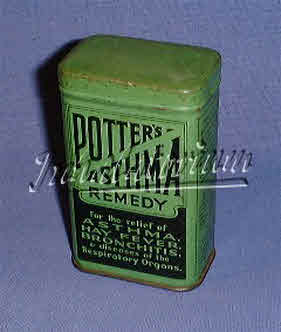
In my studies the brand I've come across most often was Potter's Asthma Cigarettes, which you can see in the picture to the right or by clicking over to inhalatorium.com.  This was among the most popular brands in Britain.

Figure 9 -- Potter's Asthma Pills (3)
The main ingredient in Potter's cigarettes were stramonium, belladonna and atropine.  Mark Sanders over at Inhalatorium.com notes that Potter's also had a variety of asthma remedies that included cigarettes, incense, pills and powders to be inhaled by Potter's funnel device (see figures 7, 8 and 9)

An asthmatic patient of mine who grew up in 1950s in Manistee, Michigan said she remembered her dad smoking cigarettes from a green package.  We later figured the produce was probalby Dr. Schiffmann's Asthmador Cigarettes.

References:
  1. "The Scarcity of Cubebs," The Chemist and Druggist," 1887, Feb. 26, page 268 of  Chemist and Druggist: A Weekly Trade Journal, 1887, Vol. XXX, January to June 1887
  2. Sanders, Mark, inhalatorium.com, http://inhalatorium.com/index.html, accessed on various dates
  3. Picture used with permission from Inhalatorium.com
  4. Jackson, Mark, "'Divine Stramonium': The Rise and Fall of Smoking for Asthma,"  Med Hist., 2010 April; 54(2): 171–194.
RT Cave Facebook Page
RT Cave on Twitter
Print Friendly and PDF

Monday, May 23, 2016

1805: American Indians smoked asthma weed

American Indians smoked dried herbs stuffed into pipes too.  Now, did they get this wisdom from travelers from far off lands, or did they come up with the idea on their own?  No one knows for sure, and either theory is a possibility.
Figure 5 -- Kellog's Asthma Relief
contained both lobelia and strammonium (2)

Either way, American Indians had access to another member of the nightshade family called lobelia inflata.  Various people experimented and observed it's effects when ingested and inhaled, and soon it was learned of the hallucinogenic effect.

At first it must have been tossed into fires, later on heated bricks or in pots, and ultimately the herbs were stuffed into pipes and smoked, just as they were in ancient India, and probably Egypt and Mesopotamia before that.

While American Indians mostly smoked their pipes for the hallucinogenic effect, or to benefit other ailments, the medicine was, at some point, recommended for asthma-like symptoms too. It is for this reason that Indian Hemp is often referred to as Indian Tobacco or Asthma Weed.

American physicians were introduced to lobelia and used it for asthma releif, yet they also used it to make some patients vomit.  The idea here was that along with vomit, toxins would be removed from the body to balance the humors and cure the ailment.

For this reason it was often referred to as pukeweed and vomitwort.  (1)

References:
  1.  University of Maryland Medical Center, "Lobelia,"  http://www.umm.edu/altmed/articles/lobelia-000264.ht
  2. Picture used with permission from Inhalatorium.com
  3. Jackson, Mark, "'Divine Stramonium': The Rise and Fall of Smoking for Asthma,"  Med Hist., 2010 April; 54(2): 171–194.
RT Cave Facebook Page
RT Cave on Twitter
Print Friendly and PDF

Friday, May 20, 2016

1802: James Anderson discovers asthma cigarettes

figure 5 --Kellogg's Asthma Cigarettes (4)
A long time passed before British physician and asthmatic James Anderson visited India and enjoyed the mild breathing relief he obtained after smoking a cigarette containing datura strammonium.  The year was 1802.  (1)

Anderson returned to England and reported his find to his friend Dr. Sims in Edinbergh.  Sims trialed it, noted the benefits, and published a report in the Edinbrugh Medical and Surgican Journal. (2) (3, page 55)

After this report asthma cigarettes were entered into British and American pharmacopoeia, and ultimately became popular for the treatment of asthma in these western nations.  (2) (3 page 55)

Of course it also should be noted here that there were no standards or regulations regarding dosing in those days, and no recommendations as to how much of a medicine should be consumed, or in this case inhaled.  (3, page 55)

Perhaps for this reason, Dr Sims reportedly died a year after his report from an apparent overdosing of Belladonna.  (3, page 55)

References:
  1. Sneader, Walter, "Drug discovery: a history, 2005, England,
  2. Sneader, ibid
  3. Smyth, Hugh D.C, Anthony J. Hickey, "Controlled Pulmonary Drug Delivery," 2100, Springer New York Dordrecht Heidelberg London
  4. Picture used with permission from Inhalatorium.com
  5. Jackson, Mark, "'Divine Stramonium': The Rise and Fall of Smoking for Asthma,"  Med Hist., 2010 April; 54(2): 171–194.
RT Cave Facebook Page
RT Cave on Twitter
Print Friendly and PDF

Wednesday, May 18, 2016

100 A.D.: Pipes made inhaling herbal remedies easy

Figure 4 --Ad for Schiffmann's Asthma Cure (1899) (3)
Again, it's impossible to know who carved out, let alone smoked, the first pipes.  It's also impossible to know for whom the first pipe was carved for, nor what herbs were stuffed inside them.

It's possible the idea of using a sharp tool to hollow out a piece of wood for smoking herbs may have occurred to various inventors in various societies at different times.  The component smoked depended on what herbs were available.

For example, in India the incentive to carve out pipes was to smoke strammonium, belladonna, or Indian hemp for it's hallucinogenic effect. The fact the herb had other medicinal properties may have been learned later, or earlier.  Who knows?

Either way, inhaling smoke directly from a pipe would have allowed direct inhalation of the smoke, resulting in a greater effect. It would also have improved convenience, meaning that herbs could be smoked anywhere and anytime.

What we know for sure is the first medicinal use of pipes to smoke a medicine for asthma-like symptoms was recorded in ancient India around 100 A.D.  There were many herbs the Indians had access to, and one such was datura strammonium. (1)

The herb produces an unpleasant smell and grows to be about five feet tall with a pale green stem with spreading branches and puplish leaves coarsely sedated along the edges.  Its flowers are white or purple.  (1)

By empirical means its entertaining effect was learned, as well as its poisonous qualities when too much was inhaled or ingested, which mainly included hallucinogenic effects.  At times it must have been observed the medicine made you mad, which may explain the name.

Datura comes from the ancient Hindu word for plant, dhatura.  Stramonium is a New Latin word meaning thornapple.  Strammonium originally came from the Greek word strychnos which means nighshade and mankos meaning "mad."  (2)

Other than thornapple, common names I've found during my research that refer to strammonium are jimsonweed, Jamestown weed, drowny thornapple, Devil's trumpet, angel's trumpet, mad apple, stink weed and tolguacha.  It was obvious by these names the side effects of inhaling too much was well known

Like belladonna, the leaves, stems and roots were dried and crushed into a fine powder the Indians stuffed into their pipes and smoked it.  The benefits obtained must have been of higher quality than simply inhaling fumes from igniting the herbs on bricks.  Although either technique may have been used, depending on what the patient had access to.

Obviously the herb may have been used for entertainment, although medicine men and physicians ultimately learned of the medicinal benefits.  By 100 A.D. Indian physicians recommended smoking  strammonium for diseases of the lungs and throat, or simply for its hallucinogenic effect.  Again, the hallucinogenic effect may be desired when no other remedy was applicable

The famous Greek physician Hippocrates wrote about stramonium and belladonna, so we know Greek physicians had access to such wisdom.  With the fall of Cordova Greek medicine made its way to Rome, so we know the Romans had access to it too.   With the fall of Rome all such knowledge was lost for over a thousand years in Europe. 

Although, shortly thereafter, all medical wisdom made its way to the Arabia, where medicine, including including the inhalation of herbs, was saved for mankind. 

References:
  1. "Plants poisonous to livestock," Cornell University's Department of Animal Science,  http://www.ansci.cornell.edu/plants/jimsonweed/jimsonweed.html
  2. "Plants poisonous to livestock," ibid
  3. Picture used with permission from Inhalatorium.comJackson, Mark, "'Divine Stramonium': The Rise and Fall of Smoking for Asthma,"  Med Hist., 2010 April; 54(2): 171–194.
  4. Jackson, Mark, "'Divine Stramonium': The Rise and Fall of Smoking for Asthma," Med Hist., 2010 April; 54(2): 171–194.
RT Cave on Twitter
Print Friendly and PDF

Monday, May 16, 2016

4000 B.C: Inhaling herbs was a great asthma remedy

Figure 1 -- Elliot's Asthma Cigarettes*
Growing up with hardluck asthma, I knew darn well the danger of tobacco smoke, or any other kind of smoke for that matter. So you can understand my amazement when I discovered asthmatics used to inhale smoke intentionally.

I made this discovery during a visit the Manistee County Historical Museum in Manistee, Michigan.  The museum is housed in the old A.H. Lyman Company building, which was a pharmacy until the mid 1950s when the building was donated.  In the back the old pharmacy shelves classic medicines.  On the box of one of these boxes was written: "Elliotts Asthma Cigarettes."  What I saw was similar to what you see figure 1.

Figure 2 -- Potter's Asthma Remedy
Photo by permission from inhalatorium.com (1)
My interest was piqued by this sight.  I thought:
If smoking was supposed to be so bad for asthma, why would any doctor recommend smoking for asthma?
I asked the museum curator if this was really a remedy for asthma, and he said that it was.  He said it was very common remedy during most of the 19th century.

It would be many years before I further investigated this, yet I never forgot about those asthma cigarettes.  My quest began in 2010, and it didn't take me long to find a ton of articles and advertisements in old newspapers and magazines and books about asthma cigarettes.

I learned that the cigarettes didn't contain tobacco, but crushed and dried herbs from the nightshade family of plants called solanaceae, which included datura strammonium, atropa belladonna, the hyoscyamus niger, Lobelia inflata and similar herbs such as Indian Hemp and Cannabis.

Such herbs contained an alkaloid called Atropine that caused mild bronchodilation, and in this way eased breathing.  The medicine also had a slight halucinogenic effect, and in this way took the edge off the feeling of air hunger by easing the mind.

So, while we think of cigarettes as hazardous, for most of history they were actually perceived as beneficial. This was, in fact, essentially the only way of inhaling medicine to obtain the greatest effect.

Figure 3 --
Kinsman's Asthma Cigarettes
(2)
It's difficult, if not impossible, to know exactly when mankind first discovered the benefits of smoking certain herbs. In fact, chances are pretty good that the first medicinal use of inhaled herbs had nothing to do with breathing and more to do with magic. 

The hallucinogenic effect allayed the mind of the medicine man so he could speak speak with the spirits or gods.  Yet other benefits must have been perceived, and at some point the quality of the medicine was shared with other members of the society. Yet even then it was probably prescribed for ailments other than asthma.

Still, at some point in the primitive world, or early on during the time civilizations were forming in Egypt and Mesopotamia, someone must have observed the medicine worked not just as a hallucinogenic but also as a mild bronchodilator, easing the mind and allowing for deeper inhalation.

In all likelihood, it occurred by chance as the herbs were tossed onto hot coals and incidental inhalation resulted in hallucinogenic effects.  Later on an asthmatic -- or someone suffering from dyspnea -- inhaled these fumes and felt relief.  This was an obvious gift from the medicine man, or more specifically, from the spirits or gods.

The first recordings of inhaling the herbs was around 4,000 B.C., which marked the dawn of the bronze age. Ancient city states of Sumeria and the empire of Egypt were in their infancy, and the discovery of papyrus and cuneiform soon allowed societies the ability to communicate from one generation to the next by writing, perhaps with a reed stick.

The Ancient Egyptians had plentiful access to atropa belladonna. It was a pungent smelling herb that grew to be about three feet high with oval shaped, pointed leaves that grew about three to six inches long with reddish or purplish flowers.   (1)

Folks experimented with this herb and discovered its poisonous effect. When too much was inhaled the person died. This gave the plant the reputation as the "deadly nightshade."

Egyptians soon learned the best recipe involved picking the leaves, stems and roots, drying them under the hot sun, crushing what was left, and using the byproduct in a variety of ways.

Egyptian women squirted drops in their eyes "for the allure given by large, black pupils: hence the name belladonna — ‘fine lady'." It made pretty eyes prettier and helped beautiful Egyptian women woo men. (1)

Medicine men, or early preist/physicians used it as a remedy for just about any respiratory ailment.

The dried and crushed herbs were tossed on bricks preheated on hot coals, and the smoke was inhaled to provide temporary breathing relief.  Over time a funnel was sometimes added to channel the smoke toward the patient's airway.

Inhaling the herb also provided a hallucinogenic effect, especially if enough was inhaled.  This may have been beneficial to the asthmatic as well, considering it helped take their minds of their trouble. Inhaling the smoke may have been beneficial to anyone suffering from a chronic illness, and was probably smoked regularly simply for recreational hallucinations.

However, there were risks, such as dry mouth, increased heart rate, dilated pupils, nausea and headache. If ingested or inhaled in high enough quantities, it may even cause death, hence the name deadly nightshade.

References:
  1.  "Belladonna," Encyclopedia.com,  http://www.encyclopedia.com/topic/belladonna.aspx
  2. Picture used with permission from Inhalatorium.com
  3. Jackson, Mark, "'Divine Stramonium': The Rise and Fall of Smoking for Asthma," Med Hist., 2010 April; 54(2): 171–194.
References:
  1. Picture used with permission from Inhalatorium.com

Wednesday, May 4, 2016

1800-2012: Evolution of back-door bronchodilator

One of the oldest and most popular asthma medicines historically are anticholinergic or muscarinic medicines. The exact mechanisms to how these medicines worked remained a mystery for most of history, so the terms anticholinergic and muscarinic are recent terms. What was known early in our history is that inhaling the medicine offered relief for asthma attacks.

Ancient Egyptian medical documents reported taking dried and crushed herbs, mainly belladonna, and placing them on heated bricks. Then the asthmatic, or the person suffering from asthma-like symptoms, inhaled the medicated smoke and was offered some relief. This was among the most common asthma remedies in Egypt.

At different times in our history, various other civilizations inhaled either belladonna, or other members of this family plants. The common name is the nightshade family, otherwise known as the Solanaceae family of plants. They include:
  • Datura stramonium 
  • Atropa belladonna 
  • Hyoscyamus niger (henbane) 
  • Lobelia inflata.
As the ancient physicians discovered, the best effect was obtained when the medicine was inhaled, and in this way, it was used as a topical applied directly to the lungs. Over time, different methods were used for inhaling the medicine, which included:

1.  Burning herbs: Leaves, roots and stems from the herbs Belladonna and stramonium were sun-dried and crushed by ancient Egyptians, placed on rocks heated on coals, and the asthmatic would roll up stalks of a reed, place one end up to the crushed herbs and inhale the smoke. Surely this sometimes made asthma worse, yet more often than not the herb offered some relief. This method was first recorded in 4000 BC, yet it was probably done long before this.

2.  Pipes:  The sun-dried products of the herbs were ground, and the powder stuffed into crude pipes, lit, and the medicinal smoke inhaled.  This technique was discovered for the modern world in 1803 for Europe and the U.S. and the asthma cigarette craze began.

3.  Cigarettes: The powder was rolled into small paper and smoked cigarettes and cigars.  This technique was commonly used in India and was discovered for the modern world in the early 19th century. An asthma cigarette craze began around 1879 and lasted until the middle of the 20th century.

4.  Pills:  During the 19th century the medicine was formed into pills that were taken by mouth.  A popular brand was Potter's Asthma Pills.  These were common from around 1880 to 1950s.

Ad for Ozone Paper
showing endorsement
by Dr. Thorowgood
(1891)
5.  Nitre/ Ozonepaper:  By the 1850s paper was impregnated with potassium nitrate, strammonium, or belladonna and ignited to produce fumes that were inhaled as a treatment for spasmodic asthma.  By 1973 this was a common mode of treatment and recommended by Dr. John Thorowgood in the British Medical Journal.  (1)  (2)  It may also be referred to as ozone paper.  One advertisement for the product even mentions Dr. Thorowgood's endorsement (see picture to right.

6.  Nebulizers/ Inhalers:  During the 19th century various nebulizers and inhalers were invented to help asthmatics inhale various solutions of the medicine.   Nebulizers, of course, were fine tuned in the 1930s, and modern inhalers were fine tuned during the 1950s.

As scientists and Pharmaceuticals worked with the plants, they learned, in 1833, that the active ingredient inside it was atropine.  From there they learned how to synthesize the medicine to create modern anticholinergics.

These include:

1.  Atropine:  It was derived from the belladonna plant in 1833, and by 1867 it was isolated and determined to be a component alkaloid of the various nightshade plants found in India, Egypt, South America and other rocky, warm climates.

It was first available for asthma cigarettes, but around the turn of the 20th century was available as a solution to be nebulized. It ultimately became a top line treatment for asthma during the 1950s.  The medicine was still prescribed for asthma during the 1980s, although by the 1990s was phased out due to a synthesized anticholinergic medicine with fewer side effects. I was prescribed this medicine in 1985 and took it up to four times per day until around 1990.

It was ultimately learned that the medicine worked by blocking the effects of the parasympathetic nervous system. This system releases a neurotransmitter called acetylcysteine which binds to muscarinic receptors that are randomly scattered along the bronchial smooth muscle. This causes bronchospasm, increased secretions, and asthma symptoms.

Prior to the 1990s, this parasympathetic pathway was thought to be the main cause of bronchospasm in asthma. Atropine and Atrovent worked by binding with muscarinic receptors, thereby preventing acetylcholine from attaching to them, thereby blocking acetylcholine. The medicine became known as anticholinergic or antimuscarinic medicine.

It was at this time, during the 1990s, that researchers learned that most cases of asthma involved some degree of underlying airway inflammation (10),  the severity of which determined how severe a person's asthma was. This inflammation worsened due to exposure to asthma triggers, resulting in bronchospasm, increased mucus production, and asthma symptoms.

It was learned that the best medicines for treating this bronchospasm and underlying airway inflammation were beta 2 adrenergic medicines and inhaled corticosteroids. At this time, anticholinergic medicine was relegated to second-line asthma medicine status, as opposed to front-line status. So, this was another reason most asthmatics are no longer prescribed anticholinergic medicine.

Atrovent Inhaler
2.  Ipratropium Bromide (Atrovent):  This is a synthesized anticholinergic, and it was first introduced in Germany in 1975, followed by the rest of Europe by the late 70s.  It was available both as a solution to be nebulized and as an inhaler, and it was prescribed four times per day.  An HFA inhaler was approved by the FDA in 2004.  I was prescribed this medicine in 1990 and took it up to four times a day until around 1995.  It was initially a top line asthma medicine, although better medicines have replaced it.  I believe the inhaler was phased out in favor of the new Ipatropium Respimat. (3) (4)

As a side note here, up until the mid-1990's, atropine, and later Atrovent, were top-line asthma medicines. Up until this time, the main pathway of bronchospasm was thought to be the parasympathetic nervous system. By this, researchers understood that atropine

3.  Oxitropium Bromide (Oxiven, Tersigen): This was another synthesized anticholinergic released along with ipratropium bromide.  It was marketed as both an inhaler and solution.  Because it was available in higher doses, the frequency was only three times per day.  This medicine was never approved by the FDA for sale in the U.S. (6)

10.  Combivent:  This is a combination of Albuterol and Ipratropium bromide in an inhaler form. It was approved by the FDA in 1996 for the convenience of COPD patients and some asthmatics who don't respond to other top line asthma medications. The medicine was set to be phased out by December 31, 2013, but due to a public outcry a new version of the medicine was introduced to the market as a replacement (see Combivent Respimat)
Combivent Inhaler

 11.  Duoneb:  This is a combination of albuterol and ipratropium bromide premixed in plastic amps with 0.3cc of normal saline. It was introduced in the early 1990s and approved by the FDA in 1996.  The medicine was nice because it made for a quicker breathing treatment, as compared to mixing separate amps of albuterol and ipratropium bromide, both with 3cc premixed.  It continues to be a top line treatment for COPD, although is an option for asthmatics.
Spiriva HandiHaler

12.  Tiotropium Bromide (Spiriva Handihaler): This dry powdered inhaler was introduced to the market in Europe in 2002 and the U.S. in 2003. It's the first long-acting back-door bronchodilator, meaning it only needs to be taken once a day.  Studies show it is more effective than ipratropium bromide in improving lung function. It is recommended as a top line treatment for COPD.   (7)

Combivent Respimat
13.  Combivent Respimat: This is the new version of Combivent approved by the FDA in 2012. The device has no propellant, is breath actuated, and delivers a dose that is supposed to provide greater lung distribution of the medicine than a metered dose inhaler. The medicine was in demand because a non CFC version of Combivent was needed.  (8)

Studies show this type of medicine may produce mild bronchodilation and mild breathing relief. Personally, I never noticed any difference with the medicine. However, modern evidence suggests the medicine, when used daily, may act as a preventative medicine, keeping lungs dilated long term.

Modern studies have found that anticholinergics that anticholinergics don't benefit asthmatics as once was suspected, and so, while they remain an option, they are no longer a top-line option.  Spiriva continues to be a top line option for COPD, as studies show it improves lung function. Atrovent and Combivent are slowly being phased out in favor of the newer medicines.

Duoneb continues to be an option for COPD patients, although even it has seen better days.  Some physicians are phasing this medicine out in favor of long acting medicines that only need to be taken once or twice a day, such as Spiriva, Brovana, and Pulmicort.

So what started out as a medicine that was sporadically recommended and inhaled as smoke around a primitive cooking fire, has evolved into a medicine that is taken in the form of simple inhalations that are conveniently and safely delivered as simple inhalations.


Anticholinergics (or muscarinics) are medicines that, once inhaled, sit on cholinergic (or muscarinic) receptor sites that sit along bronchial smooth muscles. It binds to and sits in these receptor sites, thereby preventing the neurotransmitter acetylcystine from binding to them.

of the neurotransmitter acetylcysteine to prevent it from causing bronchospasm. Because the medicine is blocking a natural response as opposed to actively causing bronchodilation, it is often referred to as a "back-door bronchodilator."


    The first "back-door bronchodilators" used came from the nightshade family of plants called Solanaceae, and were often included in ancient recipes for asthma remedies.  Some common plants used were:
    
    References:
    1. "Nitre paper," Drugs.com, http://www.drugs.com/dict/niter-paper.html
    2. Thorowgood, John, "On Bronchial Asthma," British Medical Journal, 1873, Nov. 22, page 600
    3. Sittig, Marshal, "Pharmaceutical Manufacturing Encyclopedia," 1988, vol. 1, New Jersey, page 837
    4. Barnes, Peter J., Jeffrey M. Drazen, Stephen I. Rennard, "Asthma and COPD: Basic Mechanisms and Clinical Management," 2008, page 616-17
    5. Ipatropium Bromide, package insert, http://bidocs.boehringer-ingelheim.com/BIWebAccess/ViewServlet.serdocBase=renetnt&folderPath=/Prescribing+Information/PIs/Atrovent+HFA/10003001_US_1.pdfingelheim.com/BIWebAccess/ViewServlet.ser?docBase=renetnt&folderPath=/Prescribing+Information/PIs/Atrovent+HFA/10003001_US_1.pdf
    6. Barnes, op cit
    7. Barnes, op cit
    8. "FDA Approves Combivent Respimat (ipatropium bromide and albuterol sulfate) Inhalation Spray," FDA.gov, http://www.fda.gov/Drugs/DrugSafety/InformationbyDrugClass/ucm274684.htm
    9. *Picture with much appreciated permission from Inhalatorium.com
    10. Wright, Rosalind J., Mario Rodriguez, Sheldon Cohen, “Review of psychosocial stress and asthma: an integrated biopsychosocial approach,” Thorax, 1998, December, http://thorax.bmj.com/content/53/12, accessed 7/18/17
    RT Cave Facebook Page
    RT Cave on Twitter
    Print Friendly and PDF

    Wednesday, February 24, 2016

    1833: Atropine Discovered as active ingredient in asthma cigarettes

    Figure 6 -- A variety of asthma cigarettes were available.
    There had to be something in the nightshade family of plants that produced the medicinal effect, and this component was the alkaloid Atropine.

    Atropine was first derived from the belladonna plant in 1833.   By 1867 Atropine was isolated by von Bezold.  It was then determined to be a component alkaloid of the various nightshade plants found in India, including the datura strammonium, atropa belladonna, and the hyoscyamus niger (black henbane), and Lobelia inflata (According to encyclopecia.com)

    Early studies showed atropine was the potent component in the plant, the same component that dried secretions, increased heart rate, opened air passages, and produced a hallucinogenic effect.  It was the ingredient that that made the nightshade family of plants so sought after.

    RT Cave Facebook Page
    RT Cave on Twitter
    Print Friendly and PDF