Thursday, August 11, 2016

1910: Melttzer links asthma with allergies

Samuel James Meltzer (1851-1920)
Samuel James Meltzer is another significant figure in the history of asthma. He collected and studied as much data regarding asthma as he could, and performed some studies on his own, all in an attempt to learn as much as he could about the disease.  His discoveries would have a significant impact on the evolution of the definitions of both asthma and allergies.

He was born in Curland, Russia in 1851, studied medicine in Germany, received his medical degree there in 1882. 

He visited the United States on various occasions when he was a ship surgeon during trans Atlantic trips. He stuck with this job even though he often became sick at sea because it was the only way he could afford to get to the United States.  (4, page 12)(5, page 25)

He found the democratic government of New York appealing, and decided to set up his practice there. This allowed him to make enough money to support his family, and to dedicate a portion of his time to research. (4, page 12) (5, page 25)

In 1904, he became head of the Rockefeller Institute's Department of Physiology and Pharmacology, and in 1907 he became a full time physiologist. This was of no surprise to those who knew him, because his favorite subject was physiology and research.  He became the first president of the American Association of Thoracic Surgery in 1918, and was instrumental in the advancement of the organization.

Dr. George B. Wallace explained that Meltzer:
"...was a man who loved and pursued knowledge for it's own sake.  This was an inherent characteristic... With the environment in which his medical education began, it isfemall wonder that Meltzer's interest turned to research work. What especially impressed him from the beginning was first, the necessity of careful observation and thoroughness in work, and, second, the importance of facts rather than theories. Those who have heard Meltzer present experimental work will, I think, recall numerous instances in which, when pressed for an explanation of his results, he has replied that although he had a theory, it was only the fact itself that he wished to bring out. (4, page 13)
By his research and ideas, he made significant contributions to a variety of areas of medicine.  For the sake of our history, he made significant contributions to the field of respiratory therapy.  For one thing, he invented a device for providing breaths to victims during artificial respiration. 

He also made significant advancements in the study of asthma. The following are the conclusion he made about our disease:

1.  By performing studies in his lab he determined the symptoms of anaphylactic shock were similar to the symptoms of asthma.  Both conditions result in shortness of breath due to spasms of the air passages in the lungs. (1, page 173) (2, page 54)(3, page 115)

2.  He described how an asthmatic can become sensitized to certain substances, and then, when exposed to those certain substances, the asthmatic air passages become hyper-reactive.  This response is what results in an asthma attack.  (3, page 115)

3.  He discovered that Atropine relieved asthma symptoms, and he believed it worked because it relieved allergy symptoms.  (3, page 115)

4.  Based on all the accumulated data he obtained from both his research and studies, he postulated that asthma was not a nervous disorder and that it was, in actuality, an allergic disorder.  This would have a significant impact on other asthma experts of his era, because for many generations asthma was believed to be nervous in origin.  (1, page 173) (3, page 115)

He passed away on November 7, 1970, although through his contributions to medicine his legacy will live on. The best summary of his life was made by Howell:
By his good work and his high character he attained a position of honor and distinction in American medicine and endeared himself to his fellow workers in all parts of the country. His productivity was remarkable. The list of his published papers includes over two hundred and forty titles, distributed among some forty-eight scientific journals of this country, Germany and England. These papers contain contributions to the subjects of physiology, pharmacology, pathology and clinical medicine together with a number of lectures and general addresses. That he was an investigator of recognized standing in these several branches of medicine and was regarded as a valued contributor to so many scientific journals of the first rank is a striking demonstration of the breadth of his interests and knowledge. ... his work... entitles him certainly to be ranked among the foremost American physiologists." (5, pages 25-26) 
We can especially thank him for his contributions to asthma, as through his research scientists were better equipped with knowledge to more accurately define the disease.

References:  
  1. Lipkowitz, Myron A., Tova Navarra, "Encyclopedia of Allergies," 2nd edition, 2001, New York, page 173
  2. Mittman, Gregg, "Breathing Space: How allergies shape our lives and landscapes," 2007, New Haven and London, Yale University Press, page 54
  3. Jackson, Mark, "Asthma: A Biograhy," 2009, New York, Oxford University Press, page 115
  4. Wallace, George B., "A tribute to Dr. Meltzers life and service," during a memorial service fo Dr. Melter, published in the book "Memorial Number for Samuel Meltzer, M.D., Founder and First President of the Society for Experimental Biology and Medicine," 1921, New York, Press of the New Frontier Company, pages 11-16
  5. Howell, William H, "Dr. Melter's influence on American Physiology."  This was a speech given in tribute to the life of Dr. Meltzer published in the book "Memorial Number for Samuel Melzer," 1921, New York Press of the New Frontier company, pages 25-36

Wednesday, August 10, 2016

1918, 1947: Frances M. Rackemann redefines asthma

Frances Rackemann
The year 1901 was the dawn of modern asthma wisdom and treatment. This was a year that saw the introduction of epinephrine and ephedrine. It was also the year that a young man named Francis Milton Rackemann graduated from Harvard College at the age of 14.  He would grow to become the greatest asthma and allergy expert of the 20th century.

In a memorial tribute to his friend, Dr. Walter S. Burrage explained that Dr. Rackeman was born in 1887, and then, after graduating from college, a series of coincidences lead to him becoming an allergist.

First, he followed his cousin to Harvard where he was completing his registration to medical school on the last day. After his cousin was done, the Registrar turned to Rackemann and said, "How about registering yourself? Just mail us a copy of your college diploma and turn up tomorrow at nine o'clock for the first class." Rackemann did both, and four years later he graduated cum laude.

Second, in 1914 and 1915 he worked with Warfield T. Longscope doing research on anaphylaxis. The two would write a series of papers about allergies. This experience catapulted Rackemann's career as an allergist, and he would go on to write over 175 papers on allergies. (7)

There were two popular views on asthma at this time. One was that asthma was a nervous condition, and treating it was as simple as soothing the mind of the patient. The second was that asthma was an allergic condition and that curing it was as simple as finding the right protein to inject into the patient.

Rackeman would write several papers refining the definition of asthma.  The most significant were: "A Clinical Study of One Hundred and Fifty Cases of Bronchial Asthma," written in 1918, "Intrinsic Asthma," written in 1947, and "Nervous Factors in Asthma," written in 1969.

Rackeman believed asthma was a symptom more so than a disease. He also believed not all asthma could be defined as allergic, and therefore, in his 1918 paper, he categorized most asthma cases as either extrinsic or intrinsic. He further expounded on this in his 1947 paper.

Extrinsic asthma was defined as asthma caused by substances inhaled or ingested from "without the body." In these cases, the asthmatic develops hypersensitivities to proteins on these foreign objects. Their bodies develop proteins (later identified as IgE antibodies) to these substances (now referred to as allergens), and subsequent exposures cause the allergy and asthma responses. (3).

He described extrinsic asthma as being more often associated with childhood-onset asthma and generally presents prior to the age of 12. It affects more boys than girls. Today, it's often referred to as allergic or atopic asthma and has a greater tendency to be hereditary.

The diagnosis of extrinsic asthma may be made by allergy skin testing. For the treatment of extrinsic asthma, he recommended allergy shots to make the patient less sensitive to the proteins in that substance. For example, for a pollen allergy, "treatment with an extract of the specific pollen will relieve the hay fever and the asthma often entirely."

Although, he did mention that desensitization or immunotherapy as it is often called, does not work for all patients. For example, he suggested that, for those asthmatics allergic to horses, injecting these patients with the proteins of horses does not always prevent the allergic response of those patients to horses.  (3)

Intrinsic asthma was defined as asthma caused by substances from "within the body." It would include asthma caused by sinus infections, chronic sinusitis, nasal polyps, teeth infections, gum infections, throat infections (croup), acute bronchitis, colds, kidney failure (kidney asthma), heart failure (cardiac asthma), gastrointestinal irritation, etc.  It usually affects adults more so than children and is more likely to be chronic than extrinsic asthma.

The remedy for intrinsic asthma was fixing the causative agent.  For example, if acute bronchitis is the cause, then the remedy would be to resolve the bronchitis.

However, he wrote that "the treatment of intrinsic asthma is far from satisfactory.  Local treatment of the nose, throat, and teeth has been long considered important.  The removal of nasal polypi, the drainage of sinuses and the extraction of teeth will all relieve the asthma.  This relief, however, rarely amounts to a cure and even if very marked is rarely permanent.  The fact that many patients have spontaneous intervals of freedom from asthma which last for months or years, makes the results of any treatment difficult of interpretation."

In his 1940 article, he discussed the idea of vaccines to prevent bronchial infections, yet, he wrote, "from these cases must be left for some future time." (9)

Rackemann explained that while asthma may be distinguished by extrinsic and intrinsic, the general symptoms of the disease are very similar. For instance, while pulmonary function testing may help diagnose asthma, it cannot distinguish between intrinsic or extrinsic. (3)

In 1927, he wrote the chapter on asthma and allergies for the first edition of Cecil's A Textbook of Medicine, a medical textbook still used to this day.  He explained the most up to date wisdom of these diseases at this time and listed several allergens such as dust, fumes, foods and animal dander.

He also mentioned that most asthma cases were associated with increased eosinophils in the blood and sputum, including Charcot/ Leyden Crystals. (4, page 21)

He also supported the 19th-century theory that asthma was a nervous condition. However, while he supported the nervous theory, he did not support the age-old idea that a nervous condition, such as anxiety or stress, explained all cases of asthma.

He described this in his 1969 paper. He explained that to diagnose all asthma as nervous would result in missing the real cause, which may be an allergy to a cat pillow or an infection caused by a cold. (8)

He explained that some cases of asthma are mainly nervous, and most of the time this involves intrinsic asthmatics.  He also explained how desensitization shots or skin testing may have no other effect that to "impress the patient and show that something is real and being done." (8)

Rackeman believed that the best treatment could be provided when the physician worked with the patient.  For 33 years he set up his general practice at his home, and often his family members had to shuffle through patients to get to their bedrooms.  He would also often visit his patients at their homes, and at times walk away "bandishing a guilty feather pillow." (7)

He was likewise friendly with his students.  He is believed to have provided the first exposure to allergy testing and desensitization to medical students.

In over 175 writings on allergies, he listed a variety of proteins that might cause asthma (6):
  • Ragweed
  • Horse hair
  • The spit protein of wheat
  • Egg white
  • Goose feathers
  • One meat, as beef
  • One fish, as codfish
  • Dust  (4, page 21)
  • Fumes
  • Animal dander
  • Molds (5)
Other than removal from or fixing the causative agent, Rackemann recommended the following as treatments for asthma (note that the treatment for asthma improved throughout Rackemann's career) (4):
  • 0.25 ml Adrenaline chloride repeated every half hour as needed (almost always works for all cases of asthma)
  • Smoking strammonium leaves
  • Cocaine nasal spray
  • Morphine (rarely works)
  • 20-25 mg of ephedrine three times a day as an alternative to adrenaline
  • Potassium iodide
  • Ipacec
  • Moving to a dry climate
  • No eating during an attack
  • Aminophylline in cases where adrenaline doesn't work (after it was proven to be an effective bronchodilator in 1922, it became more prominent intravenously after studies proved it to be effective in 1937.  I have an upcoming post about theophylline)
  • Diuretics for pulmonary edema (although we now know pulmonary edema is associated with cardiac asthma and not true asthma)
Burrage explained that Rackemann provided some of the first exposure to allergy skin testing that students had ever had. Other than Dr. Robert Cooke, Rackeman made more contributions to the understanding of allergy than any other physician. His name was well known within the medical communities in the United States as well as several other countries. (7)

He was a community organizer.  In 1923 he became founder of American Society for the Asthma and Allied Conditions and founder of the Allergy clinic at Massachusettes General Hospital, the first of its kind in the U.S.  He was the first president of the American Association of Allergy in 1934.  Ultimately these two organization merged to become The American Academy of Allergy.

Based on respect for Rackemann and his belief that asthma was an allergic condition and a nervous condition, most emphasis on asthma research was focused on these areas.  While he was on the right track and had noble intentions, this may have slowed the progress of asthma wisdom in other areas.

Yet, it was, Dr. Rackemann's interest asthma drove others to study it more intensely in the years between WWI and WWII. This resulted in a continued growth in asthma and allergy wisdom. Asthmatics should remember him as the most well known and respected asthma expert of the first half of the 20th century. He passed away in 1973 at the age of 85.

His dictum was "there is always something that can be done to help the asthmatic." (7) It was this way of thinking that lead to his many observations about allergy and asthma that lead to improved care for the asthmatic patient.

References:
  1. McFadden, E. R. Jr. "A Century of Asthma," American Journal of Respiratory and Critical Medicine, Vol 170, pages 215-221.  
  2. Adkinson, N. Franklin JR, "Is Asthma Always An Allergic Disease?", 1946, http://www.ncbi.nlm.nih.gov/pmc/articles/PMC2376710/pdf/tacca00085-0288.pdf
  3. Rackermann, Frances M., "A Clinical Study of One Hundred and Fifty Cases of Bronchial Asthma," Archives of Internal Medicine (The American Medical Association), Oct., 1918, Vol. 22, No. 4, page 517-552
  4. Brenner, Barry E., ed., "Emergency Asthma," 1999, New York
  5. Rackerman, Francess M., "Molds as a cause of hay fever and asthma," 1937, http://www.ncbi.nlm.nih.gov/pmc/articles/PMC2242158/pdf/tacca00017-0255.pdf
  6. Rackerman, Frances M., "Asthma, Hay Fever and Allied Conditions," The Medical Clinics of North America, Jan. 1920, Philadelphia and London, pages 1065-
  7. Burrage, Walter S, "Francis Minot Rackermann, M.D.," Trans. Am. clin. Climatol. Assoc., 1974, 85;xliv
  8. Rackemann, Frances M., "Nervous Factors in Asthma," 1969
  9. Rackemann, Frances M, "Intrinsic Asthma," January, 1940, http://www.jacionline.org/article/S0021-8707(40)90829-2/pdf, accessed 

Monday, August 8, 2016

1823: Native American sweat houses, an early panacea

Native Americans of both South and North America believed that sweating was one of the simplest and most effective means of treating diseases. The various people who lived among or studied native Americans observed their use of herbal remedies to cause a sweat, or sweat houses.

Virgil Vogel, in his 1970 book "American Indian Medicine," notes that the Aztecs used the sweat bath as a cure all for many ailments. There were various experts who noted the use of sweat baths among the natives of North America. He quotes Jean Bernard Bossu (1720-1792) who observed the Choctaws of Canada using "steam cabinets in which are boiled all sorts of medicinal and sweet-smelling herbs. The vapor filled with the essence and salts of these herbs enter the patient's body through his pores and his nose and restores his strength." (2, page 255)

John D. Hunter also describes sweating, and says it's a good asthma remedy. In fact, Hunter says that most of the medicines used to treat asthmaare meant to induce a profuse sweating, which is believed to cause healing. You may read of other remedies, and sweating is usually the desired result; rather, improved breathing through sweating. (1, page 410)

We must understand that sweating was not just used for asthma, it was sort of a panacea for many ailments. (2, page 256) It was a way of cleansing the body and the soul. Hunter describes this:
Nes-ni-ne-shu-ka-ah. — The salt water runs. Sweating. — Among all the various Indian nations with which I am acquainted, sweating constitutes one of their principal remedies, and amongst some of them * like bathing, it is practised for the pleasurable sensations which it produces. Various means are resorted to for the attainment of this object. Some effect it by drinking warm infusions; others assist these means by enwrapping themselves in blankets or skins, while a majority have separate apartments prepared for the purpose of procuring it by exposure to the steam of water. For this, a house sufficient in size to contain one, two, or more persons, is constructed of sticks or logs; commonly on the sloping side of a hill, and convenient to water. An excavation is next made in the earth-flooring, in which they place heated rocks. The bath thus prepared, the patient closes himself in, and pours water on the rocks till the apartment is filled with steam, and the intended effect produced. Herbs and roots of various kinds are placed on the rock, with a view that their virtues may unite and ascend with the vapour. During the process, the patient drinks freely of the infusion of dittany, mountain tea, or other herbs. He remains in as long as the heated rocks retain warmth sufficient to produce vapour. When he leaves it, he wraps himself in a buffalo robe or blanket, and immediately, if able, repairs to his house, and if not he is assisted and goes to bed. I have frequently known them to remain in until they became quite faint. When this bath is used as a luxury, they frequently, on leaving it, plunge into cold water; and I have never witnessed any dangerous or ill effects to arise from the practice. Some tribes resort to another expedient to induce sweating. They make a hole in the ground of a size and depth sufficient to contain the body of the person wishing to undergo the operation. They continue a fire in it till it becomes quite heated. The patient wrapped in his blanket or robe, stands over the excavation, water is poured in it, and the steam rises between his body and its envelop; while others again immerse themselves in the water.They also produce sweating by covering themselves in the hot sands of the barrens, and I believe with much advantage in some cases. (This may also be considered an early, or primitive, fumigation.) (1, page 423-44)
It was a soothing remedy and one that was easy to do. It was a remedy that was inculcated deep into folk medicine. I remember when I was a kid and having asthma trouble, my dad would sit with me in the bathroom with the hot water showering in the tub. My grandma would have me sit with my head
under a towel in the bathroom sink with the hot water on. Surely this provided a cool sensation, but it rarely if ever provided any breathing relief.

References:
  1. Hunter, John D., "Memoirs of a captivity among the Indians of North America, from childhood to the age of fifteen: with anecdotes descriptive of their customs to which is added some accounts of the soil, climate and vegetable productions of the territory westward of teh Mississippi," 1823, London, Paternoster-Row
  2. Vogel, Virgil J. "American Indian Medicine," 1970, London, Oklahoma University Press
RT Cave Facebook Page
RT Cave on Twitter
Print Friendly and PDF

Friday, August 5, 2016

1823: Hunter shares native American asthma remedies

Figure 1 - John D. Hunter

John D. Hunter published a book in 1823 describing his experiences growing up among the Indians of North America, providing us a rare opportunity to see inside Indian Tribes. Of particular interest to our asthma history is Hunter's description of how the Indians perceive hasthma and what remedies they used to treat it.

Hunter recollected no idea where he was born, although he knew the Indians massacred his parents, and took him prisoner. He became the property of a warrior named Fongoh of a tribe of the Kickapoo Nation along the Kalkaska river in Michigan. The Kickapoo were among the hundreds of thousands of Algonquin Indian tribes, and they were nomads who "roam with unrestrained freedom" to hunt for game and to cultivate the soil for the purpose of planting crops used to make food and crafts. The main crop of the Indians Hunter lived with was sugar, at least while they lived along the Kalkaska River. (1, page 8)
Figure 2 -- Kickapoo Hut (wickiup) and tribal member

The Kickapoo set up huts called wickiups, which consisted of an "oval base and a rough frame covered with reed mats, grass, or brushwood."

You can see a picture in figure 2.

As they traveled from place to place these were easily set up. Inside many of these homes, and amid the contents carried on their backs as they traveled, were medicine bags made of beaver or otter skin that were "curiously ornamented."

These bags contained "small sacred articles," along with "medicinal barks, roots, and herbs." Since they were considered sacred, not even "unhallowed hands" would interfere with their contents. (1, page 342)

Hunter said that...
...every encroachment made upon their territory, whether with or without their consent, is, sooner or later, regarded as infringement of their natural rights, and has frequently given rise to long, cruel, and exterminating wars, not only between different tribes, but between the Indians and the whites. They regard the latter with much the most scrupulous jealousy; because experience has taught them that every settlement on their part, within their boundaries, is a precursor to their farther recess, which, they most sensibly feel, will only terminate with their final expulsion, extermination, or incorporation with those they esteem their natural and most bitter enemies. (1, page 8)
This, he believes, is how he came to live among the Indians. He watched them go to war with white families, and massacre the warriors, and take the children prisoners. While jealousy is a main cause for war, he said that in most cases the the Indians were "provoked" by "frauds and thefts practised upon them, which provoke to retaliation and aggression; consequently, the innocent and guilty indiscriminately suffer. Such conduct, mutually practised by them and the whites, along the whole extent of the conceived, though arbitrary boundary, is the cause of the inveterate hostility that exists between them, and leads to all the scenes of Indian cruelty that are practised on the frontier settlers." (1, page 9)

So it was in this way that he and others like him were "forced to assume the Indian character and habits," and after a while they became "happy and contended as though they had assembled directly from the Indians, and were in possession of their patrimony." (1, page 13, 14)

Many of the other white children raised by the Indians adapted to the simple primitive life so well that they chose to live out the remainder of their lives among the Indians, Hunter said.

He added that he was not one of these.   (1, page 13, 14)

When he was 19 or 20 he says he was allowed to go free, and he most duly accepted his freedom. He returned to become a citizen of the United States, and it was during this part of his life that he wrote of his experiences among the Indians.  (1, page 13, 14)

The first Indians he lived with marched north to Mackinac where there was better hunting, and they joined with other Indians, and at some point these Indians, and all the Indians he lived with, were massacred, and once again all the women and children were taken prisoners. Somehow along the way he ended up with a tribe associated with the Osages, who were much less settlers as the Kickapoo were, and more likely to wander in search of game. Occasionally they came into skirmishes, as did the Kickapoo, and in the course massacres occurred, and the heads of enemy warriors were walked back to camp, along with prisoner women and children. He didn't know the name of the tribe, although he knew they were among the Pawnee. (1, page 18)

His tribe ended up among the Kansas tribe, were ambushed, and members of his tribe either fled, were killed, or taken prisoner. Hunter was among those taken prisoner, and with his new tribe set off on a long march to the Kansas River. He was "adapted into the family of Kee-nees-tah by his squaw (wife), who had lost a son in one of their recent engagements with the Pawnees. I was exceedingly fortunate from this election; and not only the chiefs and squaws, but the whole tribe, treated me with regard and tenderness. This conduct in respect to myself was not singular, for all the women and children were treated in the same manner; while the warriors who were so unfortunate as not to fall in battle were nearly all tortured to death: a few of them, however, were respected for their distinguished bravery, and permitted to live amongst them. (1, page 19)

In comparing the Kickapoo with the Kansas, he said:
Injustice to my own feelings, I cannot avoid making some remarks in this place, on the difference of character that exists between the Kickapoo and Kansas Indians. The former are treacherous, deceitful, cunning, not tenacious of a good character, exceedingly remiss in their social habits and intercourse, and are held in humble estimation by the neighbouring tribes: while the character of the latter, according to the estimation I formed of their conduct to me, is directly the reverse.  In this difference of their general character, it is, however, possible for me to be mistaken; but gratitude is a virtue inculcated by all the Indian tribes with which I have been acquainted; and so great was the change of conduct towards me, after my transposition from the former to the latter, that I am persuaded my readers will excuse me, even should I have committed an error. (1, page 19-20)
They had horses, and they ate venison, buffalo meat, corn, nuts, etc. He learned how to ride horses, learned how to hunt, and learned to protect his hunting grounds from encroachments. He learned their virtues, values, and customs by listening to the "inspiring narratives" of the sages. The sages, according to Hunter, would say things like:
"Never steal, except it be from an enemy, whom it is just that we should injure in every possible way. When you become men, be brave and cunning in war, and defend your hunting grounds against all encroachments. Never suffer your squaws or little ones to want. Protect the squaws and strangers from insult. On no account betray your friend. Resent insults — revenge yourselves on your enemies. Drink not the poisonous strong-water of the white people; it is sent by the Bad Spirit to destroy the Indians. Fear not death; none but cowards fear to die. Obey and venerate the old people, particularly your parents. Fear and propitiate the Bad Spirit, that he may do you no harm; — love and adore the Good Spirit, who made us all, who supplies our hunting grounds, and keeps us alive."
It is in this way that Hunter learned the ways of the Indians, and became a credible author on the subject. He said that the Indians were were a very healthy people, and that the warriors were morel likely to die in a fray as compared to natural causes. There were essentially few diseases among the Indians, and most tribes were familiar with the diseases that were most common to their tribe, and by trial and error they learned of the best remedies for treating these maladies. Since asthma was a disease that plagued those who lived to old age, there would be remedies for asthma in many medicine bags. (1, page 342)

He wrote the following about asthma:
Asthma. — When we consider the hardships the Indians undergo, it is not surprising that they should be subject to asthma. This is not an unfrequent disease among them. Their remedies are blisterings, fomentations, and anodynes. There is, perhaps, no complaint, in which Indian remedies are more successfully employed. They use the sweat-oven, as before described, with great success. Sometimes relief is obtained by the application of small bags of wet ashes upon the breast; and sometimes by inhaling the streams arising from water poured upon hot stones, and herbs of various kinds. But by far the most valuable remedy ever used among them for the cure of this distressing complaint, is a small plant, .wesh-ke-nah. This plant somewhat resembles the common flax, though it is more branched, and not linty like the latter. An infusion of it, roots and tops together, in doses of half a pint, at intervals of twenty minutes, till relief is obtained, is the usual mode of administering it . In a short time its beneficial operation is perceivable by a gentle moisture on the skin, more easy respiration, ability to lie in a recumbent posture, &c. Shortly after a more copious sweating comes on, attended with an expectoration of phlegm or mucus, and entire relief from pain. The patient now falls into a comfortable sleep, from which he awakes free from his disease. Thus have I seen these untutored followers of Esculapius subdue some of the worst cases of asthma. (1, page 443-4)
This description of asthma is not the same as our modern definition. As would be normal for the time, his description was mainly of the symptom of shortness of breath or dyspnea, which could be from any generic cause.

He also explains the asthma remedies stored in the medicine bag.
  • Wesii-ke-nah.—  It relieves hard breathing. The flax weed—grows in the fissures of rocks, particularly on cliffs, on the margin of the rivers, to the height of ten or twelve inches; the root sends off many branches, which in July produce numerous small pale blue flowers. The Indians gather the plant, while in blossom, and prescribe it for asthmas and coughs with the happiest effect . The roots, leaves, and stalks, are made into a decoction, and given freely to the patient, as warm as he can conveniently take it; and no medicine displays its salutary effects more promptly. I speak thus confidently, because I have witnessed its operations. The Indians sometimes while travelling, or when just returned from long and fatiguing journeys, are seized with the asthma, but are certain to obtain prompt and decided relief from this remedy. I believe it almost uniformly excites a perspiration, on the appearance of which the patient becomes easy. (1, page 410)
  • Was-saw-ba-he-ja. — The fat of the bear. Bears' oil.— This is used as a medicine, both internally and externally, in combination with many drugs...  For colds they seethe the roots of wild liquorice in it, which they drink hot as they can well bear it. They also take it for asthma and pleurisy. They esteem it among the most valuable articles of food, especially in their journies. It is highly nutritive, agrees well with the stomach, and produces no thirst . From the smallness of the quantity necessary to satisfy the appetite, it produces no shortness of breath. The Indians, while travelling, take about four ounces in twenty-four hours, which they continue for days together, with very little other nourishment. (1, page 404)
  • Ne-pe-sha.—Bad luck to touch it. Milk-weed.— ...The Indians use the roots in decoction for the cure of dysentery, dropsy, and asthma. It is also used as an emetic, and held in tolerably high estimation as a medicine in the above cases. (1, page 414)
  • Sin-des-nes-ni.—It grows by the water. Green-twig.—(Willow) This is a shrub very common on the banks of rivers and water courses. It seldom attains to a height exceeding six or eight feet, and is considered valuable in colds, and asthma; they give a warm infusion at night, with a design to excite perspiration. (1, page 411)
  • TU-TUS-Se-GA-O-GA-SHE. To expel Wind. Spikenard. — This spikenard is one of the most luxuriant of the forest plants: it grows in the beds of hollows in hilly districts in great abundance, and if it possesses half the virtues ascribed to it by the Shawanee Indians, it merits a high rank in the Materia Medica. They give it with a view to expel wind from the stomach, to stop coughs, and to relieve pain in the breast and asthma. (1, page 422)
  • Sweating:  The various herbs above usually cause improved breathing by causing the patient to sweat. (1, page 410)  Another means is to take in a draught of herbs and spices.  Another means was to places herbal solutions on heated bricks, rocks, or pots, and place a blanket or furs over the patient's head.  Another means was the sweat house, where water was placed on heated rocks and the fumes inhaled.  This was done while drinking tea. (1, page 423-4)
There are other ailments that plagued the Indians besides asthma, and these included pleurisy, fevers, and upset stomachs and pains. Consumption also plagued them, although rarely. (1, page 342, 347)

Usually the plagues were short term, and were the result of exposure to the elements and fatigue from long excursions and working hard and bravery. Although at times diseases became chronic, or the patient became "dangerously sick." (1, page 342, 347)

Some of these patients become sick enough to be housed in a hut for sick people, with cots that were raised from the ground. The medicine men would treat these patients daily, and nurses, usually women, would care for their daily needs. These may have been considered as hospitals. As they traveled from place to place, the sick were continuously cared for (1, page 342, 347)

Since pure asthma must have been extremely rare among the Indians, most asthma must have actually been bronchitis from inhaling smoke, or heart failure from old age, and these probably would have been the asthmatics referred to by Hunter. This must have often been what ensued when a warrior lived to old age. Of these, Hunter wrote the following: 
When all natural means fail, the physicians do not abandon their patients; on the contrary, they cling to them till their last gasp, but substitute, instead of their prescriptions, fastings and prayers to the Great Spirit. "So long as there is life," say they, "there is room for hope; and to despair of effecting good, and to neglect means that appear remote and almost foreign to the disease, bespeak a careless and unskilful practice." When their hopes fail, they seldom inform their patients of their danger, but are very cautious that their last moments may be calm and undisturbed. In general, they look upon sickness and affliction as chastisements for their offences against the Great Spirit, and commonly bear them with great resignation and fortitude. When they become peevish and fretful, as sometimes happens, their doctors then say, that the abatement of their disease permits their minds to be idle or unoccupied, and the danger is past. (1, page 350-351)
He described the Indians as having "no anxiety about the future, and they, but leave the world with an apparent satisfaction, under a belief, provided their conduct has been in consonance with the precepts which they have been taught, that their title to the future happiness is unquestionable." (1, page 352-3) 

This must be similar to modern Christians, whose belief in God and the afterlife allows them to end life with grace in dignity.

For the most part, however, as a remedy was needed, either the patient or the nurse, who was mostly the mom or consort or some other woman in the tribe, gave the remedy to the sick person.  

If the remedy no longer worked, which most likely would happen if the person was severely sick (as if close to death), the medicine man (or physician) would be consulted.  I will describe the healing powers of the North American Indian Medicine Man in my next post.  

Note:  Similar remedies were used for colds, pneumonia, consumption, and pleurisy.  (You can find some more asthma remedies by reading "Herbal and Magical Medicine: Traditional Healing Today," edited by James K. Kirkland et al, page 157)

References:  
  1. Hunter, John D., "Memoirs of a captivity among the Indians of North America, from childhood to the age of fifteen: with anecdotes descriptive of their customs to which is added some accounts of the soil, climate and vegetable productions of the territory westward of teh Mississippi," 1823, London, Paternoster-Row
RT Cave Facebook Page
RT Cave on Twitter
Print Friendly and PDF

Wednesday, August 3, 2016

1738: The Bernoulli Principle

The market for a device to create a spray was looming.  Perfume marketers yearned for a device to spray their products onto ladies.

The medical industry yearned for a product to spray medicine into the airways of respiratory patients.  Yet no such product would be possible without knowledge of the Bernoulli Principle.

We are not concerned about the perfume industry here, yet there are two times in the history of aerosol therapy that the perfume market actually helped the medical industry.

The first time was during the mid 19th century, and the second was in the mid 20th century.  The first produced the nebulizer, the second our modern inhaler.

As far as the inhalation of medicines, the medical industry already had one very good method, and that was the inhalation of smoke and steam.  The problem was that there were two different types of medicine: volatile and non-volatile.

Volatile medicines could be ignited and thus inhaled.  Tobacco, for example, is volatile and can be stuffed into a pipe and burned.  Strammonium and Belladonna were volatile, and could be placed on a brick, stone or plate, ignited, and the smoke inhaled.  This knowledge was known since the ancient world.

By the mid 19th century the search was on for a device that would turn a solution into a spray.  It was believed that such a device would break down the solution into atoms, and in this way the solution could be inhaled.  This breakdown was thus referred to as atomization, pulverizing or nebulizing, and the devices created were often referred to as atomizers, pulverizers or nebulizers.

Yet no such machine would have been invented if not for the discovery of the Bernoulli Principle. Daniel Bernoulli observed that when water hits a rock it creates a mist that can be inhaled. He published a book in 1738 where he described that a similar effect could be created by forcing water through a narrow tube.

His concept was based on the fact that the faster water flows through a tube, the less the lateral pressure will be.  A decreased lateral pressure is also referred to as a negative side stream preassure.  If there is a hole in the side of the tube, the negative pressure will force water into the stream.

This same concept was used in creating the first nebulizers, only using air.  Air is forced through a tube, and a hole in the tube is connected to a container with a solution in it that contains the medication.  The fluid is basically sucked in due to the negative sidewall pressure, and turned into a spray or mist. (1, page 61)

This concept is illustrated in figure 1.  In this figure steam is used to create the flow and the negative side stream pressure.  As the steam flows through the tube the negative side stream pressure causes the solution in the cup to be sucked into the stream, and thus a spray is developed.

References:
  1. Clark, William F., Paul J. Mathews, Kenneth A. Wyka, "Foundations in Respiratory Care," 2002, Delmar Thomson Learning

Monday, August 1, 2016

400 B.C.-1881: Steam inhalers

Stern's Inhaler (3)
Since the time of Hippocrates, and more than likely even before that, the inhalation of steam was often recommended for people suffering from various ailments, which included syphilis, asthma, bronchitis, pneumonia, hay fever, phthisis, croup, laryngitis, influenza, etc.  It was something that appeared to provide some immediate relief for difficult breathing.  

At some point in history it was determined that an additional benefit was supplied to the patient when certain medicines were added to the water to be inhaled.  

Initial steam powered inhalers were home made devises that resembled a tea pot, although by the 1870s various inexpensive and portable devices were available on the market for the inhalation of medicated vapors.

By traveling back in time we will find many different devices that were used as steam powered inhalers, some of these I covered in other posts.  Today, for your convenience, I am providing a list of all the various steam powered inhalers used over the years.

That in mind, here are some steam powered inhalers.

1.  Hippocratic Inhaler (400 B.C.):  It wasn't called an inhaler back then, and may not even have been used for asthma.  The model basically consisted of a jar with a hole in the lid. The steam itself may have been palliative, although adding certain balsamics or resinic substances may have added an additional benefit for various symptoms of lung disorders. Eggshells or a sponge may be placed between the patient's mouth and reed to prevent scolding.

2.  Teapot:  Any simple teapot would do.  Boil the water and inhale the steam.  If the water is too hot, you simply waited until it was cool enough to inhale.  This was kind of the same principle as the Hippocratic inhaler, which may even have lead to it's design.  Like the Hippocratic model, it was a simple and inexpensive inhaler. 

Inhalation Of Hot-water Vapor With The Use Of Pitcher And Towel
3.  Sponge:  Dr. John Scutter described dipping a sponge into boiling hot water, placing your face into the sponge, and inhaling. If the patient wanted he could drop some medications onto the sponge for direct inhalation.

This was an inexpensive and effective means of inhaling steam or medicated steam.  For medicines like chlorine, the medicine could be dipped on a cloth, placed over your face, and you could inhale the fumes that way. (2, page 22)

4.  Wine Bottle or jug:  Another simple method mentioned by Dr. Scutter was to simply place a wine bottle "partly filled  with hotwater" near your face and inhale the vapors as they pass from "the mouth of the bottle."

Another idea would be to insert a sponge into the bottom of a wide wine bottle and insert the water and medication onto the sponge.  The patient could use the sponge or wine bottle method, or a combination, and place a towel over your head for the full steam effect.

The patient could basically play around with these ideas until you found something that worked for you.  I remember my grandma turning on the hot water in the bathroom sink, having me set my head up close, and placing a towel over my head.  It never really worked, and there was no medicine involved, although it made her feel like she was helping. (2, page 22)

Dr. Mudge's Inhaler
5.  Phillip Stern's Contraption (1768):  It was a unique design, an advancement of sorts, on the Hippocratic inhaler.

Dr. Cohen said the lid was angled in a conic fashion so that it created a pointed mouthpiece whereby the patient placed his lips over the device, inhaled, and then took his mouth off to exhale.

Stern marketed it to be used with his own balsamic effluvium.  Half a pint of boiling water is to be inserted into the contraption, and about 30-40 drops of his balsamic effluvium (of which he does not divulge the ingredients).

The patients to whom he aimed his product at were consumptive and asthmatic patients.

6.  Dr. Mudge's Patented Inhaler (1778):  It's another design based on the Hippocratic model, and it was the first inhaler to allow both inhalation and exhalation through the inhaler.

Mudge was also the first to use the term "inhaler." Because Dr. Stern wasn't much respected by the medical community, Dr. Mudge is often given credit as the inventor of the inhaler.  (1, pages 18-20)

Flask inhaler (2)
4.  Flask inhaler:  Dr. Scutter said this inhaler could easily be made by any patient using random items around the household, or that could be easily purchased for a reasonable price at any general store.

Basically, all it required was a container that could hold heated water, and "a tube to conduct that vapor to the patient.  Fig. 1, represents such an instrument. The flask was made of flint glass, and will usually bear an elevated temperature. The cork was perforated by an opening for the attachment of the rubber tube, and for a smaller glass or metal tube for the admission of atmospheric air, as the patient inhales the vapor," said Cohen. (2, page 28-9)

5.  Tin Cup Inhaler.  Another cheap method of making an inhaler (see figure 2). 

Dr. Scutter said he often recommended this in place of the (much preferred) Nelson Inhaler (see below). 

In the words of Scutter: 
Tin cup inhaler (
"It consists of a tin cup, perforated at the bottom and a three quarter inch tube inserted and soldered. To this, is attached two or three feet of rubber tubing, which is terminated by a mouth and nosepiece as represented in the wood cut. The cup contains two cross wires to hold the sponge, which should be coarse and open. In using this apparatus, the sponge is pressed out of hot water and put in the cup, or it may be wet in the cup, and the medicine then sprinkled on it in suficient quantity. The cup being placed upon the floor, a chair, or, if more heat is required, upon the stove, the patient inhales the vapors as they arise. In country practice, it is well to have the cup made the size of a tea-kettle, or tin teapot lid, so they can be turned over these vessels if it is desirable to inhale the vapor of water. This apparatus recommends itself, in that it is simple, cleanly, and cheap, being easily manufactured wherever a tinner can be found, at a cost of 75 cents." (2, pages 29-30)
So it was easily made and cheap.


Wolfe-Bottle Inhaler (1)
6.  Wolfe-Bottle Inhaler: Cohen described this inhaler as...
"An efficient inhaler in common use is composed of a three-necked Wolfe's bottle (Fig. 2). Two of the corks are perforated. Through one an air-tube passes nearly to the bottom of the vessel; through the other the inhaling-tube passes a short distance. When in use, the bottle being partially filled with liquid, the external air passes through the straight tube into the liquid, and then out of the bent tube, to which tubing and mouthpiece may be attached. A wide-mouthed bottle, with a doubly-perforated cork (Fig. 3), answers the same purpose, and can be arranged extemporaneously at short notice. The bottles should be of the capacity of a quart, and the tubes of large calibre, so that respiration may take place with as little impediment as may be. The great defect in most modern inhalers is that the tubes are insufficient in calibre for the air to be drawn through them by mere aspiration, so that an accessory movement of suction becomes requisite." (1, page 21)
So this was another simple inhaler.

Mackenzie's Eclectic Inhaler (1) (5, page 64)
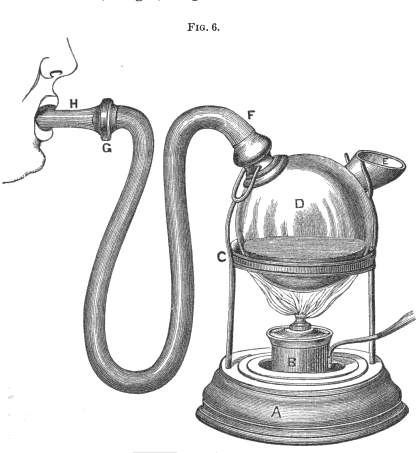
7. Morell Mackenzie's Eclectic Inhaler:  It was one of the most "complete instruments of it's kind," said Cohen. 

It was made of porcelain, and basically consisted of three parts:  A stand that was hollowed out so it could hold a heated lamp (c), a vase filled with a quart of hot water and medicine (a), and a lid that had two openings. (1, page 24)

One of the openings on the lid consisted of a pipe to allow free flow of air so te patient could breathe through the inhaler.  The other opening was attached a hose allowing the patient to inhale the steam.  (1, page 24)

Mandl Inhaler (1)
8.  Mandl's Inhaler or Fumigator:  This was a smaller version of the eclectic inhaler with some advancements. 

The lamp was inserted to the bottom of the vessel to gain better control of the temperature of the water. 

Cohen said there were a variety of inhalers of this type, but this one was the best.

The reservoir or vessel was made of glass that "rests on a stand over the spirit lamp.  The inspired air as it passes over the vapor becomes impregnated with it, and the expired air escapes by the opening of entrance. The vapor being evolved by heat there is no necessity for an air-tube to dip into the fluid. The amount of heat necessary to evolve the vapor is regulated by altering the size of the wick, or by the occasional removal of the lamp." (1, page 24-26)

Cohen must have been impressed enough with this inhaler that he made it the feature inhaler on the cover of his book. (1, page 25-26)


The Nelson Inhaler: This was by far the best of all the steam powered inhalers, and is actually still available.

The most marketable aspect of this inhaler is it allows the patient to inhale steam, or medicated steam, through a device that is portable. 
Nelson Inhale9.  

As you can see by the picture, it's quite small and compact compared to the devices mentioned above.  It's also easy to use by following the simple directions inked on the back:  "Remove the corked stopper, and fill the vessel half full of hot water; then pour the remedy to be employed upon the sponge on the mouthpiece. Place lips on mouthpiece. Breathe easily in and out as in full respiration. When only the vapor of hot water or any infusion is desired, remove the sponge from mouthpiece."

The Nelson Inhaler was one of the most common inhalers.  Due to its simple design and ease of use it was also the most copied design.

10. Maw's Double Valved Earthenware Inhaler:  It was similar in design to the Nelson Inhaler and sold by the same distributor: S. Maw, Son, and Thomson.  An ad in the December 24, 1870, edition of the British Medical Journal advertised this inhaler, along with the Eclectic Inhaler and the Nelson inhaler.

Here is what this ad said about the Earthenware Inhaler:
"For the inhalation of vapour of Hot Water, either alone or impregnated with Ether, Chloriform, Henbane, Creosote, Vinegar, etc, in affections of the throat and bronchial tubes, Asthma, Consumption, etc. For this apparatus, is especially adapted for Chloriform, Ether and other active volatile substances, as from its construction the exact quantity required may be inhaled. The lower valve opens only during inhalation, whilest the exhaled breath passes freely from the upper valve, instead of through the vessel, dissipating a large portion of the medicated vapour, as is the case in the use of most other inhalers. (6)
It was yet another inexpensive and easy to use option.
A. The inhaler with woolen cover
C. The inhaler without the woolen cover
B. The upper part disconnected from the inhaler1

It also came with a woolen cover to keep the temperature of the fluid contained in it from dropping too fast, and to prevent the person handling it from getting burned. (5, pages 68-69)

A thermometer came with the device, and when not in use it could be stored inside the apparatus.  (5, pages 68-69)

When the inhaler was needed (see figure), the thermometer was inserted through a hole in the lid.  Hot water was poured into the device (f) to just below the holes in the side of it (c).  (5, pages 68-69)

11. Martindale's Portable Inhaler: It was similar to the Eclectic Inhaler of Dr. Mackenzie, although it was made of tin, which made it more portable and less costly. (5, pages 68-69)

As the patient inhaled through the mouthpiece, air is drawn into the fluid through the holes (c), becomes medicated as it passes through the fluid, and is inhaled.  As the air goes through the holes it makes a gurgling sound. The exertion required by the patient is minimal, and using the apparatus is very easy.  (5, pages 68-69)


Bullock's Hospital Inhaler.
Left: The inhaler with mouthpiece
Right: The lid with India-rubber nasal dilator
12.  Bullock's Hospital inhaler:  It's a strong stoneware jug covered with a metal lid.  An India-rubber band holds the lid to the jug.  There are two holes in the metal lid.  In one hole is inserted a tube with mouthpiece used to inhale medicated steam.  Into the other hold was the thermometer to measure the temperature of the fluid to make sure it was not too cool and not too hot.  It could also be used for nasal inhalations by removing the tube and mouthpiece and adding an India-rubber nasal dilator.  Directions on how to use the inhaler came with it.  (5, pages 67-68)

How much medicine, if any, was usually directed by a physician. The 1881 "Pharmacopoeia of the Hospital for Diseases of the Throat and Chest" edited by Morell Mackenzie suggested that most of the devices described above required about a pint of water with about a teaspoon of the medicine, which is made according to specific recipes.  The dose may be increased or decreased slightly for desired effect.  (5, page 69) 

As noted, there were many variations of all these inhalers, many of which can be found in the various medical books and magazines from the 18th and 19th centuries.  

Note:  There were other inhalers that were steam powered, such as the Siegle Inhaler and Adams Inhaler. However, the inhalers described above allow the patient to inhale a medicated steam, while the Siegle and Adams Inhalers use steam to allow the patient to inhale a mist.  It should be noted there is a difference, as mist inhalers allow a patient to inhale both volatile and non-volatile solutions, while steam inhalers only allow for the use of volatile solutions. 

References:
  1. Cohen, Jacob Solis, "Inhalation in the treatment of disease: it's therapeutics and practice," 1876, Philadelphia, Lindsay and Blakiston
  2. Scudder, John Milton, " On the use of medicated Inhalations in the treatment of diseases of the respiratory organs," 1867, Cincinnati, 2nd edition, Moor, Wilstach, and Baldwin
  3. Sander, Mark, "Inhalatorium.com,"  page 41, http://inhalatorium.com/page41.html, accessed on 9/27/12.  Photo used by permission from Mark Sanders. 
  4. Tissier,Paul Lewis Alexandre, edited by Solomon Solis Cohen, "Pneumotherapy: Including Aerotherapy and inhalation methods," volume X, 1903, Philadelphia, P. Blakiston's Sons and Co., pages 353-
  5. Mackenzie, Morell, editor, "The Pharmacopoeia of the Hospital for Diseases of the Throat and Chest," 4th edition, 1881, Philadelphia, Plesley Blakiston
  6. Hart, Ernest, editor, "Maw's double valved earthenware inhaler," British Medical Journal, The Journal of the British Medical Association, volume II, July-December, 1870, (December 24, page 672 of this publication)
RT Cave Facebook Page
RT Cave on Twitter
Print Friendly and PDF