Showing posts with label pastaphori. Show all posts

Tuesday, October 28, 2014

2600 B.C.: Egyptian Diagnosis and Treatment

Ancient priests recognized early on in their practice that some ailments were simply not treatable.  So, to protect themselves from punishment when their remedies failed, the Hermetic Books must have informed physicians how to predict what diseases were treatable.  If the patient's illness was determined to have an unfavorable outcome, physicians were not expected to treat that patient.   (6, page 25)

Greek historian Diodorus said that diagnosis was made by the position of the patient in bed.  (6, page 25) Medical historian Thomas Bradford said treatment was standard and based on the symptoms.    (6, page 25) (1, page 6)

Bradford said:
The Egyptians paid strict attention to dietetic rules; they thought that the majority of diseases were caused by indigestion, and excess in eating. They practiced abstinence and used emetics. They had a considerable knowledge of Materia Medica (the pharmacopoeia) and used many drugs in the cure of the sick. They were somewhat skilled in operative surgery. They practiced castration, lithotomy and amputations
While preparing the ingredients, might site the following incantation: (3, page 23)
"May Isis heal me, as she healed Horns of all the ills inflicted upon him when Set slew his father, Osiris. 0 Isis, thou great enchantress, free me, deliver me from all evil, bad and horrible things, from the god and goddess of evil, from the cod and goddess of sickness, and from the unclean demon who presses upon me, as thou didst loose and free thy son Horus" 
As you can see, the medical profession among "the ancient Egyptians hold the honor of being the first people to cultivate medicine as a science," and that this "medicine was closely associated with the mythology of Egypt."  (2, page 1)

Surely we might look at Egyptian medicine, as well as medicine of any ancient society, and think to ourselves:  this is quackery. Yet these ancient societies probably benefited more from the magic of incantations and prayers, or by the gentle touch of a palm on the shoulder, than from any other form of medicine. As noted by Henry Sigerist in his 1951 book, "A History of Medicine: Primitive and Archaic Medicine: (13, page 280-1)
The oral rite was all important.  The correct choice of words to frighten a spirit, to enlist the help of the gods, the intonation probably also in which a spell was recited or sung, this all must have had a profound effect upon the patient.  We know the power of suggestion and know how highly responsive religious individuals are to such rites.  I should not be astonished if the sorcerer with his spells had had as better results in many cases than the physician with his drugs.  Magician and priest were able to put the sick in a frame of mind in which the healing power of the organism could do its work under the best conditions.  They gave him peace and confidence and helped him to readjust to the world from which disease had torn him.(13, page 280)
Sigerist also said:
The manual rites performed in the course of an incantation appear in infinite variety from the simplest to the most elaborate and complicated. The rite may have consisted of nothing but putting one's hand on the patient, the classical gesture of protection so familiar to us from the Bible.  After having exorcised a demon the magician said: 'My hands are on this child, and the hands of Isis are on him, as she puts her hands on her son Horus.'  Or the magician held his seal over the child and such as seal was obviously a powerful fetish: 'My hand is on thee and my seal is thy protection'  (13, page 281)
There may have come a day when, said Sigerist, "drugs were prepared and given without incantation and this was the moment when magic and medicine separated, when physicians and magician-priest became different individuals." (13, page 280)

Yet the priest of the ancient world, whether using magic words or herbal remedies, would have known of the power of suggestion, and perhaps, just perhaps, never ceased to use the power of magical words, amulets, talismans and gesticulations.

 References:
  1. Sandwich, Fleming Mant, "The medical diseases of Egypt, part I," 1905, London
  2. Bradford, Thomas Lindsley, "Quiz questions on the history of medicine: form the lectures of Thomas Lindsley Bradford, M.D," 1898, Philadelphia
  3. Baas, Johann Herman, author, Henry Ebenezer Sanderson, translator, "Outlines of the history of medicine and the medical profession," 1889, New York
  4. Renouard, Pierce Victor, "History of Medicine: From it's origin to the 19th century," 1856, Cincinnati, Moore, Wistach, Keys and Co., page 26, chapter 1, "Medicine of the Antique Nation."
  5. Garrison, Fielding Hudon, "An introduction to the history of medicine," 1922, Philadelphia and London, W.B. Saunders Company
  6. Dunglison, Robley, author, Richard James Dunglison, editor,  "History of Medicine from the earliest ages to the commencement of the nineteenth century," 1872, Philadelphia, Lindsay and Blakiston
  7. Hamilton, William, "The history of medicine, surgery, and anatomy, from the creation of the world to the commencement of the nineteenth century," 1831, volume I, London, Henry Colburn and Richard Bentley
  8. Puschmann, Theodor, translated by Evan H. Hare, "A history of medical education from teh most remote to the most recdent times," 1891, London, H.K. Lewis
  9. Puschman, Theodor, translated by Evan H. Hare, "A history of medical education from the most remote to the most recent times," 1891, London, H.K. Lewis
  10. Prioreschi, Plinio, "A History of Medicine," Volume 1: Primitive and Ancient Medicine," 1991, Edwin Mellen Press, Chapter IV: Egyhptian Medicine, page 257.  Reference noted by author is as follows:  Homer, "Ocyssey, IV, 229-232, Translation by A.T. Murray.
  11. Wilder, Aleander, "History of Medicine," 1901, Maine, New England eclectic Publishing
  12. Osler, William, "Evolution of Modern Medicine: a series of lectures at Yale University to the Silliman Foundation in April 1913, 1921", New haven, Yale University Press
  13. Sigerist, Henry E, "A History of Medicine: Primitive and Archaic Medicine," volume I, 1951, New York, Oxford University Press
      RT Cave Facebook Page
      RT Cave on Twitter
      Print Friendly and PDF

      2600 B.C.: The Egyptian Order of Priest/ Physicians

      Only certain priests were privileged to become physicians.  With only a few exceptions, "the office of these priests was hereditary and their privileges were exclusive; as the son trod with unvarying servility in the footsteps of his father."  (7, page 13)

      As with society, the priest/physicians were divided by classes.  The higher classes of priests studied the first 36 Hermetic Books and became Chief Priests, the rest studied the last six Hermetic Books, thus becoming the Pastaphori, Military physicians, and the veterinary.

      Here is a brief breakdown of the classes of priests who specialized in the healing arts. (3, page 16-17)(2, page 3-4)(7, page 13-14)
      1. Chief Priests:  Also referred to as Sages, Soothsayers, Image Bearers, Magi, sorcerers, wise men or magicians.  These were the wisest of the priests/ physicians, and they were privileged to all the knowledge of the gods, and hence were responsible for reading the first 36 books of the Hermetic books. They were physicians of the "higher sciences."  These priests/physicians were responsible for "conjurations, dissolving the charms of the gods by prayer, interpretations of the revelations received by the sick during incubation in the temples."  (incubation will be described later) (3, page 16-17) They were more like the medicine men of the primitive world, "disolving the charms of the gods by prayer... magic and divination."  (2, page 4)  They were even mentioned by Moses "in the 7th and 8th chapters of Exodus, under the names of wise men, the sorcerers, and magicians, of Egypt, whom Pharaoh called in to rival the miracles performed by Moses." (7, page 13)
      2. Pastaphori: The lower class of priests were responsible for studying the last six of the Hermetic books, and were responsible for visiting the sick and treating them.  They were your prototypical physicians, or ordinary physicians devoted specifically to medicine and the art of healing. Each of these physicians/ priests specialized in a certain ailment, such as internal medicine, dentistry, rectum, etc. They treated "anatomy, pathology, pharmacology, opthalmology, and gynecology." This profession probably morphed from the need of physicians to leave the temples, especially as medicine (particularly rational/civilized) evolved. 
      3. Military physicians:  They essentially were Pastaphori who followed the military, and mainly were experts in treating battle wounds with salves, casts, splints, incantations, etc. Each of these also specialized.
      4. Veterinary:  They specialized in health and healing of animals.  They specialized as well, as your cattle doctors, fowl doctors, etc. 
      Physicians were free from the bondage of taxes, were paid by the collective, and profits belonged to the temple. The only obligation of the patient was to provide gifts, which sometimes included models of the organ fixed or operated on (such as an arm or leg), and these were kept at the temples as mementos, perhaps, of the healing powers of the gods. Likewise, "during war, or in the case of anyone falling ill upon a journey, the doctors were bound to render help gratis," (4, page 17) (9, page 25)(11, page 10)

      So Egypt had a plethora of physicians who specialized in the various wounds and ailments that plagued Egyptian society.  Such specialization was both bad and good.  It was bad when you were sent a specialist who didn't specialize in what plagued you, such as if a physician who specialized in disorders of the rectum was sent to treat your son's dyspnea.

      It was good when the physician treating you specialized in what ailed you.  For instance, if you were suffering from an asthma attack, you would benefit when your physician had access to opium or belladonna, both of which had the magical ability to ease your suffering.

       References:  See: "2600 B.C.: Egyptian Diagnosis and Treatment."

      2600 B.C.: Egyptian medicine becomes specialized

      Medicine evolved into a flourishing profession in ancient Egypt.  Access to this medicine depended on what rank of society you were a member of.  Were you a member of the aristocracy, which consisted of about 1% of the people, or were you a commoner.

      By the height of Egyptian civilization, society evolved into six orders:  (4, page 32)
      • The Aristocracy.
        • Kings and princes 
        • Priests
      • Commoners. 
        • Soldiers
        • Shepherds
        • Laborers
        • Artisans.  
      Of these six orders, only the kings and princes were privy to their own physicians.  The others had access to medicine, but not their own physician.  If they were sick or wounded, they had to send for a physician.

      Most of these orders were divided into various castes, with various members of the priesthood being chosen to specialize in the various wounds and diseases and these became the caste of physicians. Members of these castes becoming "the most respected and the most powerful" members of the society. The caste "was a depot of the laws, science and religion."  (2, page 32)

      Of these physicians, the great Greek historian Herodotus (484-425 B.C.) once wrote: (5, page 50-51):
      "The art of medicine is divided among them: each physician applies himself to one disease only, and not more. All places abound in physicians; some physicians are for the eyes, others for the head, others for the teeth, others for the intestines, and others for internal disorders."
      Each physicians specialized in one disorder, such as:
      • Disorders of the head
      • Disorders of the eyes
      • Disorders of the rectum/ anus
      • Disorders of the teeth
      • Disorders of women
      • Experts in child bearing
      • Experts in surgery (surgeons)
      • Internal medicine (treat asthma-like symptoms, cancer, upset stomach, etc.)
      Homer, the great Greek poet, even noted the following regarding Egyptians:
      ...in the land where the fruitful soil bore abundance of herbs potent for good or evil, nearly everyone was, so to speak, a doctor or a descendant of Paeon and learned among the men. (8, page 18)
      According to Homer, Paeon (Paean) was the physician to the Egyptian gods.  Based on Homer's reference, some experts surmise that as medical knowledge was specialized, many of the commoners became knowledgeable in medicine, each becoming a pseudo-physician.  As our modern day homes, many people had their own medicine chests, and had the ability to treat basic cuts and scrapes, and ailments like the common cold.

      When wounds were severe, or as diagnosis and treatment reached beyond the commoners scope of knowledge, only then would the greater expertise of a priest/ physician be sought. You had a choice between the Chief Priests, the Pastaphori, the Military Physicians, and the Veterinary, and this choice depended on your status in life.  Were you a commoner? Were you in the military? Were you of the upper class?

      References:  See "2600 B.C.: Egyptian diagnosis and treatment."

      2600 B.C.: Hermetic Books improve image of medical profession in Egyp

      After Thoth educated a priests about all the wisdom of the gods, this priest created the Hermetic Books. The priests he taught transcribed these books so they could be visible in all the temples of the gods of health and healing throughout Egypt.  This made them available to all the priest/physicians, making these temples places of learning and healing.  It was these books that allowed the medical profession in Egypt to flourish.

      Many of these Egyptian temples were also the centerpieces of places that acted like our modern universities, complete with schools, libraries, laboratories, papyrus/paper factory and boarding houses.  These were places where the priests were educated in the wisdom contained in the Hermetic Books, or "Sacred Books," as they so often were referred to.

      These were places of instruction for not just priests who aspired to be physicians, but astronomers, mathematicians, and a variety of other professions. Some of the original and most famous temples/ universities were situated at Memphis, Thebes, Heliopolis, Sais, and Chennu. (4, page 16)(11, page 19)(12, page 9)

      Eventually Thoth taught the priesthood to make paper out of stalks of papyrus, and scribes were able to transcribe the Hermatic text onto large scrolls called papyri, and it is out of this that the modern term paper was derived.  So now, instead of stone pillars of wisdom only being available at select temples, scrolls of wisdom could be kept in the possession of each priests.  When called upon to visit the sick, they carried their their "Sacred Texts" in their medical bags.

      Renouard said most ancient authors referred to the "Sacred Books" in past tense, as though they knew of them to exist but had never seen them with their own eyes. So even their references to the books are not evidence that they truly existed. There is also no evidence there were 42 books, as some accounts note as many as twenty thousand.  (6, page 28)

      Assuming there were only 42, the first 36 were thought to contain basic wisdom of the gods, such as knowledge of astronomy, mandates of religion, church ceremonies, administering justice, philosophy, the art of writing, geography, cosmography, and the knowledge of weights and measures, medicine, etc.  These are what are often referred to as the Sacred Books. (5, page 24)(8, page 19)

      These books were studied by the higher class of priests who became judges, mathematicians, astronomers, geographers, philosophers, scribes, etc.  The last six books contained the medical wisdom, and these were studied by the lower class of priests.

      The higher class of priests at these schools studied the first 36 books, and others the last six.  Perhaps it was at such schools where Egyptian priests/ physicians developed such beliefs as life "should be indefinitely prolonged, unless someone or something caused death, such as a spirit, or the soul of a dead man, which cunningly entered a dead person,"  according to Fleming Sandwich in his 1905 book. (13, page 2)(14, page 25)

      The last six were the medical books studied by physicians.  These are referred to as Embre (or sometimes Ambre or Scientia Causalitatis). (5, page 24)(8, page 19) (6, page 60)(4, page 4) The name comes from the original passages of these medical texts:
      "Here begins the book of the preparation of drugs for all parts of the human body."
      Now, it must be understood that the Sacred Books served a greater purpose other than just to educate educate and guide physicians in their medical practice.  You see, most early physicians and sorcerers and magicians and alchemists and their potions (their black magic) were not looked upon in a positive light, and mainly because some people died in spite of their potions, while others died because of them.  Some people were literally afraid of physicians, preferring to treat their sick with their home remedies.

      In those earliest days of Egypt, physicians were often often accused of practicing the "Black Art," and were sometimes sentenced to death, said Johann Herman Baas in his 1899 history of medicine. (4, page 23)

      The name "Black Art" comes from Egypt becoming known as the "Black Land," which was mainly due to the black mud along the Nile River.  Alchemy, or pharmacology, or chemistry, which is the process of mixing various substances into a potion, was referred to as the "Black Art,"  said Fielding Hudson Garrison in his 1922 history of medicine. (9, page 53)

      Garrison said Homer (the great Greek poet from around 800 B.C.) mentioned how the Egyptians were adept at making various drugs by use of the "Black Art." So, while Egyptians physicians were not pharmacists per se, they were indeed involved in the "Black Art" as they usually concocted their own potions, or perhaps used the potions concocted by alchemists and pharmacists. (9, page 53)

      What made this challenging is that the only way to learn whether a potion worked, or how much to give, was to try it on the sick, and sometimes this made the patient worse, and sometimes it resulted in death. And of course their were probably times when their poisonous qualities were specifically used to kill unwanted people per request of a king or some other leader.  So a bad reputation ensued among the medical profession. 

      So there must have come a time when the head priests decided that something needed to be done to improve respect for the profession.  They decided create a book that contained all medical knowledge, and rather than allowing priests to take credit for their own miracles, credit was given to the gods.  Or, more specifically, to the one god named Thoth.

      That said, the Embre, said Baas, "served as a source of, and a mask for, the vagaries of magic, and the extravagances and frauds of the alchemists." (4, page 4)

      This mask could now be worn by magicians, sorcerers, alchemists, or any other person who participated in the act of healing or black magic.  If their magic or their potions didn't work, they could blame it on the Sacred Books, or the will of the gods.

      This must have allayed the fears of the public and improved the image of the profession.  It sort of made the risks associated with trial and error medicine acceptable, thus allowing medicine in ancient Egypt to grow into a flourishing profession.

      References: See "2600 B.C.: Hermetic Books allow medicine to flourish in Egypt."

      2600 B.C.: Egyptian medicine evolves over time

      No one knows for certain when the Egyptian priesthood became adept in medicine. While it's easy to speculate it began with one god talking with one priest in one moment in time, chances are this was not how knowledge was learned.  Common sense dictates that it was as slowly growing process that took many years to perfect.

      There was a time before medicine in ancient Egypt, and it involved laying sick people out in the streets before their houses. People who passed by who recognized the symptoms and had previous experience with healing them were expected to offer their advice. This ultimately evolved so that certain people began to specialize in the healing art.  (13, page 2)

      Renouard said that the earliest recorded evidence of physicians in Egypt came in the Bible when Jacob, the father of Joseph, died.  According to Genesis (Genesis 50: 2-3):
      "Then Joseph directed the physicians in his service to embalm his father Israel. So the physicians embalmed him, taking a full forty days, for that was the time required for embalming.
      Renouard said this event occurred 1,700 years before the birth of Christ,  and is the "most ancient, authentic monument that we possess of the Healing Art."  He further explained that "it is certain, that before the time of the emigration of the sons of Jacob to Egypt, the arts and sciences had already attained, in that country, a degree of perfection which could only be the result of long experience, that required very many years or rather centuries of observation."  (4, page 26)

      What is known is that Egypt "rejoiced in a very advanced state of civilization" long before Joseph called the Egyptian priests/ physicians to embalm his father," said Renouard. "Agriculture, Geometry, Architecture, Metallurgy had all then made a remarkable progress. Thebes, the city of a hundred gates, existed as well as some of those gigantic edifices, destined to transmit to posterity, the evidence of the power and wisdom of the Pharaohs. " (4, page 27)

      The truth to how all this wisdom was obtained remains a mystery. And all the ancient people, priests perhaps, who had the ability to collect all the records of humanity at that time "embellished them with fiction, which renders the truth more and more uncertain," said Renouard. (4, page 27)

      He said:
      "But it must be said, for their justification, that these first chroniclers had especially in view, the inculcation to man of the principles of sociability, morality, and religion, and that their marvelous, or allegorical recitals attained much more directly the end they aimed at, than if they had stated the naked truth. It is for this reason, doubtless, that instead of seeking, laboriously, the primitive source of the arts and sciences, on the earth, they placed it in the heavens, and that they attributed to their gods, or to men they deified, all great discoveries. On this account, therefore, the cradle of Medicine, as well as all the arts of first necessity, is surrounded with fables and allegories."
      Regardless of how this wisdom came down through time, a specialty of priests became the scribes, and they were among the wisest and most revered priests in all of Egypt. And regardless of where their wisdom came from, they were taught that it came from Thoth, the secretary of the gods, the inventor of all arts and sciences.

      References:  See, "2600 B.C.: Hermetic Books allow medicine to flourish in Egypt."

      2600 B.C.: Egyptian gods educate priests about medicine

      Thoth gave Egyptian Priests
      an excuse to practice medicine
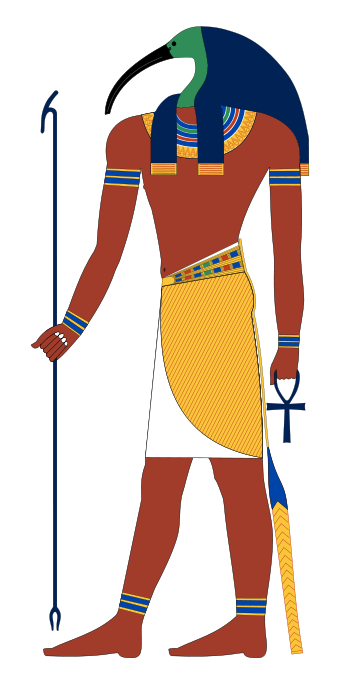
      One of the most important gods in Egyptian lore was Osiris, god of the underworld.  A good friend of his was Thoth, and he was equally important mainly because he was god of arts and sciences, and secretary to the gods.  As secretary, he was privy to all the wisdom of the gods, and therefore had the ability to share this wisdom with mortal men and women.

      Legend has it that sometime around 2,700 years before the birth of Christ, Thoth communicated with a priest, giving him all the wisdom of the gods. This priest learned about mathematics, chemistry, engineering, architecture, medicine and language.  He also learned about laws and religious practices.   (1, page 6)(2, page 19)(3) (4, page 14)

      Thoth also taught this priest how to write, and he instructed him how to carve words onto pillars of stone.  The priest then went on to communicate all the medical wisdom he learned in a collection of 42 books, which the priests referred to as the "Sacred Books."  Since the ancient Greeks referred to Thoth as Hermes Trismegistus, these books became known as the Hermetic texts. (The ancient Romans referred to him as Mercury).(4, page 14)(5, page 24)

      Medical historian Pierre-Victor Renouard said that no one knows for sure when he lived, nor whether he was an actual person. It may be that all works on religion and science were simply attributed to Thoth, and therefore bore his sign or signature.  This, Renouard said, may have been done on purpose by Egyptian priests to prevent priestly wisdom from becoming individualized. (6, page 28)

      So while some think Thoth himself wrote the books, other speculate it was Imhotep, the most famous non-Pharaoh in ancient Egypt.  He was the famous scribe, architect, physician, and vizier to King Djoser, who lived around 2650-2600 B.C.  He was so famous, and his legend so huge, that he would go on to become an Egyptian god of medicine in his own right.  So it only makes sense that, as time elapsed, he became the famous priest who obtained all the wisdom of Thoth, and thus the wisdom of the gods.   (1, page 6)

      Various opinions formed, all based on incomplete information, as to who this priest was.  Some speculated it was one of Bacchus, Zoroaster, Osiris, Isis, Searpis, Orus, Apollo, or even Shem, son of Noah. (4, page 28)

      Along with the author, there are also many theories as to the Hermetic Books.  Did they really exist? If so, who really wrote them? Chances are that it was not one priest but various priests over many years. How many years? We may never know, although various theories have arisen.

      References:  See "2600 B.C.: Hermetic Books allow medicine to flourish in Egypt."