Showing posts with label Phillip Stern. Show all posts

Monday, August 1, 2016

400 B.C.-1881: Steam inhalers

Stern's Inhaler (3)
Since the time of Hippocrates, and more than likely even before that, the inhalation of steam was often recommended for people suffering from various ailments, which included syphilis, asthma, bronchitis, pneumonia, hay fever, phthisis, croup, laryngitis, influenza, etc.  It was something that appeared to provide some immediate relief for difficult breathing.  

At some point in history it was determined that an additional benefit was supplied to the patient when certain medicines were added to the water to be inhaled.  

Initial steam powered inhalers were home made devises that resembled a tea pot, although by the 1870s various inexpensive and portable devices were available on the market for the inhalation of medicated vapors.

By traveling back in time we will find many different devices that were used as steam powered inhalers, some of these I covered in other posts.  Today, for your convenience, I am providing a list of all the various steam powered inhalers used over the years.

That in mind, here are some steam powered inhalers.

1.  Hippocratic Inhaler (400 B.C.):  It wasn't called an inhaler back then, and may not even have been used for asthma.  The model basically consisted of a jar with a hole in the lid. The steam itself may have been palliative, although adding certain balsamics or resinic substances may have added an additional benefit for various symptoms of lung disorders. Eggshells or a sponge may be placed between the patient's mouth and reed to prevent scolding.

2.  Teapot:  Any simple teapot would do.  Boil the water and inhale the steam.  If the water is too hot, you simply waited until it was cool enough to inhale.  This was kind of the same principle as the Hippocratic inhaler, which may even have lead to it's design.  Like the Hippocratic model, it was a simple and inexpensive inhaler. 

Inhalation Of Hot-water Vapor With The Use Of Pitcher And Towel
3.  Sponge:  Dr. John Scutter described dipping a sponge into boiling hot water, placing your face into the sponge, and inhaling. If the patient wanted he could drop some medications onto the sponge for direct inhalation.

This was an inexpensive and effective means of inhaling steam or medicated steam.  For medicines like chlorine, the medicine could be dipped on a cloth, placed over your face, and you could inhale the fumes that way. (2, page 22)

4.  Wine Bottle or jug:  Another simple method mentioned by Dr. Scutter was to simply place a wine bottle "partly filled  with hotwater" near your face and inhale the vapors as they pass from "the mouth of the bottle."

Another idea would be to insert a sponge into the bottom of a wide wine bottle and insert the water and medication onto the sponge.  The patient could use the sponge or wine bottle method, or a combination, and place a towel over your head for the full steam effect.

The patient could basically play around with these ideas until you found something that worked for you.  I remember my grandma turning on the hot water in the bathroom sink, having me set my head up close, and placing a towel over my head.  It never really worked, and there was no medicine involved, although it made her feel like she was helping. (2, page 22)

Dr. Mudge's Inhaler
5.  Phillip Stern's Contraption (1768):  It was a unique design, an advancement of sorts, on the Hippocratic inhaler.

Dr. Cohen said the lid was angled in a conic fashion so that it created a pointed mouthpiece whereby the patient placed his lips over the device, inhaled, and then took his mouth off to exhale.

Stern marketed it to be used with his own balsamic effluvium.  Half a pint of boiling water is to be inserted into the contraption, and about 30-40 drops of his balsamic effluvium (of which he does not divulge the ingredients).

The patients to whom he aimed his product at were consumptive and asthmatic patients.

6.  Dr. Mudge's Patented Inhaler (1778):  It's another design based on the Hippocratic model, and it was the first inhaler to allow both inhalation and exhalation through the inhaler.

Mudge was also the first to use the term "inhaler." Because Dr. Stern wasn't much respected by the medical community, Dr. Mudge is often given credit as the inventor of the inhaler.  (1, pages 18-20)

Flask inhaler (2)
4.  Flask inhaler:  Dr. Scutter said this inhaler could easily be made by any patient using random items around the household, or that could be easily purchased for a reasonable price at any general store.

Basically, all it required was a container that could hold heated water, and "a tube to conduct that vapor to the patient.  Fig. 1, represents such an instrument. The flask was made of flint glass, and will usually bear an elevated temperature. The cork was perforated by an opening for the attachment of the rubber tube, and for a smaller glass or metal tube for the admission of atmospheric air, as the patient inhales the vapor," said Cohen. (2, page 28-9)

5.  Tin Cup Inhaler.  Another cheap method of making an inhaler (see figure 2). 

Dr. Scutter said he often recommended this in place of the (much preferred) Nelson Inhaler (see below). 

In the words of Scutter: 
Tin cup inhaler (
"It consists of a tin cup, perforated at the bottom and a three quarter inch tube inserted and soldered. To this, is attached two or three feet of rubber tubing, which is terminated by a mouth and nosepiece as represented in the wood cut. The cup contains two cross wires to hold the sponge, which should be coarse and open. In using this apparatus, the sponge is pressed out of hot water and put in the cup, or it may be wet in the cup, and the medicine then sprinkled on it in suficient quantity. The cup being placed upon the floor, a chair, or, if more heat is required, upon the stove, the patient inhales the vapors as they arise. In country practice, it is well to have the cup made the size of a tea-kettle, or tin teapot lid, so they can be turned over these vessels if it is desirable to inhale the vapor of water. This apparatus recommends itself, in that it is simple, cleanly, and cheap, being easily manufactured wherever a tinner can be found, at a cost of 75 cents." (2, pages 29-30)
So it was easily made and cheap.


Wolfe-Bottle Inhaler (1)
6.  Wolfe-Bottle Inhaler: Cohen described this inhaler as...
"An efficient inhaler in common use is composed of a three-necked Wolfe's bottle (Fig. 2). Two of the corks are perforated. Through one an air-tube passes nearly to the bottom of the vessel; through the other the inhaling-tube passes a short distance. When in use, the bottle being partially filled with liquid, the external air passes through the straight tube into the liquid, and then out of the bent tube, to which tubing and mouthpiece may be attached. A wide-mouthed bottle, with a doubly-perforated cork (Fig. 3), answers the same purpose, and can be arranged extemporaneously at short notice. The bottles should be of the capacity of a quart, and the tubes of large calibre, so that respiration may take place with as little impediment as may be. The great defect in most modern inhalers is that the tubes are insufficient in calibre for the air to be drawn through them by mere aspiration, so that an accessory movement of suction becomes requisite." (1, page 21)
So this was another simple inhaler.

Mackenzie's Eclectic Inhaler (1) (5, page 64)
7. Morell Mackenzie's Eclectic Inhaler:  It was one of the most "complete instruments of it's kind," said Cohen. 

It was made of porcelain, and basically consisted of three parts:  A stand that was hollowed out so it could hold a heated lamp (c), a vase filled with a quart of hot water and medicine (a), and a lid that had two openings. (1, page 24)

One of the openings on the lid consisted of a pipe to allow free flow of air so te patient could breathe through the inhaler.  The other opening was attached a hose allowing the patient to inhale the steam.  (1, page 24)
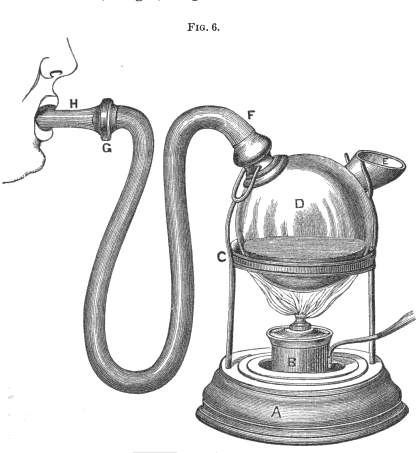
Mandl Inhaler (1)
8.  Mandl's Inhaler or Fumigator:  This was a smaller version of the eclectic inhaler with some advancements. 

The lamp was inserted to the bottom of the vessel to gain better control of the temperature of the water. 

Cohen said there were a variety of inhalers of this type, but this one was the best.

The reservoir or vessel was made of glass that "rests on a stand over the spirit lamp.  The inspired air as it passes over the vapor becomes impregnated with it, and the expired air escapes by the opening of entrance. The vapor being evolved by heat there is no necessity for an air-tube to dip into the fluid. The amount of heat necessary to evolve the vapor is regulated by altering the size of the wick, or by the occasional removal of the lamp." (1, page 24-26)

Cohen must have been impressed enough with this inhaler that he made it the feature inhaler on the cover of his book. (1, page 25-26)


The Nelson Inhaler: This was by far the best of all the steam powered inhalers, and is actually still available.

The most marketable aspect of this inhaler is it allows the patient to inhale steam, or medicated steam, through a device that is portable. 
Nelson Inhale9.  

As you can see by the picture, it's quite small and compact compared to the devices mentioned above.  It's also easy to use by following the simple directions inked on the back:  "Remove the corked stopper, and fill the vessel half full of hot water; then pour the remedy to be employed upon the sponge on the mouthpiece. Place lips on mouthpiece. Breathe easily in and out as in full respiration. When only the vapor of hot water or any infusion is desired, remove the sponge from mouthpiece."

The Nelson Inhaler was one of the most common inhalers.  Due to its simple design and ease of use it was also the most copied design.

10. Maw's Double Valved Earthenware Inhaler:  It was similar in design to the Nelson Inhaler and sold by the same distributor: S. Maw, Son, and Thomson.  An ad in the December 24, 1870, edition of the British Medical Journal advertised this inhaler, along with the Eclectic Inhaler and the Nelson inhaler.

Here is what this ad said about the Earthenware Inhaler:
"For the inhalation of vapour of Hot Water, either alone or impregnated with Ether, Chloriform, Henbane, Creosote, Vinegar, etc, in affections of the throat and bronchial tubes, Asthma, Consumption, etc. For this apparatus, is especially adapted for Chloriform, Ether and other active volatile substances, as from its construction the exact quantity required may be inhaled. The lower valve opens only during inhalation, whilest the exhaled breath passes freely from the upper valve, instead of through the vessel, dissipating a large portion of the medicated vapour, as is the case in the use of most other inhalers. (6)
It was yet another inexpensive and easy to use option.
A. The inhaler with woolen cover
C. The inhaler without the woolen cover
B. The upper part disconnected from the inhaler1

It also came with a woolen cover to keep the temperature of the fluid contained in it from dropping too fast, and to prevent the person handling it from getting burned. (5, pages 68-69)

A thermometer came with the device, and when not in use it could be stored inside the apparatus.  (5, pages 68-69)

When the inhaler was needed (see figure), the thermometer was inserted through a hole in the lid.  Hot water was poured into the device (f) to just below the holes in the side of it (c).  (5, pages 68-69)

11. Martindale's Portable Inhaler: It was similar to the Eclectic Inhaler of Dr. Mackenzie, although it was made of tin, which made it more portable and less costly. (5, pages 68-69)

As the patient inhaled through the mouthpiece, air is drawn into the fluid through the holes (c), becomes medicated as it passes through the fluid, and is inhaled.  As the air goes through the holes it makes a gurgling sound. The exertion required by the patient is minimal, and using the apparatus is very easy.  (5, pages 68-69)


Bullock's Hospital Inhaler.
Left: The inhaler with mouthpiece
Right: The lid with India-rubber nasal dilator
12.  Bullock's Hospital inhaler:  It's a strong stoneware jug covered with a metal lid.  An India-rubber band holds the lid to the jug.  There are two holes in the metal lid.  In one hole is inserted a tube with mouthpiece used to inhale medicated steam.  Into the other hold was the thermometer to measure the temperature of the fluid to make sure it was not too cool and not too hot.  It could also be used for nasal inhalations by removing the tube and mouthpiece and adding an India-rubber nasal dilator.  Directions on how to use the inhaler came with it.  (5, pages 67-68)

How much medicine, if any, was usually directed by a physician. The 1881 "Pharmacopoeia of the Hospital for Diseases of the Throat and Chest" edited by Morell Mackenzie suggested that most of the devices described above required about a pint of water with about a teaspoon of the medicine, which is made according to specific recipes.  The dose may be increased or decreased slightly for desired effect.  (5, page 69) 

As noted, there were many variations of all these inhalers, many of which can be found in the various medical books and magazines from the 18th and 19th centuries.  

Note:  There were other inhalers that were steam powered, such as the Siegle Inhaler and Adams Inhaler. However, the inhalers described above allow the patient to inhale a medicated steam, while the Siegle and Adams Inhalers use steam to allow the patient to inhale a mist.  It should be noted there is a difference, as mist inhalers allow a patient to inhale both volatile and non-volatile solutions, while steam inhalers only allow for the use of volatile solutions. 

References:
  1. Cohen, Jacob Solis, "Inhalation in the treatment of disease: it's therapeutics and practice," 1876, Philadelphia, Lindsay and Blakiston
  2. Scudder, John Milton, " On the use of medicated Inhalations in the treatment of diseases of the respiratory organs," 1867, Cincinnati, 2nd edition, Moor, Wilstach, and Baldwin
  3. Sander, Mark, "Inhalatorium.com,"  page 41, http://inhalatorium.com/page41.html, accessed on 9/27/12.  Photo used by permission from Mark Sanders. 
  4. Tissier,Paul Lewis Alexandre, edited by Solomon Solis Cohen, "Pneumotherapy: Including Aerotherapy and inhalation methods," volume X, 1903, Philadelphia, P. Blakiston's Sons and Co., pages 353-
  5. Mackenzie, Morell, editor, "The Pharmacopoeia of the Hospital for Diseases of the Throat and Chest," 4th edition, 1881, Philadelphia, Plesley Blakiston
  6. Hart, Ernest, editor, "Maw's double valved earthenware inhaler," British Medical JournalThe Journal of the British Medical Association, volume II, July-December, 1870, (December 24, page 672 of this publication)
RT Cave Facebook Page
RT Cave on Twitter
Print Friendly and PDF

Wednesday, February 17, 2016

1767: Dr. Phillip Stern writes book for asthmatics

Photo of Stern's inhaler,
Used here by permission.
(inhalatorium.com)
So it's the year 1767 and you have asthma.  For the price of just one schilling you can purchase a copy of Dr. Phillip Stern's book called, "Medical advice to the consumptive and asthmatic people of England."  It's one of the first medical books ever written specifically for you, the patient.

Now there's a catch here of course.  He apparently admits to writing the book directly to the patient because he apparently had a falling out with his fellow physicians.  Perhaps it was because his ideas are rejected by the medical profession.  Or perhaps it was because he rejects the methods of the medical community and postulates his own.

Many historians presume his ideas were rejected by the medical community specifically because he wrote his book to the public, and not to physicians (which was the norm back then).  And, to be honest, Dr. Stern does use some harsh wording when referring to his physician contemporaries.

Regardless, he provides a brief anatomical review of the heart, vessels, diaphragm and respiratory system.  He describes how the lungs are "divided into two principle lobes which are inclosed in two distinct bags, formed by a membrane called the pleura; so that the right and the left lobe of the lungs have not the least communication."

Now this separation of the two lungs is important, because when a portion of one lung becomes diseased or dies, perhaps due to pneumonia or consumption, the patient can continue to live.  He writes:
"But here it may naturally be asked, how it happens, when a part of an organ, so indispensably necessary to life, is destroyed, that the patient does not immediately die.  I answer that Nature, in this instance, has been particularly kind to us; for the two lobes of the lungs, have no communication, are not immediately affected by each other's diseases; besides, every minute branch of the same lobe is so contrived, as to perform its office independent of the rest; therefore every single vessel continues to receive and return its portion of air, till it be actually destroyed." (1, page 11)
So the lungs are resilient to disease, and parts of them can continue to work regardless of the diseased parts.  This is good when it comes to diseases like pneumonia or consumption which can close off portions of the lungs to the reception of air.

The majority of Sterns book describes the disease consumption, his theories as to the pathology of the disease and his perceived remedies.  It isn't until we get to page 33 that we learn about asthma, "that disorder, the chief symptom of which is difficulty of breathing.  It is either continued or by fits."  (1, page 33)

Regarding the cause he writes: "Now, though the cause of the disease is frequently in the lungs, yet it is sometimes owing to a morbid affection of some of the other organs of respiration, as the diaphragm, the intercostal muscles, or the windpipe, or some of the neighboring viscera."

Pretty much that's all he offers us about our disease.  He then jumps right into his only remedy, his own balsamic medicines, the same medicines he recommends for consumptives.  He explains the first remedy to asthmatics is bleeding, yet after that he recommends balsamics to be provided by the inhaler he invented.

Here we must pay attention to his explanation:
"Well; but then we administer a quantity of saccharine, oily and mucilaginous medicine, in the form of an emulsion, intending, no doubt, thereby to sheathe and obtund the acrimony, which causes the irritation in the lungs.  The intention is certainly laudable; but it happens unfortunately that these balsamics go down, not into the lungs, but into the stomach, where they immediately go through such a change, as to carry but little of their balsamic qualities even into the intestines, where they are still farther mixed and adulterated, particularly by the addition of a certain quantity of bile, immediately on quitting the stomach."  (1, page 14)
He further explains that medicine can be taken by the mouth, pass through the stomach, gather access to the vessels of the body, and effect the heart, and even act as poisons in this way.  However, he notes the following:
"Now it must be remembered that the seat of the disorder which, by their healing medicines, we are endeavouring to cure is not in the blood vessels, but in the air vessels of the lungs; and that these air vessels have no communication with the arteries, except by means of tubes or pores so extremely small, as not to admit the red globules of the blood; consequently the constituent particles of our medicine must be smaller than these, otherwise no part of it can possibly be thus applied to the part injured." (1, page 15-16)
He therefore concludes that "the only possible way of applying medicine directly to the lungs, is through the windpipe."  (1, page 16)

Later he explains to the asthmatic:
"If... these balsamics, taken into the stomach, can do nothing toward the cure of consumption, how much less likely are they to relieve an asthmatic patient?  For if they could ever be applied immediately to the part affected, they possess no one virtue that might authorize such expectation." (1, page 34)
Here he makes an observation that was probably first made by ancient people, as even the ancient Egyptians, and Ancient Indians, observed that medicine to improve affections of the airway often works better when inhaled.  And that is exactly what Stern is prescribing here: the inhalation of his balsamic powders with an inhaler that he invented.

He writes that "when the cause of the asthma is spasmotic contraction of the lungs, or windpipe, which is very frequently the case, especially when the disease returns by fits, I then expect considerable advantage from the antispasmotic powders of this vapour; and when in a continuous difficulty of breathing, the cause of the disorder is an infarction of the lungs from viscid mucus, my hopes are then build on the attenuating power of the vapour exhibited in the manner I recommend. Let those who are capable of reasoning, judge whether my expectations are well founded." (1, page 34)

The medicine may be inhaled through the use of any teapot, although for consumption (or asthma) "a more copious application is necessary.  For this purpose I have contrived a simple machine, by means of which a much greater quantity of the balsamic effluvium is received into the lungs... It holds about a pint.  Half a pint of boiling water must be poured in, and the medicine immediately dropped into the water.  The head being then fixed upon it, the patient applies his mouth to the pipe, and thus draws in the steam with his breath, removing the pipe from his lips at every expiration.  The vessel is made of pewter.  Those who are acquainted with the nature of evaporation will not be at a loss to account for the conic form of the vessel."

Note he did not use the word 'inhaler.'  (3, page 54)  In reality his invention may be the first inhaler. However, perhaps because his ideas were rejected by the medical community, his inhaler never caught on.  He also didn't use the word inhaler. So perhaps for this reason it wasn't his, but Dr. Mudge's inhaler invented a decade later, that is often given credit as the first inhaler.  Yet for the first time, we will give Dr. Stern full credit here:  Dr. Phillip Stern invented the first marketable inhaler.

He also recommends inhaling the balsamic vapours using his contraption of which he does not refer to as an inhaler, as such a word will be used by one of his contemporaries.  (2) 

The medicine:  Dr. Sterns Balsamic Vapour or Dr. Sterns Balsamic Ether

Ingredients:  Dr. Sterns will not reveal his ingredients, although we might assume he enters into it some or all of the following, which are mentioned in his book:
  •  Antiseptic powder
  •  Ether
  •  Balsams (of Gilead, Copaiba, Peru, Tolu, and Canada)
  •  Dry Balsams (Benjoine, Storax, Labdanum, Myrrh, Mastich)
  •  Terpentines
  •  Antispasmotics
  •  Opium
Research:  Dr. Sterns did a test using the vessel and his balsamic ether on himself, and it worked.

Indications:  Common colds, hoarseness, tuberculosis, asthma, etc.

Cost:  Six Schillings and sixpence per bottle

Where:  Various shops

Directions:  "I usually drop 30-40 drops into half a pint of boiling water immediately after it is taken from the fire, ordering the patient to hold his mouth over the vessel, so as to draw in with his breath as much as possible of the vapour, continuing the operation as long as the steam will rise.  I then order him to drink the water as soon as it is cold enough for that purpose: for, though I depend  entirely on the vapour for the cure of the lungs, yet, as of all the juices in the body may in some degree affected by the matter absorbed from the lungs, this balsamic water, received into the stomach, will be of some advantage." (1, page 24)

Or...

"30 or 40 drops to be dropped into a quart of boiling water, and the vessel to be placed near the bed of the patient, and to be repeated three or four times a day; or the water to be kept boiling over a lamp, in any part of the room, until it is entirely evaporated, if the disorder be of a very putrid nature, and especially in the small pox."  This technique may also be beneficial in sore throats "whether inflammatory or putrid."

Frequency:  The Stern's "Inhaler" may be used by adding half a pint of water, boiling it (2), "and by holding my head over a common pint vessel, keeping my mouth generally shut, that the steam might pass through my nose, and repeating the operation several times a day, for two or three days." (1, page 24)

When to use:  Use during an attack of asthma, although it is best to "prevent a disorder than to cure it, and as colds do no injury to the lungs, except in their remote effects, I thought it rational to suppose, if immediately after taking cold, I could dilute or obtund the acrimony of the humour that irritates and inflames the lungs, I should probably prevent the bad consequences of obstructed perspiration, at least as far as it concerned the lungs." (1, page 34)

References:
  1. Stern, Phillip, "Medical advice to the consumptive and asthmatic people of England," 1870, London  (1st edition was 1767)
  2. Sanders, Mark, "Dr. Stern's Inhaler," Inhalatorium.com,  http://inhalatorium.com/page133.html.  Mr. Sanders also provided us with permission to use the picture on this page.  Please check out the Inhalatorium to see for yourself the history of aerosolized therapy.  You may also check out a slideshow presentation by Mr. Sanders,    "The Innovators of Inhalation," http://www.ddl-conference.org.uk/files/DDL20presentations/19.Sanders.pdf
  3. Smyth, Hugh D.C, Anthony J. Hickey, "Controlled Pulmonary Drug Delivery," 2100, Springer New York Dordrecht Heidelberg London
  4. RT Cave Facebook Page
RT Cave on Twitter
Print Friendly and PDF
