
 |
| Mathieu's Nephogine (Nebulizer) (1) |
A nebulizer is any device that creates a mist. The first nebulizer was introduced in 1858 by M. Sales-Giron, and it required an operator to work a pump similar to a bicycle pump to generate a flow that caused the solution to spray onto a hard surface to produce a mist.
Similar to Danielle Bernoulli's realization that the same mist produced by forcing water onto hard a surface could be produced by his Bernoulli Principle, Mathieu discovered the Bernoulli Principle would be ideal for creating an effective nebulizer. He got the idea from the concept of treating ailments of the mouth and throat with a spray produced by squirting water out of a syringe. (2, page 188)
On May 9, 1859, at the Paris Academy of Medicine, he introduced his product, which he called the Nephogene (nebulizer), to the Medical Academy at Paris. It was not a pulverizer or atomizer because it didn't pulverize nor atomize, it simply broke the solution into "a cloud or nebula"; it thus nebulized. (2, page 188)
The nebuliezr is described here: (1, page 462-463)
On May 9, 1859, at the Paris Academy of Medicine, he introduced his product, which he called the Nephogene (nebulizer), to the Medical Academy at Paris. It was not a pulverizer or atomizer because it didn't pulverize nor atomize, it simply broke the solution into "a cloud or nebula"; it thus nebulized. (2, page 188)
"In it the subdivision of the medicated fluids is brought about, not by checking the jet against a solid body, but by forcing the fluid to escape at high pressure, along with a blast of compressed air, through a tube with a small opening. Fig. 2 shows Mathieu's original instrument. In it the air is compressed in the brass ball, A, by means of the pump above it, whilst the fluid to be atomised is put into the glass ball, B. As soon as the instrument is set in motion the two stopcocks are opened, when; the medicated fluid escapes drop by drop into the tube c, and there meets the blast of compressed air, which forcibly projects it outwardVin the form of a very fine but cold spray."
Another version designed by Mathieu can be seen in figure 18, and thus described here:
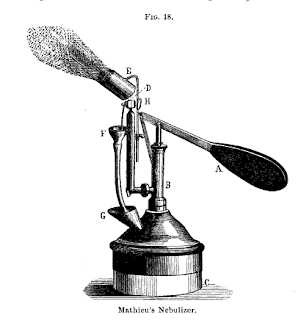

"This apparatus (Fig. 18) is composed of a glass reservoir c, in which the liquid to be employed is poured through the little funnel G. On compressing the air in the pump B, by motion of the lever A, the fluid is forced through a small groove in one of the plates forming the joint D, and by turning the screw H, the smooth plate is more or less compressed against the groove, thus regulating the delicacy of the stream. A stream as fine as the finest hair can be thus secured if the instrument be properly constructed. This capillary stream against the upper portion of the cylindrical metallic drum E, whence it is diffused in a very fine spray. A waste-pipe f, conveys the excess of fluid back into the reservoir. The force with which this little apparatus works is evident on removing the drum, when the stream will be projected up for several feet, then falling like a fountain. It is said that at a few inches distance the stream can be projected into the skin, thus forming a mode of endermic medication." (2, 193-194)Before 1862 all the nebulizers produced were either based on the Sales-Giron or Mathieu design. It was in 1862 the mechanisms of Mathieu's idea was greatly improved upon by a German named Dr. Bergson when he introduced the Bergson Apparatus and Inhaler in 1867.
Reference:
- Beatson, George, "Practical Papers on the Materials of the Antiseptic Method of Treatment," Vol. III, "On Spray Producers," Coats, Joseph, editor, "History of the Origin and Progress of Spray Producers ", Glasgow Medical Journal, edited for the West of Scotland Medical Association, July to December 1880, Vol. XIV, Alex and Macdougall, pages 461-484
- Cohen, Jacob Solis, "Inhalation in the treatment of disease: it's therapeutics and practice," 1876, Philadelphia, Lindsay and Blakiston
Rick Frea's Facebook
RT Cave on Twitter


