Friday, April 4, 2014

5000 B.C.: An Egyptian hero thinks about air

Sometime around 5,000 years before the birth of Christ a man was sitting in an otherwise empty cave cutting open the body of an ox. As he set the knife upon the animal's chest he observed the chest was moving, and he cracked open the ribs and saw that the heart was still beating, although as he held it in his hands the beating stopped. The animal was dead.

After the rain stopped his brother's arrived, and helped him carry the animal back to the women and children at the shelter cave. The men rushed along because the wind was blustery, and the sky looked ominous. Our hero observed as he ran his own chest went in and out, and something cool and refreshing entered his nose and filled his chest. He felt a beating in his chest.

Upon entering the cave he and his brother unloaded the ox, and he sat on the floor trying to catch his breath. He paid attention to his breathing, enjoying the "air" that entered into him. "What is this?" he wondered, as he approached the animal once more, and finished cutting it open. He observed the blood this time. He surely saw it many times before, but now he was observing it. What was it really?

He held his baby daughter later that night as he sat around the fire, and felt her hair, her face, and her chest. He felt her chest bob in and out, in and out, in and out. He put his cheek near her mouth, and his hand upon her chest, and felt a warm, humid breeze each time her stomach moved in. He wondered what it was she was "exhaling" and "inhaling."

The next day he was in the wilderness along the Nile again, and he wondered what the blue sky was. He speculated it must be a gift of the gods, as his grandfather taught him. He did not doubt his grandfather, although he wondered if there was something more to it. Out of fear of being taunted by his fellow men, and mainly out of fear of offending the spirits, he tried to squash these thoughts. But he couldn't squash these thoughts. He wondered if he was blessed by having them, or cursed.

He told these thoughts to one person and one person only, and that was his son. He also told his son that if he ate to many figs he'd become nauseated and probably toss out his lunch. He told his son about the poppy herbs he found in the fields and how he used them one day when his mother lay dying in the back of the cave. He prepared them into a drink, and she drank of it, and she felt no pain and she died peacefully.

He told his son how he watched his mother "breathing" as she lie there in her sleep, and he saw that she stopped breathing and she was no more: she was dead. The father told his son that he wondered if breathing was essential to life, and if breathing in the air was necessary for life. He told his son he wondered if there was some form of vital substance in the air that was essential to life. When you no longer breathed you no longer inhaled this substance. The same must be true of the animals as for humans.

The son remembered the words his dad spake, and he also remembered the vow his dad forced him to make: "Never tell anyone you cannot trust with this knowledge." He thought of these words as several years later he was inside a cave, awaiting out a rainstorm, cutting open an ox. He split the cavity wide open and he observed a heart between two lungs, and he saw the liver and spleen and kidneys. He came up with names for these organs.

Yet he didn't stop there. He found that there is a series of vessels throughout the body of the ox, and when he cut one of these vessels open blood spurted out. He decided these vessels must contain the essence of life, and that perhaps this "blood" contained the air that was inhaled during breathing. He wondered if this was the gods communicating to him.

He was told to worship the Nile as the Great River, the heart of the gods. The Nile was the soul of Egyptian life, and through the channels (metu) his fellow men made through the land the gods were able to nourish the land so the crops would grow and the animals and humans could stay alive. The Egyptians learned to worship the Nile, and celebrate it as the essence of life.

Several years later the Egyptians formed several cities around the Nile River. The great-great-great--great grandson from the same family is the sage of the village: the medicine man. Yet he is more than a medicine man, as he has the ability to communicate with the gods, acting as a mediator between the gods and the people. He was a priest, the same line of priests that would eventually become the physicians. He was, in essence, the first physician, communicating directly with the god Thoth, who was the secretary of the gods.

Alone in a mud-brick house this first physician traced the vessels around the body, and he found that they went to all the parts of the body: to the arms, fingers, legs, toes, chest, head, and brain. He also found that these vessels all seemed to originate in the heart, and so he speculated that perhaps the air is the substance of life, or the words of the gods, and perhaps this air flowed through the body through channels (metu) carrying with it the words or nutrients of the gods to nourish the body, just as the black mud flowed from the Nile through the land through channels (metu) carrying with it the words and nutrients of the gods to nourish the land.

In this way, he speculated, the gods communicate with the land and the human body through the metu. So as one day one of these priests learns about a new method of writing down words, and so he copies these words onto paper made of papyrus, and he rolls it into a scroll. Now all priests will have this wisdom. And he makes anyone who is to be taught this wisdom to make a sacred oath to the god Ra that he will not share this wisdom with anyone. He does not know where the oath came from, but he knows it is wise to repeat it, and to consider it sacrosanct (too valuable to be interfered with).

The wisdom taught is that the god's words are the air, and the heart is the Nile, and the vessels of the body are the metu thought which the Nile speaks to the various parts of the body and land. The heart, therefore, is the essence of life. The heart is the soul. The heart is as the Nile: the center of everything. Your home is the Nile-heart of your life. Your child is the Nile-heart of your life. Bread is the gift of the gods, and it "strengthens your heart." If you have the gods with you then goodness will be with you, and you will be of "good heart." Your children are the heart and soul of your life. You share a heart with your spouse.

In this sense, he believed that as the Nile was the center of life in Egypt, the heart was the center of life in the human body. He believed that all senses communicated with the heart: the ears, the eyes, the tongue, the fingers, the toes, the nose, and so forth. Every part of the body, including all the organs, communicated witht the heart. It was the where all thought, emotions and intelligence was formed. Heart, to the Egyptians, was used in lieu of our words for mind. They'd say things like "keep your heart on the project at hand," instead of saying "keep your mind on the task at hand."

There were other organs of the body, and these were merely helpers. The substance in the head was the brain, and it controlled the flow of mucus to the nose. There is a metu between the brain and the nose, and therefore the gods spoke through this metu as well. There is also a metu that connects the vessels of the various organs of the body, including the ovaries and testicles.

Life and good health of the land and civilization is determined by the flow of black mud through the land, carried by the floods of the Nile and through the channels. If there is some sort of obstruction or problem with the flow, then there is a problem with life and health. When the water doesn't flow to Memphus, then the crops do not grow, the animals die, and people suffer and die as well. Severe drought results in severe problems with life. If drought is ongoing this means the gods are no longer speaking with the lands, and this results in death.

Likewise, Life and good health is determined by the flow of air, blood, sperm, tears, saliva, mucus, urine, nutrients, and feces through the metu of the body of animals and humans. If something happens whereby this flow is altered or obstructed, then this is when diseases happen. If the flow is obstructed in the ovaries, then diseases of the ovaries occur. If the flow is obstructed between the brain and the nose, then diseases of the respiratory tract occur, such as diseases like coughing, sneezing, wheezing, panting, or increased phlegm. If all the flow is obstructed so that a drought in the body occurs, then the gods are no longer speaking and death happens.

Yet while the metu carry the words of the gods, they can also carry bad words or poisons (wehedu). They can also carry poisons that entered the body by demons or angry gods. They can also carry poisons that entered the heart by inhaling poisons of the many evil spirits, or by the poisons that entered the body through food. Sometimes such poisons can enter the body by the evil people around you, perhaps someone you love wants you sick or dead. In either case, good substances and bad substances flow through the metu.

These poisons can cause various diseases and death, just as the good words of the gods can cause health and life. The good words can keep the flow flowing smoothly, and the bad words can cause obstruction and drought. These poisons can cause a person's breathing to become weak and labored. These poisons can cause a person to pant or gasp for air, or to cough, or to have increased phlegm. These poisons can take away life by making the heart stop beating.

Sometime around 3100 B.C. a king by the name of Menes, or maybe it was Narmer (or perhaps they were one and the same), became ruler of all of Upper and Lower Egypt, and by now there are many scribes and physicians among the priesthood, and these are the educated people among the land of Egypt. They are educated in or near the temples of the gods in Heliopolis and Memphus and various other cities. Historians now refer to Egypt at this time as one of the first civilizations, or one of the first GREAT civilizations.

He shared this knowledge with all aspiring priests. These priests were made to say an oath that his father made him say: ""Never tell anyone you cannot trust with this knowledge." The knowledge was taught through the years to all the priesthood, but only the priesthood, or anyone, for that matter, who is privileged to an education. This knowledge, herefore, as was all knowledge, esoteric: a privilege to only the few.

One of the priests, perhaps an ancestor of our hero, attributed this wisdom to the god Thoth, and he wrote a series of books that would later become known as the Hermetic Books. The first copies were written on clay tablets and placed at the temples. Once papyrus was invented these books were recopied and recopied over many years, and many physicians had their own copies and perhaps their own versions. Samples of these texts are still preserved to this day, perhaps in the tombs of one of our hero priests. Many are still at rest with their original owners.

A sample of one of these is referred to as the Ebers Papyrus, and it was discovered between the legs of a mummy. The man it is named after, Georg Ebers, thought it was a copy of the original Hermetic books, and he even believed the author was the priest-physician-architect Imhotep. Yet later experts realized the Ebers Papyrus was more like an encyclopedia, and contained copies of magical, yet mostly rational medical remedies for the various ailments of the day. It was a copy of a copy, more than likely, and the material within it was dated to be as old as the oldest empires of Egypt, perhaps as far back as 3000 or 4000 B.C.

Yet even though it wasn't an original copy, it contained recipes that were probably used by the owner it was buried with, and this owner was probably a physician. He either made the copy himself or had a scribe make it for him. Or, perhaps this book was made specifically by a scribe to be placed in the tomb of this physician for him to use in the afterlife. Although in the margins are the notes of the author, with words such as "I tried this. It works great." Some also speculate this copy was not used by a physician in practice, so much as a textbook for an instructor or student.

Along with the recipes, it also contained parts of another book called the Book on the Vessels of the Heart, and it reads as follows:
The Physician's Secret: Knowledge of the Heart's movement and Knowledge of the Heart. There are vessels (metu) from it to every limb. As to this, when any physician... or any exorcist applies the hands or his fingers to the head, to the back of the head, to the hands, to the place of the stomach, to the arms or to the feet, then he examines the heart, because all his limbs possess its vessels, that is: if (the heart) speaks out of the vessels (metu) of every limb.
The parts copied described the then known anatomy of the human body that consisted of a heart that communicated to the rest of the body through a series of vessels that acted as metu (arteries, veins, ducts, muscles, and nerves). The priest-physician was taught that by feeling the pulse he could hear the words of the gods from the heart.

By comparing this beat with his own, he was instructed, he could determine if the heart beat is slow or fast, and this would help him determine if something wrong was going on with the body. It was then his job to diagnose the problem: where is the flow obstructed? Why? What remedy would correct it, an incantation or herbal remedy or both? The answer could often be found in the book. 

On the other hand, if the heart beat was normal compared to his own, then the words of the gods had spoken: this person is healthy, or he will get better. Perhaps an incantation or a simple herbal remedy was in order to correct the ailment, or to prevent it from occurring in the future. The answer could often be found in the book.

The author of the Ebers Papyrus, the man who lived around 1600 B.C., shared with us some of the known anatomy of the day. Thanks to a 1937 interpretation by B. Ebbell, we know the Egyptians were aware of 46 vessels in the human body, and we know their basic anatomical wisdom as this:
There are 4 vessels in his nostrils, 2 give mucus and 2 give blood
There are 4 vessels in the interior of his temples which then give blood to the eyes; all diseases of the eyes arise through them, because there is an opening to the eyes.
There are 4 vessels dispersing to the head which effuse in the back of the head...
There are 4 vessels to his 2 ears together with the (ear) canal, 2 on his right side and 2 to his left side. The breath of life enters into the right ear, and the breath of death enters into the left ear...
There are 6 vessels that lead to the arms, 3 to the right and 3 to the left; they lead to his fingers.
There are 6 vessels that lead to the feet, 3 to the right and 3 to the left; they lead to his fingers.
There are 2 vessels to his testicles; it is they which give semen.
there are 2 vessels to the buttocks, 1 to (the right) buttock adn the other to (the left) buttock.
There are 4 vessels to the liver; it is they which give to it humor and air, which afterwards cause all diseases to arise in it by overfilling with blood.
There are 4 vessels to the lung and to the spleen; it is they which give humor and air to it likewise.
There are 2 vessels to the bladder; it is they which give urine.
there are 4 vessels that open to the anus (rectum?); it is they which cause humor and air to be produced for it. Now the anus opens to every vessel to the right side and to the left side in arms and legs when (it) is overfilled with excrements.
However, in another section of the Ebers Papyrus it's noted that there are 22 vessels of the human body. Some think this was because they were aware that there were different kinds of vessels, such as arteries that carried air and life to the various parts of the body, and veins that carried poisons to various parts of the body. However, this is mere speculation. Our hero had no knowledge of circulation, nor did he understand a difference between arteries, veins, ducts, tendons and nerves, and perhaps the Egyptians didn't either. They did however, as noted above, note the flow of water/blood from the Nile/heart.

There was another book copied in the Ebers Papyrus, or at least parts of it. It is from here where we get many of our recipes for remedies. The book is called The Collection on the Expelling of the Wehedu. Wehedu is the Egyptian word that refers to the material that makes pus, or, in other words, poisons. The book offers remedies to get the poisons out of the body and fix the damage. One remedy for asthma-like symptoms, according to Ebbell anyway, consisted of using a primitive inhaler device:
Thou shalt fetch 7 stones and heat them by the fire, thou shalt take one therof and place (a little) of these remedies on it and cover it with a new vessel whose bottom is perforated and place a stalk of a reed in this hole; thou shalt put thy mouth to this stalk, so that thou inhalest the smoke of it. Likewise wit all stones. Thereafter thou shalt eat something fat, of fat meat or oil."
This might have been the remedy for cough, wheezing, gasping, or increased phlegm. To the modern reader this may seem rational, considering the inhalation of herbs allowed for the medicine to be applied where the injury occurs: in the respiratory tract; in the lungs. Yet this remedy more than likely was used for other purposes, perhaps to blow herbal remedies over the royal anus, or the anus of any sick person.

The Egyptians were infatuated with the flow of this metu, and they were also infatuated with the mouth and nose where the air and food and poisons entered, they were also concerned with the anus where it all exited. One common remedy of the Egyptians was regular purging (vomiting) or enemas (bowel movement), because they believed most poisons entered the body from the foods that were eaten, and such remedies cleansed the system, allowing for continued and prolonged flow of the good words through the metu of the body.

It was a normal routine for Egyptians, regardless of class, to purge themselves for three consecutive days each month, according to Herodotus, the great Greek Historian (484-425 B.C.). Another Greek historian, Diodorus (90-30 B.C.), said they sometimes purged themselves "every day and sometimes at intervals of three or four days."

This was the knowledge that lasted for over 3,000 years while the Egyptians ruled, and this knowledge was protected by laws that forbade the dissection of the human body, even by physicians trying to understand why diseases happened. Neither priest nor priest-physician disobeyed these laws, because they knew they were the wishes of the gods, who were omniscient.

Ancient Greek philosophers such as Thales and Miletos, and later Hippocrates, entered the schools at Heliopolis and they were taught the wisdom of the Egyptian books. They shared this knowledge with their fellow Greek men and women, and such wisdom was advanced slightly and shared with the rest of the western world.

This knowledge was later shared with Rome by physicians like Asclepiades. When Rome collapse, this knowledge made it's way to Persia where the Arabs preserved it for Europe, when knowledge was once again appreciated by men in the west. Andreas Vesalias learned this wisdom, and in 1543 he wrote the first ever accurate book of anatomy, and from this medicine was advanced even further.

Yet the idea that disease was a concept caused by the absorption of poisons carried by the vessels of the body into the intestines is an idea that was believed even as recent as the beginning of the 18th century. The Egyptians believed almost from their early days that diseases were caused by some kind of imbalance in the body, perhaps due to some poison or Wehedu. The Greeks likewise believed this, although they referred to it as an imbalance of the four humors: blood, phlegm, black bile and yellow bile. It was taught at the Asclepion Temples in Greece, by Hippocrates, by Galen, and by various other physicians.

Some poison, they believed, caused an increase or decrease in any one of these, causing an imbalance, and thus disease. The remedy, therefore, was to do something to recreate the balance. The remedy may be something as simple as allowing nature to take its course, or something more invasive as having the patient eat an excessive amount of figs to toss up the poisons, or a purging, or enema. It could also involve the process of bleeding the patient, and all these remedies were utilized even up to modern times. In some places of the world, the primitive world, these remedies are still utilized.

Yet it all began with our hero, a man who will never be known to history. He is a man without a face, a man without a name, a man without a known burial site, a man with no attribution, not even a random marker. Yet while others thank the Egyptians, or the Greeks, or the Romans for medicine, we know now that the man we must thank is our hero, the first man to think about air.   

References:
  1. Evzen, Strouhal, "Life of the Ancient Egyptians," 1992, Translated by Deryck Viney, London, England, University of Oklahoma Press, page 245
  2. Sigerist, Henry E., "A History of Medicine: Primitive and Archaic Medicine," 1951, New York, Oxford University Press, pages 325, 349-52
  3. Prioreschi, Plinio, "A History of Medicine: Primitive and Ancient Medicine," 1995 (1999 reprint), Omaha, NE, Horatius Press, page 310-5
  4. Ebbell, B, translator, "The Papyrus Ebers: the greatest Egyptian document," 1937, Copenhagen, Levin and Munksguard, page 144, 114, 96, 97, 

Thursday, April 3, 2014

10,000 B.C.-1492: Natives of North America

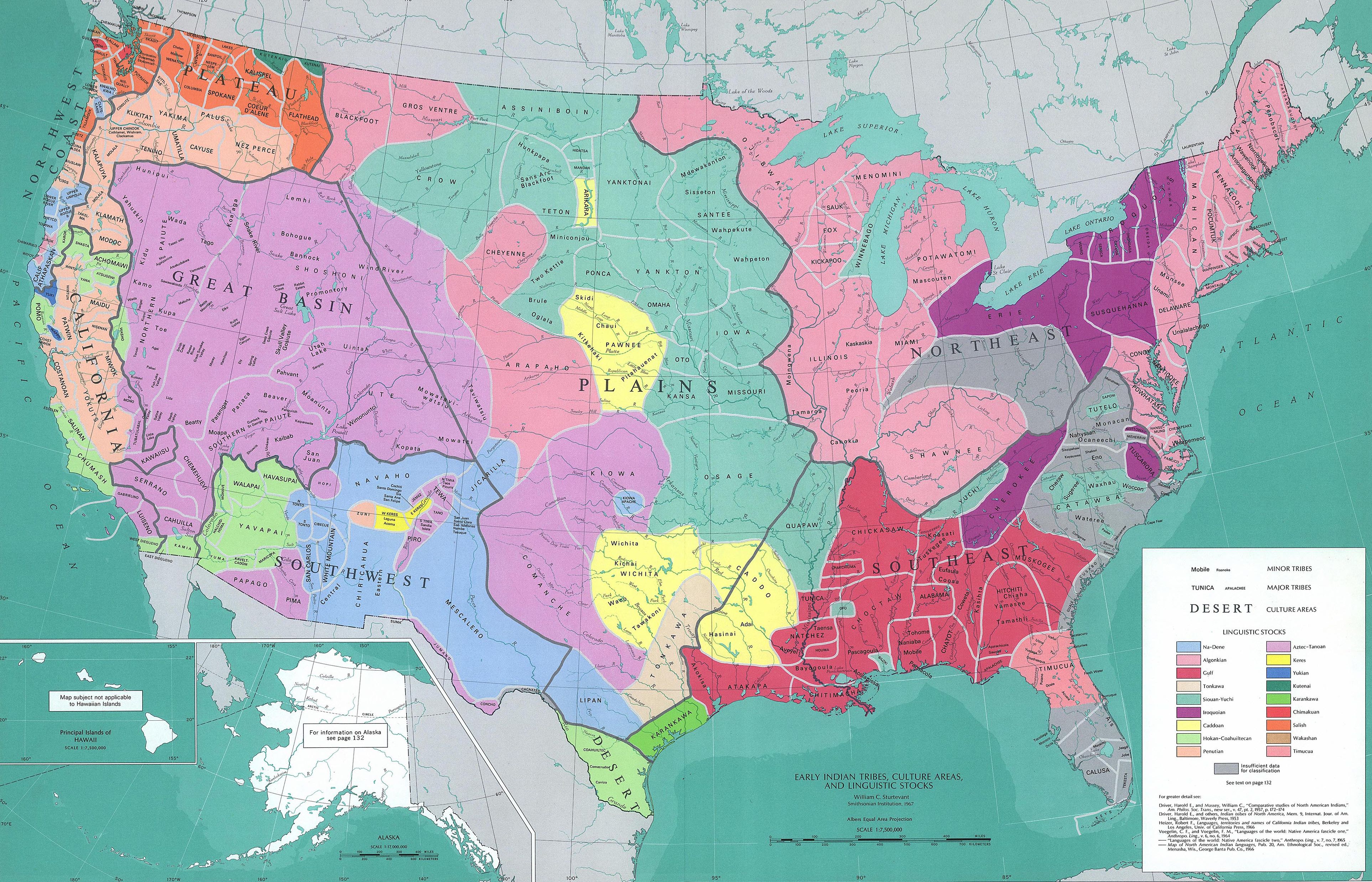
Map of cultural ares of North America at the time of the
European invasion (from Wikepedia)
So what was it like to live with asthma in the early Americas?  To answer this question we must first understand the people who lived in the Americas.

Many of the tribes and families that migrated across Beringia stayed in North America.  Some continued to hunt and gather as individual tribes and families, and some of these tribes and families banded together to form larger tribes. They must have been at peace with their way of life, and had no reason to change unless nature, or enemy tribes, forced change.

As with other primitive societies, they worshiped the land, and believed health sickness, peace and strife, were the result of the many spirits that lived among them.  For the most part they were at peace, spending their time as hunters and gatherers, and as worshipers of the many spirits.  Some would ultimately become farmers.   

No one knows exactly when the various tribal nations were formed, although some estimated times are given when possible.  That said, here are some of the tribes of North America: 

Natives of North America
Clovis People:  13,500-13000 B.C.
Fluted spear tips (spear tips chipped into shape by stone tools) were found amid Bison bones in Clovis, New Mexico in the 1920s and 1930s, hence the name of the spear tip and the people.  These people are believed to be among one of the first cultures to develop in North America.  “Clovis people” is a generic name for the paleo-indians who came across the Bering Land Bridge and populated the Americas.  They were basically nomads, although from time to time they returned to places they found to be well stocked with vegetation and animals.  There were people who came before them, although some consider them parents many future native American cultures.
Eskimo (Inuit): 10:000 B.C. to current

There are hundreds of other tribal nations of the Subarctic Regions of North America, most of which speak Algonquin or Athapascan languages. Some of these are: Ojibwa, Chippewa, Cree, Innu, Kaska, Yellow Knives, Han, Chipewyan, Ahtna, Oji Cree, Anishinini, Tagish, Tlo Cho, Lower Tanana, Upper Tanana, Southern Tutchone, Northern Tutchone, etc. Click here for more
These are people indigenous to Siberia, Alaska, Greenland, and Canada.  They are considered among the last of the paleo-indians to cross Beringia.  They refer to themselves as the Inuit, or “the people.” Most of them came across over the ice on sleds led by dogs, and they lived in igloos and pit house. (Encyclopedia Britannica) They were fishermen and hunters, hunting reindeer, musk ox, seal, walrus, and whale.  Because they were known to eat both cooked and raw meat, they were called the Eskimo by the English, which is Algonquin for “eaters of raw meat.” The British often used Algonquin when referring to Native Americans, mainly because they were the first Native Americans they came into contact with. (Hakim, page 24, 25, 28)
Cliff Dwellers (Anasazi): 1100-1400 A.D.

Early Pueblo Indians
They are given their name by the large dwellings they built into the cliffs of the Rio Grande, along the Colorado river, New Mexico, Arizona, and Utah. They also lived in pit houses and pueblos, which were large, rectangular adobe houses made of clay, rock and straw. Some Pueblos had many rooms. They lived off the animals of the area (rabbit, deer, elk, etc.), and crops they planted along the river valleys below their cliff-homes.
Mound Builders:  3,400 B.C. to 1500s

Many mounds were built over a thousand years prior to the great pyramids of Egypt. 
They lived in cities with formal governments east of the Mississippi.  They made and collected gorgeous artistic ornaments, and even had their own businesses.  They also built mounds by carrying baskets of dirt.  The mounds were used as burial sites for the dead, and for temples to worship the spirits.  Some were used as palaces for the leaders of the tribes.  They were traders, collecting artifacts from other tribes from all over the Americas.  They created relay systems as trading routes. They were hunters and gatherers. 
Pueblo Indians
They basically live in the same regions as the Cliff Dwellers, after the cliff dwellers have moved on.  They lived in small villages with homes made of mud-brick, sticks and brush.  Many live around the Rio Grande, in rectangular houses made of sun-dried clay that were called adobe. The roof of one house is the front yard of another house built behind it on the hill or mountainside. To get inside they climb ladders and go through a hole in the roof.  They use rivers to irrigate land to grow crops that they rely on to survive. (Hakim, page 32)
Northwest tribes:

Kwakiuti, Tsimshian, Tlingit, Notka, Chinook, Makah, Haida, Okanagon, Spokane, Quinsault, Kalapuya, Kalispel, Shuswap
They lived in the states of Washington and Oregon.  There was enough food that they had no need to farm (creatures from the ocean, game that roamed the land, fish in the ocean and rivers, berries and plants amid the trees).  They made wooden canoes, houses, and totem poles.  They gathered in circles at night and beat drums, rattled beads, chanted songs, told stories of ancestors, and prayed.  Along with having celebrations, they also owned land and collected material possessions. The went to war only to collect slaves.  Their society was divided among nobles, commoners, and slaves. 
Plains Indians:

Comanche, Sioux, Omaha, Arapaho, Kansa, Iowa, Missouri, Cree, Osae, Cheyenne, Wichita, Crow, Ojibwa, Blackfoot, Mandan

They lived in the center of America from Canada to Texas and from the Rocky Mountains to the Mississippi, mostly in the open lands where there are few forests and no mountains.  The people are nomads, moving to where the food is (such as following Buffalo herds).  They hunted animals, and tried farming (although it was difficult).  They carry tepees and set them up wherever they are staying.  Sometimes they move daily, sometimes they stay in one spot if the crops are growing well. 
Woodland Indians:
Algonquin Indians:  They spoke a similar language, along the Great Lakes, the St. Lawrence River, and in the forests along the coastline. These are the Indians the Europeans first came into contact with, which is why many other Indian terms are based on Algonquin languages, including the term “Iroquois.” They were hunters and gatherers who did some farming. They live mostly in wigwams that can be easily built as they relocate to where the game is. Although in cold weather they built long houses. They are among the most common Native American tribes of North America, numbering in the hundreds of thousands.

Iroquois Indians:  They all spoke a similar language. Five tribes of the eastern woodlands created a League of Indian Nations (Iroquois Confederacy) that formed councils and lived in peace. Each tribe had its own laws, although in times of war they banned together. All council decisions were made unanimously. They mainly lived in long houses, and therefore they called themselves Haudenosaunee, or “people of the long houses.” They were farmers who did some hunting and gathering, moving their villages every few years to grow crops on new land, allowing the old to rest.. They league consisted of the Mohawk, Oneida, Onondaga, Cayuga and Seneca, although there were many other tribes.. The league later added a sixth tribe: the Tuscarora. joined in 1722.
These are the indigenous people who lived in the Eastern Woodlands amid the vast (and very large) trees between the Atlantic Ocean and the Mississippi River, and the Great Lakes and Gulf of Mexico.  The men hunted beaver, deer, raccoon, possum and bear with knives and bow and arrows. They also made canoes that they used to set up nets and fish for salmon, sturgeon, trout, smelt, etc. The women staid home and grew crops of corn, beans, squash and pumpkins.  They also pick wild nuts and grapes.   Some are the ancestors of the great mound builders. The forests are thick, so the Indians have to clear fields by scraping off the bark of trees (girdling) and waiting for them to die, before chopping them down with their axes.  They wear weather appropriate and simple clothes, usually made of animal hide and leather, and they decorate their bodies with tattoos, paint, feathers and jewelry. They make homes out of tree limbs called wigwams that could easily be constructed for quick shelter. Some built long houses out of mud and clay that were lived in for longer periods of time. There were hundreds of thousands of tribes across this region, which you can view here.

Long House
So you can see there were hundreds of thousands of tribal nations scattered around North America, some stretching across to more than one region.

There were also hundreds of thousands of languages (as you can see by this map), so you can see how this might cause some confusion when it came to cross tribal communications.

If you had a remedy for dyspnea, for example, you might not be able to share it with the other tribes, even other tribes around you.  So, although some tribes were able to create methods of communicating, and sharing ideas, talents, and even medicine, most did not.  So as new ideas were rarely shared in North America prior to the Spanish, French and British invasions, and this prevented the advancement of medicine, let alone any other civilized art.

I have barely scratched the surface in describing these great people, and I have not listed them all here. I simply want you to have an understanding of some of the societies of North America so you can get a feel for what it would be like to live among them.

Chances are if you were sick, it was the result of the unhappiness of the many great spirits, and to heal you must find a medicine man, a Shaman.  He or she has great wisdom and will heal you, or at least provide you words, or even a remedy, that will provide you with comfort.

Algonquin Village
Who knows what would have happened to the various cultures that existed in North America had the Spanish, British and French not have invaded the lands, forcing them to adjust to European way of life. Would they have ultimately formed huge civilizations like the Sumerians, Egyptians, Oltec and Maya.  We will probably never know.

What we do know is that the various tribal nations of North America had access to an array of herbs and berries, many of which were experimented with over many centuries.  Over time they learned that some of these could be prepared in various concoctions that could be used to treat the various ailments that plagued the Native Americans.

Among these "drugs" was a paralytic that was coated on the tips of spears called curare. Others drugs were used to create ointments to heal wounds.  Others were used to create potions that would cure the various internal ailments.

It's important to note for the sake of our asthma history some medicine was inhaled by stuffing it into pipes and inhaling the smoke. Yet while inhaling was a remedy for many ailments, it was rarely a remedy for asthma.

Still, the potential was there, if only the North American Indians were made aware that a medicine, and method, they already possessed was a remedy for an ailment that must have plagued an Indian from time to time.  

Although, for the sake of argument, many experts presume asthma was so rare among the North American Indians that there was no urgency to find a remedy for it.  

Regardless, most primitive societies believed diseases, asthma or otherwise, were caused by the spirits, and therefore mankind had no control over them.  It is for this reason that the main emphasis was on prevention over cure.  

Like the Egyptians and Hebrews so many years before their time, the Americans, therefore, were concerned with cleanliness, perceiving this to be the best method of preventing disease.  

As later Europeans and American Colonists came interacted with native American Indians, they were quite impressed with their cleanliness.  They observed the Indians washing daily in a river, or lake, or stream.

Upon investigation they learned this was because the Indians believed diseases were a result of a disharmony of the soul, and one of the means of maintaining an orderly soul was a daily washing.  (2, page 253-254)

John D. Hunter, in is 1823 book "Memoirs of a Captivity Among the Indians of North America," was one such person to have observed the Indians cleansing in the river:
Shes-ka-ne-shu. — Washing in the river. Bathing.—This, though perhaps not strictly speaking a cure for their diseases, is a very good preventive. It is much practised, constitutes one of their greatest pleasures, and, I am persuaded, contributes very much to strengthen the body and invigorate the constitution. Men, women, and children, from early infancy, are in the daily habit of bathing, during the warm months; and not unfrequently after cold weather has set in. (2, page 403)
North American Indians practiced year round bathing?  Could you imagine bathing in Lake Michigan in the middle of the winter?  Brrrrrrr

Would this have prevented, let alone cured, your asthma? Probably not.  Chances are, however, that simply believing it would may have eased your mind enough to take the edge off.

References:
  1. Hakim, Joy, "A History of U.S.: 
  2. Vogel, Virgil J, "American Indian Medicine," 1970, London, university of Oklahoma Press, pages 22-35, 252

Thursday, March 27, 2014

10,000 B.C.: Asthma caused by too much phlegm?

Asthma-like symptoms were described in ancient societies in Egypt, China, Korea, India, Greece and Rome, and while various terms were used to describe respiratory ailments, most societies believed in one way or another that disease was caused by an imbalance of bodily humors.

The humors are the bodily fluids. Primitive people must have noticed puss on open sores, and colored phlegm in those sick with breathing trouble.  They must have noticed the diarrhea and vomiting of people with stomach discomfort, pain, nausea and malaise.

So early on they must have associated the humors with being associated with disease, and at some point linked them with the cause.

They most likely would have noticed that, upon spitting up a wad of phlegm the person who was short of breath felt better, or that after a good bowel movement or after vomiting, a person with stomach discomfort felt better.

So early on they must have linked the humors with the cure.

Some humors that were most certainly observed were blood, phlegm (sputum, nasal secretions, saliva), water and bile. (1, pages 111-112)

There are different descriptions of the humoral cause of disease.  For instance, the Chinese describe it as an imbalance of yin or yang causing an obstruction of sorts to the flow of human life, or qi.  The Ancient Greeks believed it was an imbalance of the four bodily humors:  blood, phlegm, yellow bile and black bile.

The cause of such an imbalance was believed to be things like living non-virtuous lives, stressful living conditions, poor living conditions, uncleanliness and improper diet.  Remedies for disease were believed to be incantations, drinks or inhalents of various herbal concoctions, or anything to purify the system to return the humors back to normal.

Yet whatever way you look at it, the similarities of the causes and cures of diseases by different civilizations is stunning.  It almost makes one think such a theory was proposed before mankind split up into six different regions during the neolithic revolution or agricultural revolution nearly 10,000 years before the birth of Christ.

Either that or there was more communication between Ancient Eastern and Western societies than historians are aware of.  And in this way was devised the convection theory by Friedrich Ratzel in 1882 which states that nations have "identical phenomenon" because of communication between the various groups of humans, according to Fielding H. Garrison, in 1921 his book "An introduction to the history of medicine."  (2, pages 17-19)

A separate theory mentioned by Garrison is the convection theory devised by Adolf Bastian in 1881.  This states that "the appearance of identical ethnic phenomenon in different relations of space and time is due to the spontaneous development of certain 'elemental ideas' which are common to primitive man everywhere.(2, pages 17-19)

Garrison explained it as the "Solidarity of folkways."  This theory postulates "humans have instinctive actions" that cause them to gather in groups, form societies, and generate myths to explain natural phenomenon.  They tend to reach a "common point of similarity or identity." (2, pages 17-19)

Worded another way:  "The development of the individual is but an epitome of the development of the race. Left to itself in a favorable environment, any savage tribe will inevitably evolve a culture all its own, for the regulation of food supply, sexual and social relations, adjustments to the unknown, manifesting itself as a political economy, ethics, law, medicine, religion, and so on." (2, pages 17-19)

In this way it's believed certain human actions are instinctive, no matter when a society is formed, at a certain stage in it's development.  This may explain why the ancient Egyptians created their pyramids and mummification, and similar pyramids and mummification methods were discovered in Mexico thousands of years later.  There may have been no communication between the two groups, just that the Mexicans were slower to develop their society and advance to this state.

Religions and laws in all societies are ultimately realized to be an important element of maintaining peace in the society, and a government with a totalitarian ruler was determined to be the best way to get people to do things that were needed to be done for the society to function, such as tending to the land, creating structures, and managing irrigation.

And plants were determined to have poisonous and medicinal properties in the evolution of the society.  To explain how they worked myths were created.  Myths were also created to explain health and sickness.  It just so happens at a certain point the myths appear to be the same, such that disease is caused by an imbalance of some sort of substance, which the Greeks called humors and the Chinese called Qi and other societies called something else.  Yet the ideas are similar, and this type of medicine is referred to as folk medicine (folklore).

These similarities are the natural, or instinctive, evolution of human societies.  And at some point the society will develop a need to communicate ideas from one generation to another, and this is where folklore comes in.  Poems and songs are recited to make it easier to remember stories and recipes, and then at some point a form of writing material and written language is developed.  It's by this we have evolved to where we are today as a society.

In this way, societies evolve as new ideas are thought up to make life better for the civilization, but the heart and soul of the people has never changed.  Humans always have an inert tendency to socialize, to think, to communicate, to breathe, to eat, to adjust to change, and to have empathy for fellow men and women.

Men and women observed their relatives and friends suffering, and yearned to find a way to help them.  They attempted to find myths to explain the symptoms they observed or their fellows complained of.  They created myths to give people hope and faith for a better future.  This is always essential, as death and sickness are omnipresent.  Life can be melancholy, and hope and faith are needed to give people a reason to do what they need to do to keep the society afloat.

Asthma, or asthma-like symptoms were believed to be caused by too much phlegm that causes a ceizure or epilepsy of the lungs resulting in various respiratory symptoms such as foaming at the mouth, cough, dyspnea (short of breath), and wheezes.  These symptoms would be the result of anything that causes dyspnea, including exertion from running or battle.  The remedy for asthma, as with any disease, was as simple as improving diet and getting plenty of sleep and exercise.

While the definition of asthma matured through the years, it wasn't until the mid 19th century that the myth of humoral causes of disease left the medical profession. This evolutionary advancement occurred in western nations of Europe and the United States.  In this sense, the humoral cause of disease was such a simple description of disease it was easy to believe, and this dogmatic theory lasted perhaps 11,850 years if not longer. Yet at a certain point in the advancement of knowledge science would be learned, and myths would be found to be myths.  Although I think it's safe to say that some medical myths still linger.

Even the great asthma expert of the second half of the 19th century, Dr. Henry Hyde Salter, didn't completely reject the humoral theory, although he was the first to successfully sway from this mindset. And even then it took a lot of convincing to finally change the minds of dogmatic physicians and an ignorant society.  It took science, and a lot of hard work by a few physicians struck by asthma.

While most modern civilizations have moved on from old myths, some primitive societies continue to believe in them.  They continue to worship gods and spirits, and justify health and sickness as being caused by transcendental forces.  Medicines are thus gifts from the other world.  As their society advances, as knowledge progresses, they too will some day reach the modern world.

Likewise, if our society continues to exist, society will continue to change.  Who knows what the future will bring.  Yet what we do know is that the heart of humans will continue to be the same.

Click here for more asthma history.

References:

  1. Neuburger, Max, writer, "History of Medicine," 1910, translated by Ernest Playfair, Volume I, London, Oxford University Press
  2. Garrison, Fielding Hudson, "An introduction to the history of medicine," 1922, Philadelphia and London,

Friday, February 28, 2014

10,000 B.C.: The first Materia Medica (review later.... ideas for later chapters)

The year 30,000 B.C. is often considered as the dawn of medicine.  By then, men and women learned to socialize, and to love and care for their fellow human beings.  A pharmacopoeia had developed, and it, along with myths and food recipes, was shared by means of easy to remember lyrics. Most clans had at least one person, an elderly woman perhaps, who remembered the recipes, and utilized them when needed.

When a young boy becomes short of breath, his body stiff as he struggles to inhale, perhaps due to asthma, his mother recognizes his agony and she emphasizes with him.  She makes every effort to comfort him, and it's useless.
So she sends for the wise old lady, the medicine lady perhaps, who approaches the boy wearing animal skins, replete with charms and rattles and drums with the magic ability to communicate with the spirits and demons abounding.

The old magical lady reaches into her pocket and pulls out some herbs, perhaps with some poppy seeds included, and asks for a bowl that the boy's mother provides.  She then has the boy stand before her, as she whispers and sings incantations as she mixes and stirs the herbs into the solution.  Then she does a little dance, rattles her beads and pounds on her drums.  Then she places her hands upon the boy's forehead, and her lips to his lips, and then pops back as she shouts "The evil has now passed."

The boy continues to be stiff, and to work against the symptoms caused by the evil spirits that are no longer within him.  Then, finally, as though by some miracle or magical means, his tense shoulders relax, his breathing is easy, and he lies back and falls fast asleep.  The medicine woman sets forth on her knees, presses her hands upon the boy's shoulders, and blesses him with another incantation, before walking off into the distant night.

The medicine lady was proud of herself, and she continued to chant incantations as she walked.  She believed the medicine worked because of magic provided by the spirits or gods, and when it was used for good it was white magic. When it was used for evil purposes, as poison, it was referred to as black magic. Regardless, it's probable such original pharmacologists as this were "eyed with suspicion."  (1, page 24)(4, page 23)

Humans had already learned that living in small groups was advantageous, and made hunting for food, creating shelter, and, as seen here, healing the sick easier. By around 10,000 B.C. they learned how to better manage the land, and many of these smaller groups became united and formed the first civilizations.  They put their heads together and learned how to best irrigate and harvest crops, and they created gods and religions and laws.  These were all necessary in order to keep order among the society, and to provide an incentive for each man and woman to do his or her part for the benefit of the many.

There were many advantages to working together, and one was that "People began to specialize.  Some people farmed.  Others took care of the animals.  And now there were chances to do things people had never done before.  People had time to work on their crafts.  Weavers wove grass into fine baskets. Others made pottery from clay and baked it in ovens.  Using wool from sheep, some people learned to spin thread and to weave cloth," according to Joanne Suter in "World History."  (3, page 19)

She explains that "as different jobs developed, so did trading.  A weaver might trade his cloth for food from the farmer.  A goat might be traded for an ax from the toolmaker.  First, trading was carried on within the village.  Later people traded from one village to the next." This increased trading resulted in ideas and culture being shared, including medical wisdom.  Perhaps this might have been how knowledge of the first inhalers the medicine lady mentioned above traveled from one culture to the next.  (3, page 19)

This, perhaps, was what occurred in the earliest days of what would become ancient Egypt and Mesopotamia, and what was the beginning of the agricultural revolution in about 10,000 years before Christ.

The medicine woman had time to work on creating better incantations, and to search the forests and streams for herbs she needed for her potions.  Sometimes she discovered new herbs, and experimented with them to learn their magical abilities.  One day she discovered a plant that would later be called the belladonna plant, and she pulled it from the ground, and she let it sit in the sun for two days, allowing it to become sun dried.  She crushed the roots, leaves and stems into a bowl, and discovered that they, like the poppy seeds, had the ability to cause a soothing effect.

Several years later she was called to another asthmatic boy, and she had no poppy seeds with her.  So she grabbed a handful of the crushed and sun dried belladonna roots, and, in her usual dance routine, some of the herbs spilled onto a heated brick that was on the fire, and the asthmatic boy inhaled the smoke this created and the result was a soothing effect, and also it made his breathing easier. So the medicine lady had a new remedy to add to her pharmacopoeia.

There was another significant reason for people getting together in this way, and it was the unity required to irrigate the land and harvest the crops  The greatest minds got together and learned how to dig canals and build aqueducts to control the flow of water, and invent new tools and find new material for building.  As numbers increased, so to did the need to incentivize the people to be loyal, productive members of society.  For this reason laws and religions were created to encourage, even force compliance with the wishes of the aristocracy.

Kinds and queens were chosen to create these laws, and priests were selected to manage the religions.  They worked together to provide the people with a reason to get up in the morning, and to do the arduous work needed for the society to stay together.  They created the gods, and they ordered for large temples to be built where the people could go for worship, and see as a daily reminder that the gods are ubiquitous and can see everything you do, even hear your thoughts.

As society advanced in this way, a need arose for communication, and this lead to the invention of the first languages.  There also arose a need to keep track of when the sun rose and when it set, and to determine when the annual floods would occur.  Accurate measurements were needed to construct the monuments and temples.  For generations and generation legends, myths, recipes and formulas were relayed from one generation to the next by word of mouth, usually by easy to remember lyrics of poems and songs.  Yet this was no longer useful, as recipes and formulas became too abounding and complex.  So a written language was invented.

An early example of a written language was discovered on the wall of a cave in Pindal, where archaeologists discovered a crude drawing in red ochre the outlines of a mammoth with a dark dot in the middle, perhaps a representation of the heart.  This may have been the first time a person shared knowledge to future generations by writing.  It was also proof primitive, savage, or prehistoric people knew what parts of the body were essential to life. (2, page 21)(1, page 106)

Yet such primitive methods of communication were no longer valid by 4,000 B.C., and why great minds among the Sumerians created such the first written language.  Lyrics shared by word of mouth could now be written down, and this made it easier to share knowledge between generations.  Each generation no longer had to start from scratch, and this allowed for formulas and recipes to become more complex.  This provided increased time and another incentive to discover and invent, so new wisdom could be compiled above the old.

Laws were carved into stone for all to see.  Perhaps the best and earliest example of this were the Hammurabi Codes carved into stone around 1772 B.C. This was perhaps the best incentive for people to be  loyal, productive members of society, because noncompliance meant you would be punished according to the crime you committed.  Food and medical recipes were written down, and these became the first cook book and the first written pharmacopoeia, or Materia Medica

The brightest members of society were chosen to be kings, queens, priests, and scribes.  These were among the few, perhaps less than ten percent, among the society who were educated.  The rest of society remained ignorant, and perhaps this was done on purpose to assure compliance with the wishes and desires of the aristocracy.

Temples became places of healing, and they became the schools.  Teachers were needed to educate children born to the aristocracy, and as wisdom progressed some of the scribes became teachers and priests became physicians.

References:
  1. Sigerist, Henry E "History of Medicine," volume I: Primitive and Archaic Medicine, 1951, Oxford University Press, New York, pages 
  2. Prioreschi, Plinio, "A History of Medicine," vol. 1
  3. Suter, Joanne, "Fearon's World History," 2nd edition, 1994, U.S., Globe Fearon Educational Publishing
  4. Garrison, Fielding Hudson, "An Introduction to the history of medicine," 1921
  5. Wilder, Alexander, "History of Medicine, a brief outline of medical history and sects of physicians, from the earliest historic period; with an extended account of the new schools of the healing art in the nineteenth century, adn especially a history of the American eclectic practice of medicine, never before published," 1901, Maine, New England Eclectic Publishing Co.
Print Friendly and PDF

Sunday, February 23, 2014

30,000 B.C.: Fumigations were the first inhalers

It is probably true that the first inhalers were fumigations.  And there's really no idea of knowing when the first fumigations occurred.  It probably first happened by accident; someone tossing poisonous herbs into a fire, accidentally inhaling them, and realizing the enjoyable side effects.

After a while it was probably done on purpose with the intentions of relaxing and listening to visions sent during hallucinations from the gods or spirits.  Medicine men may have experimented with small fires, and then large fires were made at night with the clan surrounding the fire.  This may have occurred as far back as 30,000 B.C.

Egyptian scribes made the first recordings of fumigations with cyphiac.  Cyphiac was, according to James Prosser in his 1884 book "Therapeutics of the Respiratory Passages,
"According to Dioscorides, a mixture of various drugs, and as the Egyptians had made great advances in the use of spices, balms, and other odorous medicines, it is probable that these entered largely into their cyphi. As soon as men began to use warm baths, indeed, as soon as they made water hot, they would become acquainted with its vapor, and probably notice the soothing effect of breathing steam, and endeavor to turn it to useful account."  (1, page 276)
So early on in human history mankind had access to fumigations of smoke and steam.

While this may have originally been part of religious ceremonies, there came a time in the course of history, perhaps at some point in both Ancient Egypt, where it was realized that smoke was more useful for medicinal purposes when the herbs were placed on heated bricks and inhaled this way.

Sometime around the time of Jesus people in nations some nations learned how to control smoke by making crude pipes for inhaling herbs. So now people had use of several methods of inhaling medicines, including fumigations of smoke and steam, insents, pipes, and ultimately cigarettes.

The Ancient Greeks also describe fumigations, as Homer mentions them.  And, much like the Egyptians learned to master smoke for medicinal purposes, the Greeks learned to master steam for medicinal purposes.  Around 400 years after Homer, Hippocrates mentions an inhaler-like device of which I describe in detail in an upcoming post (post will be published within the next few weeks) .

When Greek wisdom made it's way to Rome, this wisdom traveled with it.  When Roman knowledge made it's way to the Arabs, this wisdom traveled with it then too.  So, despite most of our efforts on the study of inhalers made by man, the first inhalers were probably simple fumigations. (1, page 276)

References:
  1. Prosser, James, "The Therapeutics of Respiratory Passages," 1884, New York, pages 281-282

Saturday, February 22, 2014

30,000 B.C.: The birth of allergies

Surely allergies have been around since the beginning of human existance.  Dr. Paul M. Ehrlich, in his 2009 book "Living with Allergies," explained one theory in which allergies are believed to be "a leftover survival tactic" whereby ancient people living along the Tigris and Euphrates Rivers where repeatedly exposed to harmful germs such as bacteria and parasites.  (1, page 6)

Ehrlich said that back then, perhaps as far back as 30,000 years before the birth of Christ, our immune systems needed to be powerful to fight off these germs.  The people with the strongest immune response survived while others died.  "So," he said, "being an allergic person may have been an advantage." (1, page 6)

Yet today we have many defenses against such invaders, such as shoes, clothing, clean drinking water, processed food, vegetables that are treated with pesticides, air conditioned buildings, etc.  We receive vaccinations and use hand sanitizers.  People today are barely exposed to germs, so the allergic response isn't needed.

For most of us, our immune systems have adapted to the change.  Yet for some of us, our immune systems continue to work overtime.  Lacking harmful germs to occupy our immune systems, they become bored and develop a sensitization to things that are supposed to be safe, such as dust mites, pollen, molds, and cockroach urine.

So this is the basis, at least one theory anyway, of why about 10 percent of the world's population develop allergies.  I would speculate the same holds true to asthma as well.

References:
  1. Ehrlich, Paul M., Elizabeth Shimer Bowers, "Living with Allergies," 2009, page 6
Print Friendly and PDF

Wednesday, February 19, 2014

30,000-2600 B.C.: Medicine man may cure your asthma

In the primitive world, the medicine man was the person you'd seek
out when you were sick.  He had the ability to communicate with
the spirits, and therefore had the ability to heal. 
Humans migrating to Europe around 30,000 years ago rationalized everything by transcendental forces. When you were sick or injured you were powerless, and you needed the help of the all powerful spirits and gods of healing.  For this reason a medicine man (or woman) was needed to intercede, creating a link between patient and the all powerful supernatural beings.

There were various names for these medicine men and women, such as witches, witch doctor, magicians, sorcerers, seers, shamans, healers, wizards, priests, etc. He would make noise with rattles and drums, chant incantations, and use a variety of magical maneuvers to hide whatever he was doing.  (1, page 21)

In the meantime, he'd be "pretending (or endeavering) to extract the active principle of the disease by sucking it through a hollow tube," according to Fielding Hudson Garrison in his 1922 history of medicine.  "To prevent future attacks, in other words, to keep the demon away for the future, he provides his patient with a special fetish or amulet to be worn or carried about his person."(1, page 21)

He would create potions using a variety of plants and herbs, and these were believed to work by their magical qualities, probably provided by the spirits or gods. And over time he developed "a special talent for herb doctoring, bone setting, and rude surgery," said Garrison. "We find that savages in widely separated countries easily get to know the most fatal arrow poisons—curare, ouabain, veratrin, boundou—as well as the virtues of drugs, like opium, hashish, hemp, coca, cinchona, eucalyptus, sarsaparilla, acacia, kousso, copaiba, guaiac, jalap, podophyllin, or quassia." (1, page 25)

They also learned about viable remedies for asthma by experimenting with the leaves, stems and roots of the deadly nightshade called belladonna and another similar plant called strammonium.  And he also must have experimented with the effects of drugs like opium, tea, coffee, and alcohol and learned they caused a sort of "artificial paradise," said Garrison. (1, page 30)

All of these would provide at least some relief to the sick and injured, if for no other reason than to provide some mental relief and relaxation, or to help them forget their misery.  Such relaxing effects may even have ended an attack caused by the spirits. (1, page 30)

And if these remedies didn't work, he might try a remedy called bleeding by using a sharp stone or flint knife to balance the humors of the body. Or perhaps he might try trepanation to let the evil spirits out of the sick man's body by cutting or sawing an opening in the scull.(1, page 26)

Although the emphasis of the medicine man was on more than just as a healer of the human body.  Garrison said: (1, page 23)
Primitive medicine is inseparable from primitive modes of religious belief. If we are to understand the attitude of the primitive mind toward the diagnosis and treatment of disease we must recognize that medicine, in our sense, was only one phase of a set of magic or mystic processes designed to promote human well-being, such as averting the wrath of angered gods or evil spirits, fire-making, making rain, purifying streams or habitations, fertilizing soil, improving sexual potency or fecundity, preventing or removing blight of crops and epidemic diseases, and that these powers, originally united in one person, were he god, hero, king, sorcerer, priest, prophet, or physician, formed the savage's generic concept of 'making medicine.' A true medicine-maker, in the primitive sense, was the analogue of our scientific experts, philanthropists, and "efficiency engineers," a general promoter of human prosperity. (1, page 20-21)
When these "sorcerers" first appeared is unknown, although it's speculated they originated as the smartest, wisest, most sagacious, most knowledgeable, most curious members of the families, clans or societies that grew from the ashes of mankind. These individuals listened to the lyrics told at night, and remembered them.  They asked questions about the human body, and searched for and experimented with the various plants and herbs amid the lands around them until they found the answers.

They created various medical recipes, and, by experimentation, learned of their poisonous or healing properties. Many of these sorcerers were seen as healers, and were sought out when needed.  Others were seen as utilizing what was referred to in Egypt as the "black art," and they were punished with death.  So how they were viewed differed from one nation to the next. Although, what is known about them is they were the first physicians, with their specialty in healing, divination, pharmacy, chemistry, and magic. Although many of these specialties evolved over time.

Primitive and ancient people did not have an understanding of the human body, and their curiosities of it were nary satiated because to investigate the human body was considered to be offensive to the gods and the spirits. What they did learn about anatomy was accumulated by animals they dissected for food and sacrifices, and later by the process of embalming, although due to fear of the ubiquitous gods even the priests performing these duties were fearful to exceed the bounds of the task at hand.

The ancient Egyptians had knowledge of the vessels of the body, and they knew that they originated in the heart.  They knew the heart beat could be felt at various points on the body. And although they had some knowledge of anatomy, they in no way associated this with the various ailments and the remedies used to treat them.  They did not know diseases were caused by germs, or problems with the inner workings of the body, and they did not know that the remedies they created over time had anything to do with their effects on the body.

For thousands of years transcendental forces were at work all the time.  People had to "know prayers, sacrifices, rites, spells," to keep the transcendental forces happy and at balance.  (2, page 270)

They were educated about these by the medicine man, and when their own self remedies failed, or when they could no longer tough it out, the medicine man was sought for his wisdom.

By all means, the spirits of the dead were abounding, and they needed to be satisfied and even fed.  If they were not satisfied, they caused diseases and injuries.

Another thing that caused disease was when a person was not pure, or did something wrong.  Often times when a person was sick the rest of the clan would wonder what god or spirit he offended.  And, of course, the only person who had the ability to learn this, and learn how to placate that god or spirit, was the medicine man; the sorcerer; the priest. He also had the ability to drive out demons, and to counteract black magic that might have been used to cause the ailments.

So the ailments that plagued the various clans, villages and civilizations were not caused by germs or problems with the body, and injuries did not just happen by chance: they were caused by spirits, demons, gods, and black magic.  People, therefore, didn't think of diseases the way we do today.  What we have today are a variety of diseases based on quantitative evidence about various systems of the body. We see diseases such as asthma, allergy, cold, sinusitis, rhinitis, etc.  Through most of history, however, ailments were diagnosed by the symptom.  If more than one symptom persisted, the diagnosis was based on the one most prominent.

In other words, your sypmptom was your disease.

In this sense, even while the following may be caused by various disorders, most prehistoric, primitive and ancient people/societies considered them diseases (1):
  • Fever
  • Coughing
  • Dyspnea (shortness of breath)
  • Nausea
  • Hematuria
  • Headache
  • Excessive sputum
  • Pain
The following definitions will help you understand the role of the medicine man/sorcerer:

1.  Black magic:  This is evil.  The use of supernatural powers for selfish and evil purposes.  An example is casting a spell on someone you don't like to cause a disease or to cause something bad to happen.  It can be as simple as an evil eye, witchcraft, or finding someone to make an evil potion for someone to drink.

2.  Black art:  This was the use of drugs for evil purposes.  This involved the mixing and matching of various drugs and solutions to create potions that were used to evil purposes, such as poisons to kill people you did not like.  Early alchemy, chemistry, and pharmacy was considered to be a black art in the early days of ancient Egypt.  

3.  Omen: Telling the future.  It can tell you if something good or bad is going to happen to you.  If something bad is going to happen you can seek out help in order to prevent it from happening.  

4. Amulet: An object that possesses magic properties to ward off evil spirits. Generally it can be anything from a bone from prey, a rondel (bone chipped away during trepanation), a rabbit's foot, a squirrel's tail, stones, rocks, etc. It may be an object such as an ax, knives, necklace, bracelet, etc. They meet and destroy evil spirits. They catch and neutralize black magic directed toward the owner of the amulet. These are often the chief means of preventative medicine in many primitive and ancient societies. (1, page 40)(2, page ?) They are objects that must be worn at all times in order for their magic to work. Ancient Roman children were made to wear necklaces with amulets made of amber hanging from them. This was so that its magic would protect the child when the parents were not around. (4, page 80)

5. Fetish: An object that is the seat of magic power. It may be the abode of a spirit or may have been charged by the medicine man with the mystic power, mana, or manitou, or whatever it may have been called. It may be an object of worship. The owner of a fetish expects it to act according to his intentions. 

6.  Totem:
  The totem is usually an animal or other natural figure that spiritually represents a group of related people such as a clan. 
7: Charm: Something worn or carried on one's person for its supposed magical effect, such as an amulet, talisman, incantation, conjuration, prayer and even exorcisms. It could be a bracelet, necklace, ring, or just about anything. It could be anything that provides the magic necessary to ward off evil, either words or some object. It could be words like ABRACADABRA. (1, page 41)

8.  Talisman
 These are amulets or charms that were "closely guarded but not worn." (1, page 41) It could consist of stone, metal, or even parchment paper that has certain characters engraved on it. (4, page 80) The ancient Romans would often have a talisman in their homes in order to protect it, although it would also have the ability to protect the owner too. It's simply any object that possesses magic properties and brings good luck, and does not have to be worn at all times like a an amulet does.


9.  Mascot:  An animated talisman, a person or animal that brings good luck

10.  Incantation
The chanting or uttering of words that are supposed to have magic qualities, as through preventing or healing disease.

11.  Prayer:  Words, a petition, meant to provide protection and healing by calling to the divination for such help.


12. Spells: According to dictionary.com it's "a word, phrase, or form of words supposed to have magic power" which may include a charm or incantation.

The following are what the sorcerer evolved into:

13.  Fumigation
Creating fumes or smoke with fires, incense, pipes, steam, etc., with the intent of healing through inhaling the fumes of burned or steamed herbs or otherwise, and more likely in ancient times, to please or ward off evil spirits to prevent and treat diseases, prevent bad things from happening, etc.

Now, it is true that you might see the medicine that is described here as poppycock and quack medicine. However, when you think of it, this was probably the best medicine available at the time as it gave people hope and faith. This was observed by Garrison in his 1922 history of medicine:
In surveying these different superstitions, one point becomes of especial moment. It is highly improbable that any of the remedies mentioned actually cured disease, but there is abundant evidence of the most trustworthy kind that there have been sick people who got well with the aid of nothing else. How did they get well? Short of accepting the existence of supernatural forces, we can only fall back upon such vague explanations as "the healing power of nature," the tendency of nature to throw off the materies morbi or to bring unstable chemical states to equilibrium, the latter being the most plausible. But, in many cases of a nervous nature or in neurotic individuals, there is indubitable evidence of the effect of the mind upon the body, and in such cases it is possible that a sensory impression may so influence the vasomotor centers or the internal secretions of the ductless glands as to bring about definite chemical changes in the blood, glands, or other tissues, which, in some cases, might constitute a "cure." (1, page 42)
He also wrote:
"The best inspirer of hope is the best physician," an aphorism which contains the germ of the Freudian theory of psycho-analysis—to "minister to the mind diseased" by removing the splinter of worry or misery from the brain, in order to restore the patient to a cheerful state of mental equilibrium... It is also the secret of the influence of religion upon mankind, and here the priest or pastor becomes, in the truest sense, tin Arzt der Seele. In practical medicine, the principle now has a definite footing as psychotherapy... Psychotherapy cannot knit a fractured bone, antagonize the action of poisons, or heal a specific infection, but in many bodily ills, especially of the nervous system, its use is far more efficient and respectable than that of many a drug which is claimed to be a specific in an unimaginable number of disorders. (1, page 33-34)
So while the magic of the medicine man/ sorcerer/ weer/ priest may not have healed you physically, it may have provided you with the mental relief, or peace of mind, necessary to buy time for nature to cure what ails you, even the dyspnea caused by asthma.

Note:  Some societies, even in today's world, have yet to advance past the primitive state.  Where this is the case, medicine men and women continue to communicate with the spirits and gods around them for health and prosperity.

References:
  1. Garrison, Fielding Hudson, "An introduction to the history of medicine," 1922, 3rd edition, Philadelphia and London, W.B. Saunders Company
  2. Sigerist, Henry,"History of Medicine: Primitive and Archaic Medicine," volume I, 1951, Oxford University Press, page 322
  3. More references will be listed here soon as some of the wording among the lexicon here is not mine.  Sorry for any invonvenience.  Much of the lexicon comes from Sigerist's 1922 history of medicine, and I will update this reference as soon as his book arrives in the mail. 
  4. Bradford, Thomas Lindsley, writer, Robert Ray Roth, editor, “Quiz questions on the history of medicine from the lectures of Thomas Lindley Bradford M.D.,” 1898, Philadelphia, Hohn Joseph McVey
Print Friendly and PDF